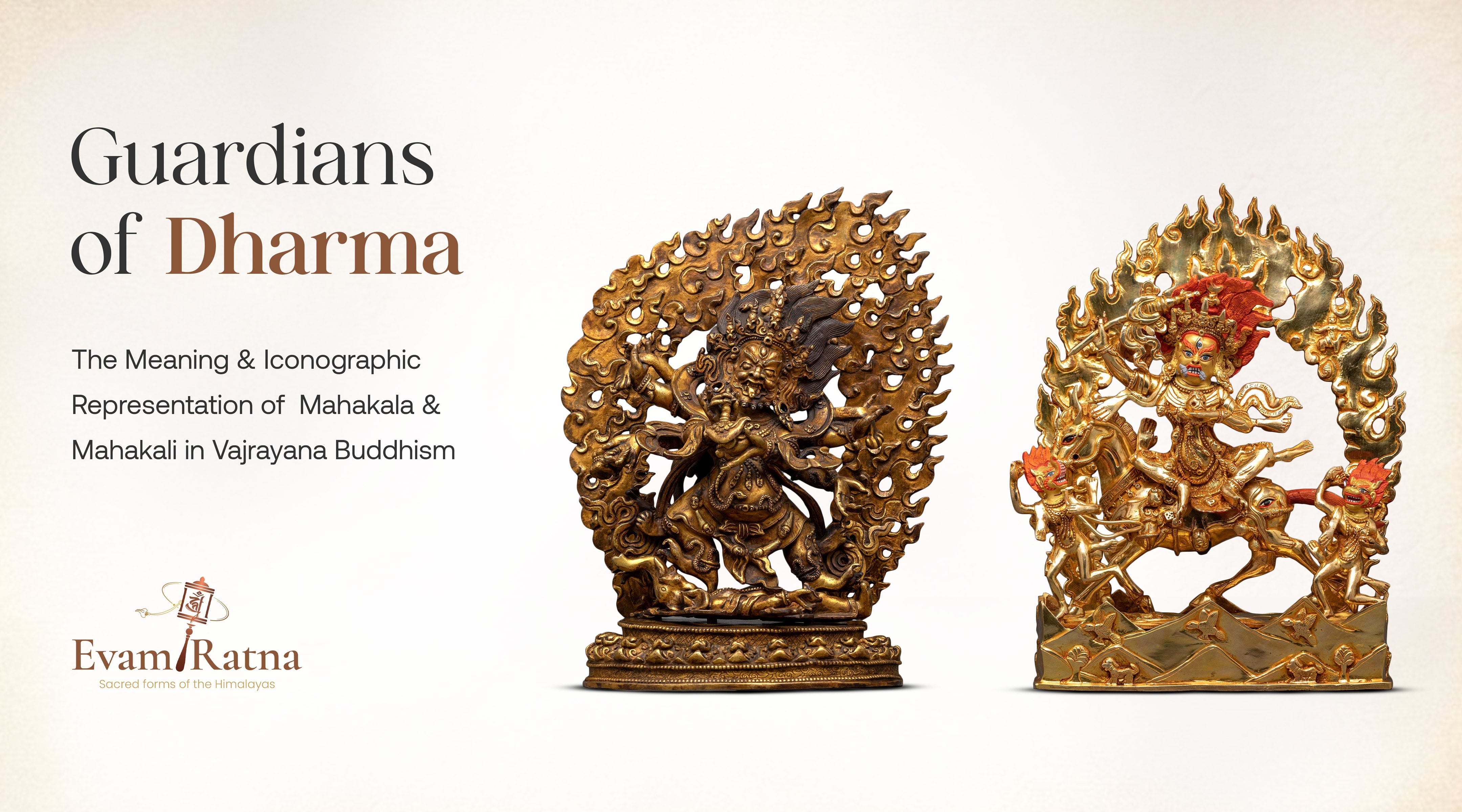
Exploring the Meaning and Symbolism of Vajrayana’s Fierce Protectors
In a Vajrayana shrine room in Kathmandu, Lhasa, and somewhere in the shadows behind the serene, gold-faced Buddhas, you will find him: a squat, muscular figure the color of a moonless sky, garlanded with skulls, eyes bulging, and flames roaring from his hair. Beside him, or in a shrine of her own, stands an equally fierce goddess riding through a sea of blood on a mule, crowned with fire, and girdled in severed heads.
Among the many enlightened beings revered in Vajrayana Buddhism, Mahakala and Mahakali hold a unique and powerful position. They have a fierce look, but they do not represent destruction or anger. They are the compassionate power of enlightened wisdom, which overcomes obstacles, guards the Dharma, and helps the practitioner reach spiritual enlightenment. Both deities are known as the wrathful protectors, the active aspect of compassion. Their terrifying forms symbolize the power of enlightened consciousness to overcome negative emotions, harmful forces, and spiritual obstacles to achieve liberation.
What Does "Dharmapala" Actually Mean?
In Vajrayana, the "Diamond Vehicle" of Buddhism practiced across Tibet, Nepal, Bhutan, and Mongolia, treats the path to enlightenment as urgent and direct, a fast route through difficult terrain rather than a slow, gentle incline. That terrain is guarded by obstacles: doubt, ego, distraction, malevolent forces, and spiritual complacency.
A Dharmapala exists to guard that terrain, both deities are wrathful only in appearance; their fury is aimed entirely at what blocks liberation, never at beings themselves. Vajrayana art can hold two seemingly contradictory ideas at once: a being can look like your worst nightmare and still be, underneath, an expression of perfect compassion. Mahakala and Mahakali are the most famous of these guardians, one masculine, one feminine, and both essential.
Mahakala: The Great Black One

Origins and Meaning
The name Mahakala comes from Sanskrit: “maha” (great) and "kala" (time or black). Depending on how you read it, Mahakala means either "The Great Black One" or "Beyond Time." Black, in Vajrayana color symbolism, is the color that absorbs every other color; it represents the totality of all things collapsing into emptiness, the ground from which all phenomena arise and into which they dissolve. "Beyond time" points to the same idea from another angle: a being that exists before and beyond the ordinary cycles of birth, death, and karma. His roots trace back to early Indian tantra, where he was already a fierce protector figure before Vajrayana Buddhism absorbed him and reoriented his role entirely toward safeguarding the Dharma. As Vajrayana spread from India into Tibet, Nepal, and eventually China, Mongolia, and Japan, he took on regional forms, but the essential function never changed: he clears the obstacles that stand between a practitioner and awakening.
Iconographic Elements

Mahakala's imagery is not decorative horror; every element is a teaching in symbolic shorthand:
-
Black or dark blue-black body: The absorption of all color and all phenomena into emptiness (sunyata); the primordial ground before form arises.
-
Bulging eyes and wrathful expression: Not anger in the ordinary sense, but the intensity required to shock the mind out of habitual delusion.
-
Flaming hair: The blazing energy of wisdom burning through ignorance.
-
Skull crown and garland of skulls: An ever-present reminder of impermanence and the death of the ego needed for authentic spiritual metamorphosis.
-
Chopper (kartika) and skull cup (kapala): The chopper cuts away the root of ego and dualistic thought; the skull cup collects what has been cut away and offers it back.
-
Many arms: The ability to undertake numerous protective actions at once in many instances related to the protection of beings in each of the six realms of existence.
Many Forms, One Function
Mahakala is not a single fixed figure but a family of related emanations, each suited to a particular lineage or purpose:
-
Shadbhuja Mahakala (Six-Armed Mahakala) is among the most widely practiced forms in Tibetan Buddhism, his six arms symbolizing protection extended across all six realms at once.
-
Bernakchen (The Black-Cloaked One) is a two-armed form closely tied to the Karma Kagyu lineage and its founding figures; his relative simplicity reads as swiftness and focus rather than reduced power.
-
White Mahakala is invokes not for fierce but for prosperity, generosity, and the material support a practitioner needs to sustain their spiritual life. His presence is a reminder that Vajrayana's wrathful deities are not defined by color alone, but by function.
Mahakali: The Fierce Feminine Principle

A Complicated Lineage
Mahakali's presence in Vajrayana Buddhism is more layered than Mahakala's, and it's worth being precise about it. The name "Mahakali" is most strongly associated with Hindu Shaktism, where she represents the terrifying, all-devouring aspect of the Divine Mother. Vajrayana Buddhism develops its own lineage of wrathful female protectors who share her visual language and function without being identical to her.
The most important of these is Palden Lhamo, the principal female protector of Tibetan Buddhism and the only woman among the traditional Eight Great Dharmapalas. Her iconography closely parallels the Mahakali archetype: the dark body, the garland of severed heads, and the fury turned toward protection rather than destruction, which is why the two names are so often used interchangeably in casual and even scholarly writing, even though Palden Lhamo's role is distinctly Buddhist rather than Hindu.
Alongside her stands Ekajati, a fierce one-eyed, one-toothed protector especially significant in the Nyingma tradition, and together the two are sometimes grouped as the "Wrathful Mothers" of Vajrayana, proof that in this tradition, the divine feminine is never confined to gentleness alone.
Iconography of Palden Lhamo

In her most widely recognized form, Magzor Gyalmo (Queen Who Repels Armies), Palden Lhamo rides sidesaddle across a sea of blood on a mule, her saddle famously said to be a flayed human skin. Her key iconographic features include:
-
Dark blue-black or deep indigo body: Fury transmuted into unwavering defense.
-
One face and three eyes: Fierce insight into past, present, and future obstacles.
-
A vajra-tipped staff and skull cup: Cutting through misconception while transforming what is cut into spiritual nourishment.
-
A garland of freshly severed heads: Impermanence and the destruction of ego, echoing the same symbolism found in the wider Kali tradition of Indian tantra.
-
The mule crossing a sea of blood: An origin story in which she is said to have sacrificed even her own son for the protection of the Dharma, making the crossing itself a symbol of total, uncompromising commitment to her protective vow.
Palden Lhamo holds a uniquely intimate role in Tibetan Buddhism as the personal protector of the Dalai Lamas across successive incarnations and as the guardian deity of Lhasa and Tibet itself, a reminder that Dharmapalas are not abstract cosmic principles alone, but are invoked for very concrete, historical protection.
Mahakala and Mahakali: Understanding Their Differences
Although Mahakala and Mahakali share the same root concept of enlightened protection, their expressions differ through masculine and feminine symbolism.
|
Aspect |
Mahakala |
Mahakali |
|
Meaning |
Great Black One |
Great Black Female One |
|
Aspect |
Masculine protective energy |
Feminine wisdom energy |
|
Role |
Guardian of Dharma and teachings |
Protector through transformative wisdom |
|
Symbolism |
Strength, stability, fearless action |
Wisdom, transformation, dynamic compassion |
|
Appearance |
Usually a powerful, male, wrathful deity |
Feminine wrathful protector or dakini-like form |
|
Spiritual Meaning |
Active compassion overcoming obstacles |
Enlightened wisdom cutting through ignorance |
Why Fierce and Compassionate Are Not Opposites

In Vajrayana iconography, the wrathfulness and compassion are not shown as opposites; they are shown as the same energy pointed in a useful direction. Ordinary anger multiplies suffering. The wrath of Mahakala and Mahakali, by contrast, is described as an expression of enlightened activity, force used surgically only against what obstructs liberation, never against beings themselves. Their terrifying appearance functions almost like a mirror: it reflects the practitioner's own inner obstacles, pride, ignorance, fear, and attachment and dares them to be cut through rather than avoided.
These deities are approached with such ritual seriousness in Vajrayana practice. They are not worshipped the way a wrathful deity might be feared and appeased in other traditions; they are invoked as allies, called upon precisely because their fierceness is trustworthy, aimed with precision.
Guardians Still Standing at the Threshold

In the Kathmandu Valley, where Newar Buddhism has preserved some of the oldest continuous Vajrayana practices in the world, images of Mahakala still watch over monastery gateways much as they have for centuries, placed deliberately at thresholds, at the boundary between the ordinary world and sacred space. Palden Lhamo's presence, meanwhile, remains inseparable from the protection of the Dalai Lama's lineage and of Tibetan Buddhism's institutional continuity itself.
That threshold placement is the clearest possible summary of what these deities are for. Mahakala and Mahakali are not there to be worshipped from a safe distance, and they are not obstacles themselves. They stand exactly where obstacles arise at the doorway between confusion and clarity so that anyone serious enough to walk through does not have to walk through it undefended.
Conclusion: The Compassion Hidden Within Fierce Forms
Mahakala and Mahakali demonstrate one of the most profound teachings of Vajrayana Buddhism: enlightenment can appear in many forms. The expression in their faces is not of violence or destruction, but of the strength of compassion necessary to eradicate ignorance and suffering. They are guardians of the Dharma, safeguarding the Buddhist teachings and inspiring the practitioners to be courageous, wise, and transformative. Their iconography is sacred and a reminder that compassion does not always feel tender; sometimes it is a rejuvenating force, a way to light the path to enlightenment.
By knowing Mahakala and Mahakali, one will perceive the deeper message of the wrathful deities of Vajrayana, who are not killing life, but rather those things that prevent enlightenment.