From Sarnath to Your Shrine: Ritual Items Rooted in the First Turning of the Wheel
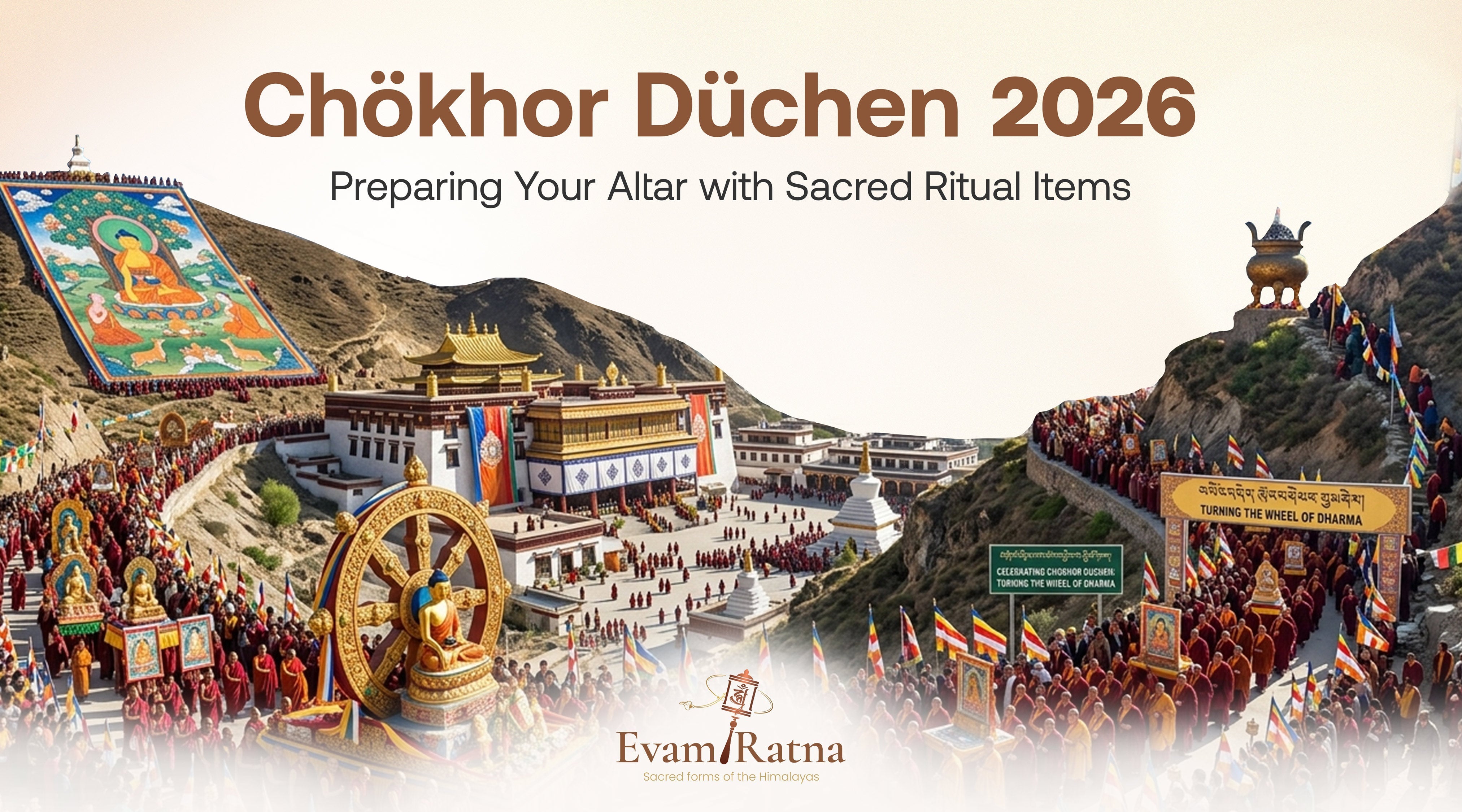
Once a year, the Buddhist calendar turns to one of its four great days, Chökhor Düchen, the day we memorialize the Buddha's first teaching at Deer Park in Sarnath. Chökhor means "Dharma Wheel," and Düchen means "great occasion." After his enlightenment beneath the Bodhi tree, the Buddha spent seven weeks in contemplation, hesitant to teach a truth he feared few could grasp. It was only at the urging of the deities Indra and Brahma that Buddha travelled to Sarnath, where he set the Wheel of Dharma in motion for the first time, giving his five former companions the teaching we now know as the Four Noble Truths.
This year, Chökhor Düchen falls on Saturday, July 18, 2026, the fourth day of the sixth month of the Tibetan lunar calendar, just a few days away. According to Tibetan tradition, this is one of the "hundred-million-multiplying" days, a window in which the karmic weight of any action, positive or negative, is magnified far beyond an ordinary day. For practitioners, that makes it one of the most meaningful times of the year to slow down, return to the altar, and make offerings with full presence.
If you keep a home shrine, this is the day to bring it fully to life. Below are the ritual items that carry special significance for this occasion and how each one supports your practice.
Preparing the Altar: Creating a Space for Reflection and Practice

A Buddhist altar is not just for decorative purposes. It is a tangible symbol of attributes that we wish to develop in ourselves: compassion, wisdom, patience, generosity, and awareness.
The Three Jewels of the Buddhist tradition are traditionally represented on an altar:
-
The Buddha is depicted in a statue or image and symbolizes enlightenment and awakened potential.
-
The Dharma is represented by the scripture or sacred object; it symbolizes the community preserving and practicing the path.
-
The Sangha is represented as a group of realized masters and practitioners, symbolizing the community preserving and practicing the path.
Before Chökhor Düchen, many practitioners purify their shrine, carefully assemble offerings, light the lamps, and meditate or pray. The external act of preparing the altar becomes an internal practice, creating clarity in the environment while cultivating clarity within the mind.
The Dharma Wheel Itself

No symbol is more fitting for this day than the Dharmachakra, the eight-spoked wheel that represents the Noble Eightfold Path: right view, thought, speech, action, livelihood, effort, mindfulness, and concentration. A hand cast Dharma Wheel placed at the center of your altar is a direct visual reminder of what the day commemorates: the moment teaching itself began to move through the world. Many practitioners choose this piece specifically for Chökhor Düchen and keep it displayed year-round afterward as a permanent anchor for the altar.
Offering Bowls, Filled with Intention

Generosity is one of the simplest and most powerful practices for a merit-multiplying day. A set of seven offering bowls, traditionally filled with water (and sometimes flowers, incense, light, perfume, food, or sound), represents the offerings made to enlightened beings. Filling and emptying these bowls each morning is a small, repeatable ritual, but on Chökhor Düchen, it becomes an act of considerable merit. Hand-hammered copper or brass bowls, cleaned and refilled with care, are a fitting way to begin the day.
The Vajra and Bell

The dorje (vajra) and ghanta (bell) are the two implements most associated with the union of method and wisdom in Vajrayana practice. The vajra, held in the right hand, represents skillful means and unshakable clarity; the bell, held in the left hand, represents the wisdom that realizes emptiness. Using them together during recitation on this day is a way of physically embodying the teaching the Buddha first offered at Sarnath that liberation arises from the union of compassionate action and clear seeing.
Incense and the Spread of the Dharma

Lighting incense is one of the oldest offerings in Buddhist ritual, and its rising smoke has long been read as a symbol of the Dharma spreading outward, exactly as the Buddha's first teaching spread from five listeners in a deer park to the whole of Asia and beyond. A well-made incense burner, ornate for a temple-style shrine, or simple for a quiet home corner, turns this offering into a daily anchor point of practice, and feels especially resonant on the day the teaching itself began.
Butter Lamps for the Light of Wisdom

Light dispels darkness, and in Buddhist symbolism, the Buddha's first teaching is often described as an illuminating light filling the realms at the moment he began to speak. Lighting a butter lamp (or a set of them) on Chökhor Düchen recreates that image on your own shrine. The soft, steady flame is traditionally understood to represent wisdom overcoming ignorance, a fitting focus for meditation on the Four Noble Truths.
The Conch Shell

Fewer objects are as directly tied to teaching itself as the conch shell. Its sound has long announced the proclamation of the Dharma, much as it was blown to herald the Buddha's first turning of the wheel. Sounding a conch, or simply placing one on the altar as a visual reminder, connects your practice to that first moment when the teaching began to be heard.
Explore Our Collection of Daily Altar Essentials
Other Sacred Objects to Consider for Your Altar
While the items above are especially connected with Chökhor Düchen, practitioners may also include other meaningful sacred objects:
- Buddha Statue: A statue of Shakyamuni Buddha in Dharmachakra Mudra directly represents the first teaching and is one of the most meaningful additions for this occasion.
- Buddhist Scriptures: Texts represent the living presence of the Dharma and remind practitioners that wisdom must be studied and applied.
- Prayer Wheel: A prayer wheel symbolizes the continuous movement of enlightened teachings. Spinning it with good intention is the dissemination of compassion and wisdom around the globe.
- Mala Beads: A mala is used for the recitation of mantras and for meditation to develop concentration and awareness.
Craftsmanship: Preserving the Sacred Through Himalayan Art

Every ritual object placed on an altar has symbolic content and the dedication of the artisan of the object.
Over the centuries, the craftsmen of the Kathmandu Valley have passed on the traditional methods of the Himalayas and have patiently, carefully, and lovingly made sacred objects. The creation of a ritual item by hand starts with shaping, casting, engraving, and finishing. Techniques passed down through generations turn copper, brass, silver, and gold into sacred objects. The detailed patterns, the surfaces that have been worked to a high finish, and the sacred symbols are not just intended as decoration for the art. They represent a living connection between craftsmanship and spiritual practice. Practitioners help to keep the Dharma Wheel alive for another thousand years by supporting traditional artisans of the Himalayas.
A Simple Way to Mark the Day
You don't need every item at once. Start with what resonates: a wheel, a set of bowls, or a stick of incense, and build your shrine over time. What matters on Chökhor Düchen is not the completeness of the altar but the sincerity brought to it: a few minutes of quiet reflection on the Four Noble Truths, a lit lamp, and an offering made with an open hand.
Each of these ritual tools is handcrafted by artisans in Nepal, carrying forward centuries of Himalayan devotional craft. Bringing one onto your shrine is a way of participating, in a small but real way, in the same lineage of practice that has kept the Dharma Wheel turning since that first teaching in Sarnath.
"May this Chökhor Düchen be a cause for the flourishing of the Dharma in your life and in the lives of all beings."