The Complete Guide to the Buddhas of the Three Times: Past, Present, and Future Buddhas
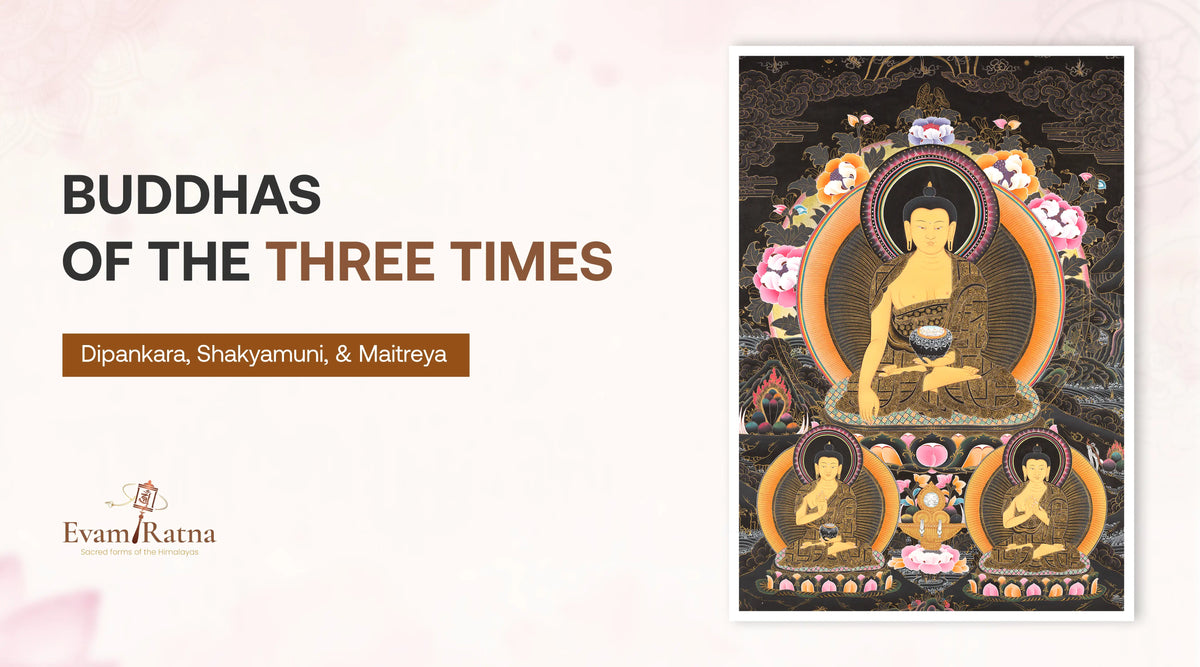
The Buddhas of the Three Times represent the eternal flow of the Dharma across past, present, and future cosmic eons. This foundational Buddhist triad links Dipankara, the ancient "Lamp Bearer" who prophesied the current age; Shakyamuni, the historical Gautama Buddha who founded modern Buddhism; and Maitreya, the future Buddha of loving-kindness who will descend to renew the teachings once they fade. Frequently depicted together in East Asian altars and Himalayan thangkas, this lineage symbolizes the unbroken continuity of cosmic wisdom and serves as a powerful reminder of spiritual grounding and future aspiration.
What Are the Buddhas of the Three Times? (Dü Sum Sangye)

In Tibetan, the Buddhas of the Three Times are called Dü Sum Sangye. The phrase breaks down simply: dü means time, sum means three, and sangye means Buddha, or "one who has awakened." The term is described as the Buddhas of the past, present, and future, often represented by Dipamkara, Shakyamuni, and Maitreya.
Dü Sum Sangye mean all the Buddhas of every era. Dipankara, Shakyamuni, and Maitreya are the most familiar trio chosen to stand for that vastness, much as three candles might stand for a whole hall of light. According to Dharma Drum Mountain, the notion of Buddhas of the past, present, and future first appears in the Agama Sutras, among the earliest layers of Buddhist literature. So when you place these three together, you are honoring a very old way of seeing.
Dipankara: The Buddha of the Past

Dipankara, whose name is usually understood as "Lamp-Bearer" or "Maker of Light," is remembered as a Buddha who lived countless ages before our own. In Tibetan he is called Marme Dze, which carries the same meaning. In the Pali tradition's Buddhavamsa, the chronicle of past Buddhas, he is counted as the fourth of twenty-eight Buddhas, with twenty-seven preceding Shakyamuni.
The Story of Sumedha
Dipankara's fame rests on one of the most tender stories in Buddhist literature. Long ago, a young ascetic named Sumedha learned that Dipankara was approaching a town. The road was muddy, and the people were preparing it for the Buddha's arrival. Sumedha, with nothing else to offer, lay down across the mud and spread his hair over it so that the Buddha could walk across without soiling his feet. Moved by this wholehearted act of devotion, Dipankara looked upon the young man and foretold that, after many lifetimes, Sumedha would become a fully awakened Buddha named Gautama. That prediction is called a vyakarana, and it marks the moment the future Shakyamuni's long path became certain.
The lesson is quiet but powerful: awakening begins with sincere aspiration and generous giving, long before any enlightenment is in sight.
How Dipankara Appears in Art
Dipankara is often shown standing or seated on a lotus, radiant with golden light, and associated with the symbol of the lamp. Depending on the tradition and the artist, he may be depicted with the fearlessness gesture (abhaya mudra) or a teaching gesture. His expression is calm and steady, the face of a teacher who has already lit the way for others.
In the Kathmandu Valley, Dipankara holds a place of special affection. Newar Buddhists honor him through festivals of giving, including the Pancha Dan celebration, where generosity itself becomes the offering. It feels fitting, as Dipankara's own story begins with an act of giving.
Shakyamuni: The Buddha of the Present

Shakyamuni, "the Sage of the Shakyas," is the historical Buddha of our era. Born as Prince Siddhartha Gautama in Lumbini, in present-day Nepal, he lived roughly in the 6th to 5th century BCE, though scholars continue to debate exact dates.
Raised in comfort, he was moved by the realities of sickness, aging, and death, and he set out to understand the nature of suffering. After years of searching, he sat beneath the Bodhi tree at Bodh Gaya and awakened. He then spent decades teaching, offering the Four Noble Truths, the Noble Eightfold Path, and the Middle Way, the foundations on which every Buddhist school stands today.
For Nepal, this is no distant history. Lumbini is part of our own landscape, which is one reason Shakyamuni statues feel so personal to artisans and families here.
Why He Is the "Present" Buddha
In the Three Times, Shakyamuni represents now: the Buddha whose teachings are still alive, still practiced, and still available. He is the one we can actually study, recite, and follow. Where Dipankara reminds us of the lineage behind us, Shakyamuni gives us the path under our feet.
Within the Tibetan system of the "Fortunate Aeon," which speaks of a thousand Buddhas appearing in our age, Shakyamuni is counted as the fourth.
How Shakyamuni Appears in Art
The most recognized image shows Shakyamuni seated in meditation, his right hand reaching down to touch the earth. This is the bhumisparsha mudra, the earth-touching gesture, recalling the moment he called the earth itself to witness his awakening. Often the figure is gilded or golden, with the ushnisha (crown protuberance), long earlobes, and a serene, downcast gaze.
Maitreya: The Buddha of the Future

Maitreya, whose name comes from maitri, "loving-kindness," is the Buddha yet to come. In Tibetan he is Jampa. Buddhist tradition teaches that Maitreya currently dwells in Tushita Heaven as a bodhisattva, perfecting the qualities of a Buddha. When Shakyamuni's teachings have faded from human memory, he will take birth among humans, awaken, and turn the wheel of the Dharma once more.
A Promise of Renewal
It is easy to hear this as a distant prophecy, but many practitioners hold it as something closer to a promise: that compassion returns, that wisdom is never permanently lost, and that every age, however dark, can be met by a new dawn. Maitreya reminds us that the Dharma does not end. Our own kindness, practiced today, becomes part of the soil from which that future grows.
How Maitreya Appears in Art
Tibetan and Himalayan artists often show Maitreya seated upright on a throne with both feet resting on the ground, as though ready to stand and begin teaching at any moment. A small stupa may rest in his crown, and he is frequently shown with a water vase and a wheel supported on lotus stems at his shoulders. In some early Buddhist sculpture, such as the grottoes at Yungang, Maitreya appears seated cross-legged, reflecting his status as a bodhisattva who has not yet become a Buddha.
How the Three Buddhas Fit Together
Seen together, the three form a single story told across time.
| Key Points |
Dipankara Buddha |
Shakyamuni Buddha |
Maitreya Buddha |
|
Time |
Past |
Present |
Future |
|
Tibetan name |
Marme Dzé |
Shakya Thubpa |
Jampa |
|
Meaning of name |
Lamp-Bearer |
Sage of the Shakyas |
The Loving One |
|
Core message |
The lineage that came before us |
The path available now |
The promise of renewal |
|
Common imagery |
Radiant light, lamp, standing or seated on a lotus |
Earth-touching gesture, seated in meditation |
Upright seat on a throne, stupa in the crown, vase and wheel |
One way to hold the trio is as a reflection on practice. The past asks us to honor the teachers and traditions that carried the Dharma to us. The present asks us to practice, because this is the only moment in which practice can happen. The future asks us to cultivate loving-kindness now, since what we plant today shapes what unfolds tomorrow.
The connection between Dipankara and Shakyamuni is especially touching. Shakyamuni, as Sumedha, once offered his hair to Dipankara. Dipankara, in turn, foretold his awakening. And Maitreya will one day carry the lineage forward. It is one unbroken chain.
The Three Buddhas Across Buddhist Traditions
The three Buddhas are honored in different ways depending on the lineage.
In the Theravada tradition, the focus is on historical Buddhas. Dipankara and others of the past are remembered in texts such as the Buddhavamsa, and Maitreya (Metteyya in Pali) is the expected Buddha of the future. Faith in his coming inspires moral effort and generosity.
In the Mahayana tradition, the three are often understood as expressions of the timeless nature of awakening, reminding practitioners that Buddhahood is not confined to one person or one century.
In the Vajrayana and Tibetan tradition, the Buddhas of the Three Times appear on thangkas and in shrine arrangements, and they are also woven into devotional practice. One of the most beloved examples is the opening of the famous prayer "Dü Sum Sangye Guru Rinpoche," which praises Guru Rinpoche (Padmasambhava) as the embodiment of the Buddhas of the Three Times. Here, the phrase is a devotional epithet rather than a list of three historical figures, a distinction worth keeping in mind when you meet the words in prayer books or on statues.
One more gentle note: in some traditions and temples, Kashyapa (Kassapa) takes the place of Dipankara as the Buddha of the past. Dharma Drum Mountain mentions this variation. Neither is "wrong," and each reflects a living tradition shaped by its own texts and teachers.
Three Buddhas, Three Directions, Five Dhyanis: Clearing Up the Confusion
Because Buddhist art features many groups of Buddhas, it is easy to mix them up. Here is a simple guide.
- The Buddhas of the Three Times are about time: Dipankara (past), Shakyamuni (present), and Maitreya (future).
- The Buddhas of the Three Directions (sometimes called the Three Jewels Buddhas) are about place: Shakyamuni in the center, Medicine Buddha in the Eastern Pure Land, and Amitabha in the Western Pure Land.
- The Five Dhyani Buddhas are Vajrayana meditational Buddhas who represent five aspects of awakened wisdom: Vairocana, Akshobhya, Ratnasambhava, Amitabha, and Amoghasiddhi.
When Shakyamuni appears in more than one group, it is because he anchors each of them. In the Three Times arrangement, he sits in the center with Dipankara and Maitreya on either side. Dharma Drum Mountain notes that this particular combination is more common in cave temples like Yungang than in everyday temple halls, which makes a Three Times altar set a rare and special thing.
The Three Buddhas in Himalayan Art
In Himalayan art, a Buddha is never "just a figure." Every element follows centuries-old iconographic rules: the posture, the hand gesture, the lotus seat, the robe folds, the proportions of the face. These details are the language through which the image teaches.
Nepal's Newar artisans have been fluent in this language for generations. In the workshops of Patan, craftsmen cast Buddhist statues using the traditional lost-wax method: a figure is first sculpted in wax, encased in clay, and then heated so the wax melts away and molten metal takes its place. After casting, each piece is chiseled, refined, and often gilded by hand, with finishing details such as faces painted in the final stage. It is slow work, and it is done with devotion, often following lineages passed from parent to child.
The three Buddhas are depicted in thangkas, murals, and metal sculpture alike. When you hold or place one, you are holding the work of hands that have studied the proportions and meanings of these figures for a lifetime.
Bringing the Three Buddhas Into Your Home Altar
Many families wonder how to welcome the Buddhas of the Three Times into daily life. There is no single right way, but a few gentle guidelines are widely shared.
- Choose a clean, respectful space. A shelf, a dedicated altar table, or a quiet corner of a meditation room all work well. Sacred images are traditionally placed higher than the waist, at a height above where people sit or walk.
- Arrange them with intention. If you place all three, set Shakyamuni in the center with Dipankara and Maitreya beside him. If you have only one, many families choose Shakyamuni as the main image, or Maitreya if they feel drawn to loving-kindness and hope.
- Keep the space simple. Fresh water offerings, a small lamp or candle, and a stick of incense are enough. A lamp feels especially fitting for Dipankara, the Lamp-Bearer.
- Let the image support your practice. A statue is a visual reminder, a gentle anchor for the mind during meditation, prayer, or reflection. Sit before the three and consider: What has been given to me? How am I practicing now? What am I planting for the future?
- Consider consecration. Many practitioners choose to have a statue consecrated by a qualified lama or at a monastery, so that it becomes a fully empowered object of devotion. This is a personal decision, and one we are always glad to talk through with anyone who asks.
At Evamratna, our copper statues are made by Newar artisans in Patan, and we think of everyone who brings one home as part of our extended family. If you would like help choosing a size, a finish, or a set that suits your space, we are always glad to guide you, with no pressure at all.
Frequently Asked Questions
Who are the Buddhas of the Three Times?
They are the Buddhas of the past, present, and future. In the most common presentation, Dipankara represents the past, Shakyamuni the present, and Maitreya the future. In Tibetan, the group is called Dü Sum Sangye.
What does Dü Sum Sangye mean?
Dü Sum Sangye means "Buddhas of the Three Times." Dü means time, sum means three, and sangye means Buddha. The phrase can refer to all awakened beings across time, not only the three most familiar figures.
Who is Dipankara Buddha?
Dipankara, "the Lamp-Bearer," is a Buddha of the distant past who predicted that the young ascetic Sumedha would one day become Gautama Buddha. In Tibetan, he is known as Marme Dzé.
Is Shakyamuni the same as Gautama Buddha?
Yes. Shakyamuni ("Sage of the Shakyas") and Gautama are two names for Siddhartha Gautama, the historical Buddha who was born in Lumbini and awakened at Bodh Gaya.
Why is Maitreya called the Future Buddha?
Tradition teaches that Maitreya is the next Buddha to appear. He now lives in Tushita Heaven as a bodhisattva and will descend to the human world when Shakyamuni's teachings have faded.
Are the Three Buddhas the same as the Five Dhyani Buddhas?
No. The Three Buddhas express time (past, present, future), while the Five Dhyani Buddhas are meditational Buddhas in Vajrayana who represent five aspects of awakened wisdom.
What is the difference between the Buddhas of the Three Times and the Buddhas of the Three Directions?
The Three Times (Dipankara, Shakyamuni, Maitreya) are arranged across time. The Three Directions (Shakyamuni, Medicine Buddha, Amitabha) are arranged across space, with each presiding over a different realm.
How should the Three Buddhas be arranged on an altar?
Traditionally, Shakyamuni sits in the center, with Dipankara and Maitreya on either side. Keep the images clean, in a respectful and elevated place, and add simple offerings such as water, a lamp, or incense.
What does "Dü Sum Sangye Guru Rinpoche" mean?
It is the opening of a well-known supplication to Guru Rinpoche (Padmasambhava), who is praised as the embodiment of the Buddhas of the Three Times. In this context, the phrase is a devotional epithet rather than a list of three Buddhas.
Conclusion: A Light That Continues Across Time
The Buddhas of the Three Times offer something rare in a restless world: a sense that we belong to something longer than a single lifetime. Dipankara reminds us that we are held by a lineage of light. Shakyamuni reminds us that the path is open now. Maitreya reminds us that loving-kindness has a future. Through traditional Himalayan Buddhist statues, sacred thangka paintings, and meditation practices, the Buddhas of the Three Times continue to inspire devotion, compassion, and spiritual understanding. Their collective presence reminds practitioners that the path to enlightenment connects all generations through the enduring teachings of Buddhism.