The Celestial Coordinates of Patan: The Ashoka Stupas
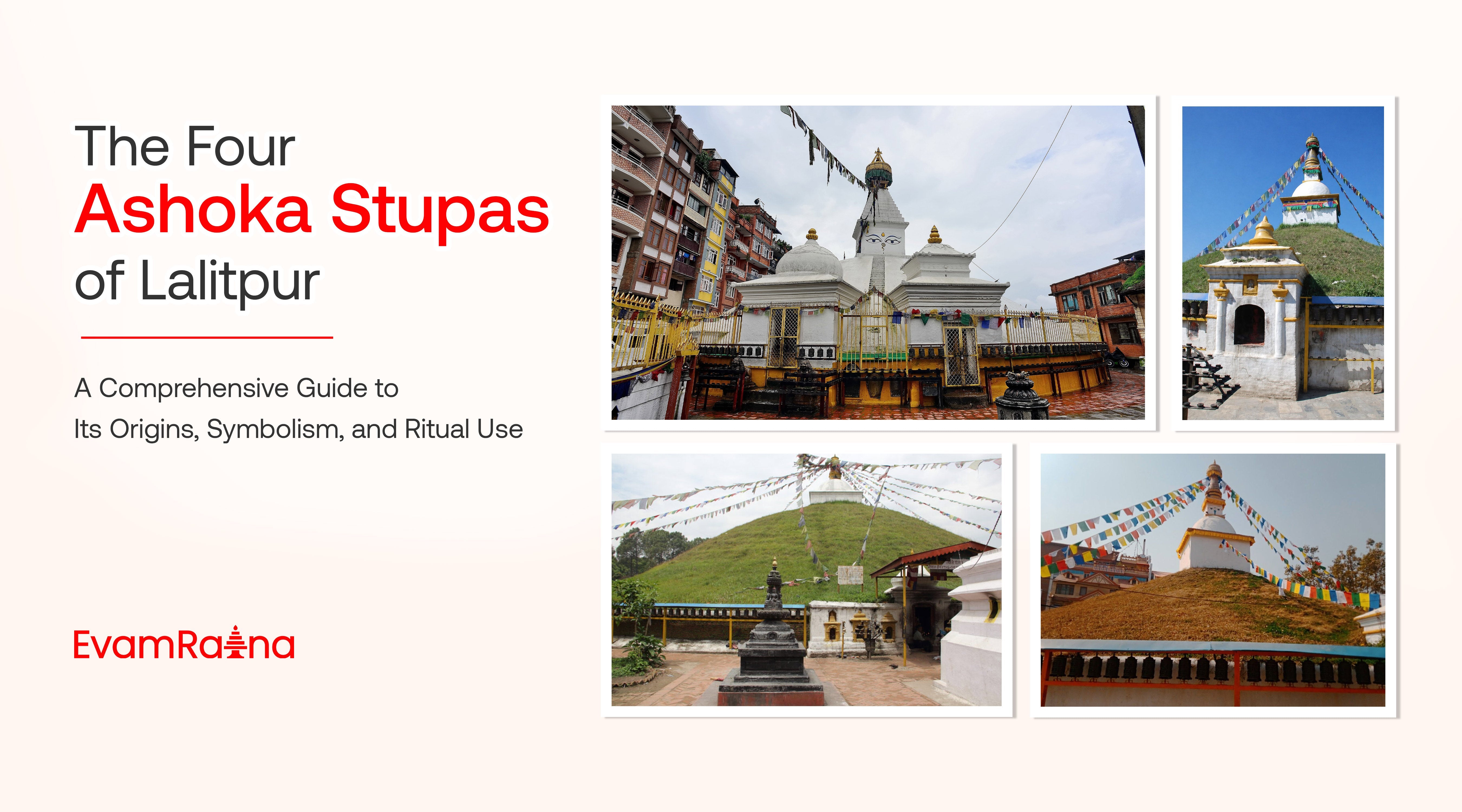
Patan, one of the ancient cities of Nepal, is a most revered cultural and spiritual place, and there stand four remarkable Buddhist stupas, the Four Ashoka Stupas, that have stood in silence for over 2000 years in the Kathmandu Valley. Built by the Indian Emperor Ashoka during the third century BCE, these ancient monuments define the four cardinal points of the holy city and serve as some of the oldest religious structures in the region. But they are not just old structures from history. Even today, they are alive with devotion. You’ll see prayer wheels spinning, colorful Tibetan flags fluttering, and local people visiting them for prayer and reflection. For travelers, pilgrims, and anyone curious about culture, these stupas offer a beautiful glimpse into Nepal’s deep spiritual roots and living traditions.
Who Was Emperor Ashoka?

Emperor Ashoka (c. 304 - 233 BCE), grandson of Chandragupta Maurya, is widely regarded as one of the greatest rulers in the history of Asia. At the height of his power, his Mauryan Empire stretched across most of the Indian subcontinent. However, after witnessing the devastating aftermath of the Kalinga War, Ashoka underwent a profound spiritual transformation and embraced the teachings of the Buddha.
According to Buddhist tradition, Ashoka commissioned the construction of 84,000 stupas across his vast empire to honor the relics of the Buddha and spread the Dharma. His reign from 273 BCE to 232 BCE marks one of the most significant chapters in the spread of Buddhism across Asia. He sent missionaries to Sri Lanka, Central Asia, and, as local legend holds, to the Kathmandu Valley.
Historical Significance of the Four Ashoka Stupas
The Four Ashoka Stupas of Lalitpur are believed to be some of the oldest Buddhist monuments in Nepal. The stupas are traditionally dated to 250 BCE; however, historians and archaeologists point out that while the link to Ashoka is a myth, they are probably associated with the establishment of the city of Patan and its subsequent development, perhaps in the late 4th century CE.
Despite the uncertainty over the exact date, the four monuments are of exceptional historical and cultural significance. They reflect the ancient culture, tradition and way of life of the Kathmandu Valley, and the strong Buddhist heritage of Patan. The city has over 160 Buddhist monasteries (baha).
The stupas also reflect the Newar tradition of circumambulation (Pradakshina), a devotional practice in which worshippers walk clockwise around the stupa as an act of veneration. This tradition has been observed since the earliest days of Buddhism and continues uninterrupted at these four sites today.
The Four Stupas in Lalitpur: Individual Profiles
The Four Ashoka Stupas are strategically placed at the four cardinal points of Patan (Lalitpur), forming an ancient protective circle around the old city. Together, they form a sacred mandala or a cosmological map of the city, as some scholars call it.
Lagan Thura: The Southern Ashoka Stupa (Lagankhel)

The Southern Stupa, known as Lagan Thura, is the biggest among the four Ashoka Stupas at Patan. Lagankhel is named after the local area where it is situated. It was once farming land and then became a royal military barracks.
The mound is crowned by a miniature cenotaph added in more recent times. The shrines of Tathagatas (Buddhas) at this stupa are believed to have been installed around 1878. The dome itself is a large earthen mound, partially grassed over, giving it the appearance of a natural hill rising out of the urban landscape.
Teta Thura: The Eastern Ashoka Stupa

(Image from buddhistcircuits.com)
The Eastern Stupa, Teta Thura, stands approximately 200 meters east of Tyagal Tole near the Ring Road. Its name is derived from one of the Hindu cosmic ages, the Treta Yuga, reflecting the deep interweaving of Hindu and Buddhist traditions in the Kathmandu Valley.
This stupa features a fire Vedika (railing) of 1.6 meters height with one Tathagata figure placed in each cardinal direction. The dome, 4.5 meters in height, is paved with firebricks and topped by a square Harmika, a balcony-like structure that symbolizes the abode of the gods. Three inscriptions are found here, though they are now very difficult to decipher.
The Eastern Stupa sits in a relatively quieter residential part of the city, offering a more contemplative and unhurried atmosphere compared to its southern counterpart.
Pucho Thura: The Western Ashoka Stupa (Pulchowk)

(Image from Kathmandu Valley Temples.com)
Located at the busy Pulchowk intersection at the western entry point of Patan, the Western Stupa, Pucho Thura or Pulchowk Thura, is perhaps the most visible of the four, as it stands at a major traffic junction encountered by anyone entering Patan from Kathmandu.
This stupa has a Vedika of 1.2 meters in height, with one Tathagata figure facing each direction. Unlike the Eastern Stupa, Pucho Thura does not have a Harmika. Instead, thirteen-ring Cakravalis (representing the thirteen levels of Buddhist cosmology) are constructed directly over the dome in a distinctive square-shaped pyramid structure, capped by a Yasti (spire) at the very top. The dome itself is 6.5 meters tall and paved with firebrick.
Ibahi Thura: The Northern Ashoka Stupa

(Image from Wikimedia.org)
The Northern Stupa, known as Ibahi Thura or Yampi Thura, is the closest stupa to Patan Durbar Square, a 10-minute walk from the UNESCO World Heritage Site. Its name honors the two nearby monasteries: I-Bahil and Yampi Bahil, both built in the 16th century.
Ibahi Thura is considered the most architecturally complex of the four. It closely resembles the great Swayambhunath Stupa of Kathmandu in its design, featuring five Buddha figures in the Vedika alongside their consorts, with the exception of Tathagata Vairocana. The Vedika stands 1.5 meters tall, and a square Harmika sits atop the dome. A dramatic 13-step Cakravali topped by a Yasti rises from the Harmika.
Uniquely, this stupa was repaired and finished in concrete in 1957, making it the only one of the four with a white plastered exterior, giving it a bright, finished appearance compared to the grass-covered earthen mounds of the other three.
The four stupas are all within walking distance of Patan Durbar Square, and it is certainly possible to visit all four in a day.
Ashoka’s Involvement in Building Stupas:
Ashoka’s involvement in building stupas was a central part of his mission to spread Buddhist teachings:
- Global Construction: According to Buddhist tradition, Ashoka recovered the relics of Buddha from earlier structures and used them to erect 84,000 stupas during his tenure.
- The Patan Stupas: Ashoka visited the Kathmandu Valley over 2000 years ago. He constructed four stupas (or chaityas) in the holy city of Patan (also called Lalitpur) at each of the four cardinal points to mark the city as holy and to spread Buddhism.
-
Celestial Coordinates: The four monuments were constructed at Pulchowk, Ebahi, Lagan, and Imadol in the modern city and form the "celestial coordinates" of the city. The southern stupa at Lagan is the biggest, at a diameter of 47.4 meters.
- Architectural Legacy: Originally, these stupas were built on top of brick platforms, and are now covered with grass, and are among the oldest religious structures in Nepal.
Ashoka considered Buddhism to be beneficial for all and built not just stupas but also monasteries and other religious structures at significant Buddhist sites throughout his empire.
The Legend of Charumati: Ashoka's Daughter and the Stupas
A favourite legend of the Four Ashoka Stupas is that of Charumati, daughter of Emperor Ashoka. Folklore has it that Ashoka and Charumati visited the Kathmandu Valley on a journey from Buddha's birthplace, Lumbini, to Swayambhunath.
Charumati fell in love with the valley and decided to stay, marrying a Kshatriya noble and dedicating herself to doing good works. She is said to have erected the Northern Stupa (Ibahi Thura) and established the Buddhist nunnery of Charumati Vihara at Chabahil, on the outskirts of Kathmandu.
This story, though unproven by archaeological records, is a significant part of the heritage of Patan. Charumati embodies the human face of Buddhism - a princess who chose to leave her palace and found great happiness in the religious life of the valley's inhabitants.
Pimbahal Pond (Pimbahal Pokhari) & the Ashoka Chaitya

Pimbahal Pond, also known as Pimbahaa Pukhoo. The historic man-made pond is at the core of a vibrant community meeting place its still waters reflecting centuries of Newar spiritual life.
The Lakhey Legend: Local folklore tells the story of its origin, claiming that a Lakhey, a fearsome Newa demon of Nepalese folklore, built the entire pond in a single night. In one version of the legend, the Lakhey's wife was forced to go to the far end of the city to get water during the winter months when the water taps were dry. The demon could not bear to see his wife in distress, and he dug the pond in one night. Another narrative tells that a local man named Gaya Baje used his magical powers to tame the mischievous Lakheys and had them dig the pond, knowing that as long as they had space, they would continue to cause trouble.
Near the pond sits the Ashoka Chaitya, a holy shrine that elegantly symbolises the central elements of Vajrayana cosmology. The chaitya is adorned with four Buddhas, each of which faces in a cardinal direction, and embodies the enlightened wisdom:
- Akshobhya (East): The Immovable Buddha, symbolising the mirror-like wisdom and the transformation of anger.
- Ratnasambhava (South): The Jewel-Born Buddha, representing the wisdom of equality and the transformation of pride.
- Amitabha (West): The Buddha of Infinite Light, representing discriminating wisdom and the transformation of desire.
- Amoghasiddhi (North): The Buddha of Unfailing Accomplishment, representing all-accomplishing wisdom and the transformation of jealousy.
Together, these four Dhyani Buddhas form the sacred Mandala of the Five Tathagatas, a cornerstone of Vajrayana Buddhist iconography, with the fifth Buddha, Vairocana, understood to preside at the center.
Spiritual Significance: The Stupas as a Cosmic Mandala

The Four Ashoka Stupas of Lalitpur are together are an integrated sacred landscape. Placed at the cardinal points, they constitute a mandala (diagram of the universe) described by Buddhist scholars with Patan at the centre.
Such a mandala-like pattern mirrors the Buddhist notion of the Dharma-Chakra (Wheel of Righteousness) in which the four stupas represent the four guardians of the four directions, who guard and protect the city and its people. For the local Newar Buddhists, the four stupas represent the ancient guardians of Patan - ancient sentinels that have protected the city since time immemorial.
Circumambulation (Pradakshina) around each stupa is a devotional practice in which the devotee understands themselves as part of the universe, walking in a clockwise direction around the stupa in accordance with the cosmic order. It links the individual to an uninterrupted tradition of worship that spans more than two millennia.
Rituals and Festivals Associated with the Stupas
The Four Ashoka Stupas come alive during several important occasions throughout the Nepali calendar year:
- Buddha Purnima (Buddha Jayanti): On the full moon day (Purnima) of the month of Baisakh (April/May), Buddhist and Hindu pilgrims take a walk between the four stupas, burning incense, lighting butter lamps, and placing flowers.
- Gunla Festival: In the sacred month of Gunla (August), Newar Buddhist devotees make early-morning circumambulations of the four stupas, accompanied by traditional music and rituals.
-
Auspicious Full Moons: Tibetan and local Buddhist pilgrims make it a point to follow the full circuit of all four stupas in a day on auspicious full moon days throughout the year, an act believed to generate great spiritual merit.
Read More About Stupa of Blessings: A symbol of Enlightenment and Devotion
Conclusion:
The Four Ashoka Stupas of Patan stand as timeless guardians of the city, with roots deeply embedded in both history and spirituality. Built by Emperor Ashoka in the 3rd century BCE, these stupas continue to serve as living symbols of unity, wisdom, and spiritual protection. Each stupa, placed at the cardinal points of the city, forms a sacred map, guiding both the devout and the curious through the rich spiritual landscape of Patan. Today, these stupas not only reflect Patan's Buddhist heritage but also symbolize the unbroken connection between past and present, offering a profound space for contemplation, devotion, and cultural continuity.