The Power of the Kalachakra Mantra Monogram: Protection, Cosmology, and Initiation
The one with ten powers is a complex spiritual monogram representing the Kalachakra mantra monogram in a distinctive arrangement of ten interlocking syllables. The Tibetan name for this stacked monogram is sPungs-yig dbang-ldan (or spungs yig mom bcu dbang ldan), which preserves the entire cosmological teaching of the Kalachakra Tantra, one of the most important and intricate tantric systems in Vajrayana Buddhism. This is both a protective and meditational symbol and is simultaneously the seed syllable of the deity Kalachakra, a diagram of the outer cosmos, a map of the subtle human body, and an image of the complete path to enlightenment.
Introduction to Kalachakra Mantra Monogram

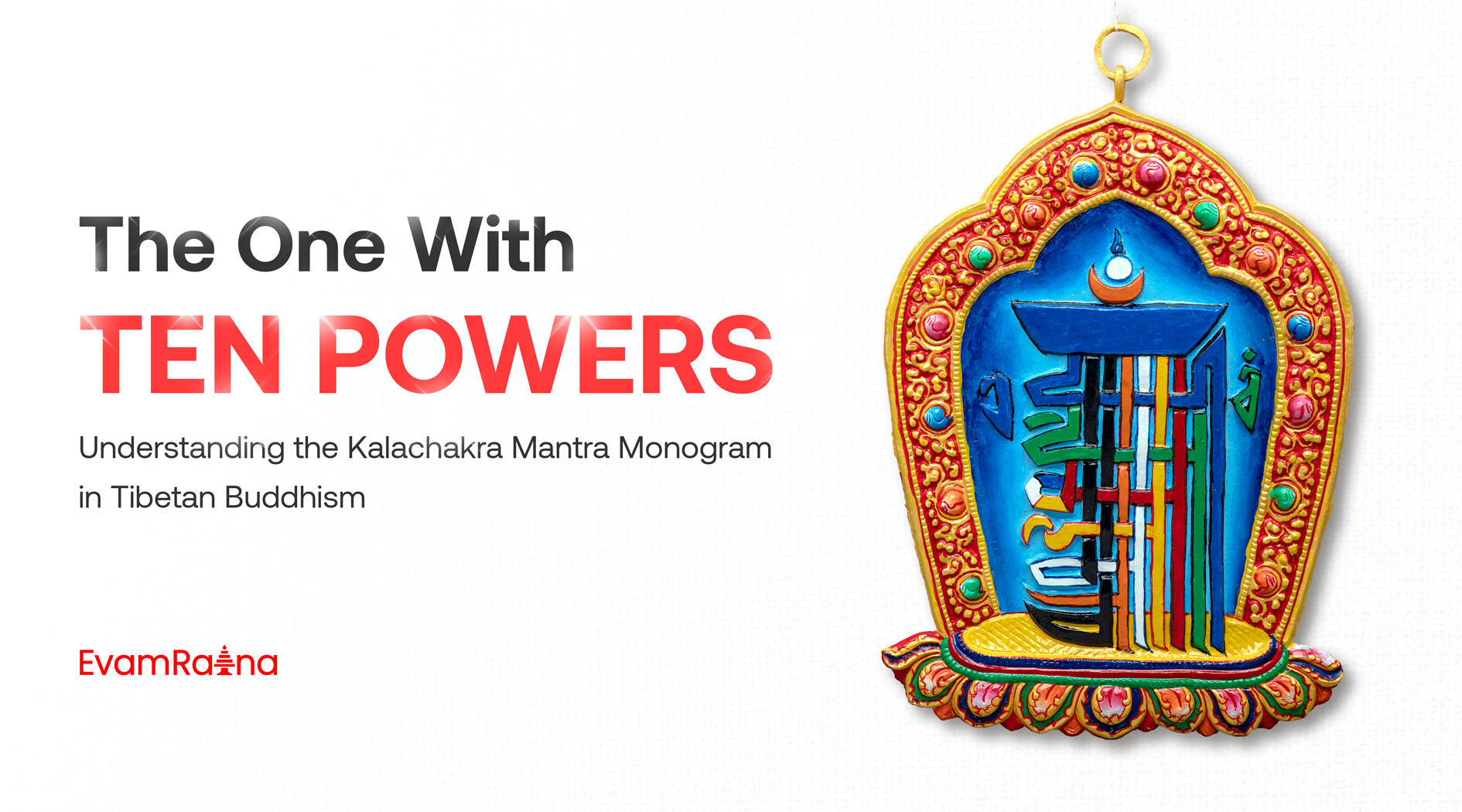
As described in the name itself, the all-powerful ten syllable is comprised of the ten interlocking or stacked syllables of the Kalachakra mantra: Om Ham Ksha Ma La Va Ra Ya Sva Ha. Together they form a mystical monogram, sometimes called a yantra, that serves as the visual embodiment of the Kalachakra (Wheel of Time) deity and his entire mandala of 722 deities. Primarily written in the ornate Lantsa script, this symbol visually stacks seven consonants and three celestial elements to encapsulate the external cosmology, internal energy systems, and spiritual deity practices of Tibetan Buddhism. It is colorful, and each colored syllable corresponds to specific elements, directions, and psychic channels, acting as a condensed map of the universe and the human body. The monogram serves as a protective tool believed to purify karma and ward off negativity by invoking the blessings of the Kalachakra deity. It is a mantra as a union of wisdom and compassion designed to safeguard the practitioner's mind through primordial awareness.
The monogram is composed of two layers:
Seven consonant syllables, Ham, Ksha, Ma, La, Va, Ra, Ya, written vertically in Lantsa script, forming the interlocking "body" of the design with vertical "legs" and horizontal "arms".
To these seven syllables, three additional components are added to reach the total of ten:
The visarga: usually red; crescent-shaped. Represents the sun.
The bindu (anusvara): usually white; a circular disk. Represents the moon.
The nada: deep blue; a wisp with three twists at the top. Represents space.
An eleventh element, the vowel syllable (A - representing space/emptiness), is not visually depicted but is understood to merge with all consonant sounds, just as a tonic drone note gives life to a melody.
The Lantsa Script: Sacred Language of the Mantra
The seven consonant syllables are written in Lantsa (also written Ranjana), an ornate Indian Buddhist script believed to be of late Pala origin, though some scholars date its codified use as late as the seventeenth century. This stylised, beautifully ornate script was derived from the Sanskrit alphabet and became the standard vehicle for mantra syllables and the titles of sacred texts throughout Nepali and Tibetan Buddhism.
In the All-Powerful Ten, the Lantsa characters are stacked vertically in an interwoven structure:
- Vertical Legs: The seven vertical strokes of each consonant syllable, descending from the lotus throne.
- Horizontal Arms: The seven horizontal strokes weave between the legs like interlocked basketwork.
- Full Form: Seven legs and seven arms, the complete, elaborate version
- Condensed Form: Three legs and three arms, a simplified version commonly used in practice
Accompanied on both sides are the Lantsa syllables E (left, coloured blue for Kalachakra) and Vam (right, coloured orange for his consort Vishvamata), together forming the sacred seed-syllable Evam representing the indivisible union of skillful means and wisdom.
The True Meaning of 'Mantra' in the Kalachakra Context

A very important point, which is often misunderstood, is the proper definition of the word mantra. The Sanskrit word man-tra literally means mind (man) protection (tra). It is not just a verbal formula, but a technique of protecting and stabilizing the mind through the integration of wisdom-emptiness and method-compassion.
Importantly, the Kalachakra system is sometimes described as belonging to Mantrayana, the "vehicle of mantra". Translators have sometimes mistakenly rendered this as belonging to the "Tantra vehicle," but the Tibetan word for tantra is gyu (rgyud), and the two terms carry distinct meanings, even if they overlap in popular usage.
"Mantra protects the realms of body, speech and mind; the term 'mantra' refers to the unchanging, primordial awareness-emptiness. Mantra arising from merit and primordial awareness is that emptiness-compassion itself."
The Ten Syllables: Meaning, Colour & Symbolism

Each of the seven vertical consonant syllables corresponds to a specific colour, element, and cosmic reality. Reading from the base upward:
- Ya,1st Leg, Black: The disc of wind/air upon which the entire mandala rests. Rests on the lotus throne.
- Ra, 2nd Leg, Red: The single-pointed disc of fire; the second element sustaining the cosmos.
- Va, 3rd Leg, White: The U-shaped disc of water; the element of purity and flow.
- La, 4th Leg, Yellow: The lance-and-crescent disc of earth; the stable foundation.
- Ma, 5th Leg, Red: The oval is divided into four quadrants representing Mt Meru and the mandala palace itself.
- Ksha, 6th Leg, Green: The eight-petalled lotus above Mt Meru; the form and desire realm deities.
- Ham, 7th Leg, Dark Blue: Also, the 6th arm and "head" represent the four formless god realms and the mandala of enlightened wisdom.
The Three Crowning Symbols
Above the dark blue head of the seven stacked consonants, three further elements complete the ten:
Crescent Moon (white or red): the visarga, representing the first 'h' consonant sound of Ham; symbolises the left lunar energy channel.
Solar Dot/Bindu (red, yellow, or white): the anusvara, the final 'm' sound, represents the right solar energy channel.
Dissolving Flame-Tip/Nada (dark blue, green, or black), the tilaka, the central vowel sound, represents the central channel as the eclipse planet Rahu.
"The crescent moon, solar dot, and triple curving flame-tip above the head of the seven stacked syllables symbolise the three psychic channels, and the deities of the mandala of great bliss."
-Traditional Kalachakra Commentary
The Three Aspects: External, Internal & Alternative
The Kalachakra Tantra operates across three interlocking dimensions of meaning, and the All-Powerful Ten encodes all three simultaneously. This is what makes the monogram uniquely profound and a complete philosophical diagram.
|
Aspect |
Domain |
What the Syllables Represent |
|
External |
Cosmology, astronomy, astrology |
The four elemental discs (air, fire, water, earth); Mt Meru; the eight-petalled lotus; the form and formless god realms; the sun and moon of the outer cosmos |
|
Internal |
Subtle energy systems of body and mind |
The four internal elements: the spinal column, the sexual centre, the three psychic channels (nadis); and the arising of bliss through the chakra system |
|
Alternative |
Actual deity practice of Kalachakra |
The eleven stages of initiation, from the seven childhood initiations through the four higher initiations, combined with the underlying A vowel of emptiness |
Within the subtle body (the vajra body), the four elemental discs rest above the sexual chakra; Ma represents the spine; Ksha spans from the throat to the ushnisha; and Ham with its moon and bindu, represents the three main psychic channels or nadis. The practitioner is therefore always meditating on the cosmos, the body, and the deity simultaneously.
Cosmological Symbolism: Mt Meru and the Kalachakra Universe

The most immediate and primary layer of meaning in the Kalachakra mantra monogram relates to the cosmology of Mt Meru and its surrounding universe as understood within the Kalachakra system. The stacked syllables function as a vertical map of the entire cosmos:
The Ma syllable's oval form is particularly rich in meaning. Its four quadrants are coloured red (right/south), yellow (bottom/west), white (left/north), and black (top/east), mapping directly to the four sides of Mt Meru according to Kalachakra cosmology. Above Meru rises the green lotus of Ksha, then the wisdom realms of Ham, and finally the three psychic channels at the crown.
Beneath the whole monogram, seated on the lotus throne (whose eight petals symbolise the heart chakra) are four planetary discs, one on top of the other, in the colours white (moon), red (sun), blue-black (Rahu), and orange or golden (Kala-agni). These five items (lotus & four discs) represent the innermost sanctum of the Kalachakra mandala.
The geometry of the painted or coloured sand mandala represents this cosmology from the outermost flame-circle (wisdom) to the circle of space, wind, fire, water, earth, and triple mandalas of enlightened body, speech, mind, wisdom, and great bliss at the mandala's heart.
Spiritual Power & Relevance to Practice
For modern Tibetan Buddhist practitioners, in Nepal, Tibet, Bhutan, Mongolia, and across the global diaspora, the Kalachakra mantra monogram remains among the most potent sacred symbols in active devotional and ritual use. Its functions are both protective and transformative:
- Protection: The monogram is believed to create a protective aura, warding off negativity and inauspicious forces. It appears above doorways, on thangkas, printed on prayer flags, and pressed into clay offering tablets (tsha tsha).
- Karma purification: Contemplation and recitation of the mantra is said to purify negative karmic imprints from previous lives.
- Meditation support: The intricate visual structure of the interlocked syllables serves as a yantra, an object for meditation that enhances concentration and directs attention towards the mandala it symbolises.
- Connection to the deity: The ten syllables invoke the direct blessings of the Kalachakra deity, which is taken to be an enlightened awareness appearing as the Wheel of Time.
- Initiation prerequisite: The symbolism of the monogram is thought to be essential for those receiving the Kalachakra initiation, one of the most complex and widely transmitted initiations in Tibetan Buddhism.
Conclusion:
The Kalachakra Mantra Monogram is a profound and sacred symbol in Tibetan Buddhism, "the one with ten powers" referring to the ten elements (seven syllables plus visarga, bindu, and nāda) that together encode ten aspects of the Kalachakra system across outer, inner, and other dimensions. It represents the deity Kalachakra and the entire universe, its cosmology, spiritual energy, and the path to enlightenment. Through its intricate design, it connects the practitioner to the cosmic energies, body, mind, and the deity itself. This sacred monogram is both a protective tool and a meditative object, guiding practitioners toward inner peace, spiritual awakening, and the ultimate realization of wisdom and compassion. For practitioners and spiritual seekers worldwide, the Kalachakra Mantra Monogram remains a beacon of transformation, offering both protection and a path toward karmic purification.