Vajrayogini: The Tantric Goddess of Bliss, Emptiness, and Radical Transformation
In Vajrayana Buddhism, Vajrayogini stands out as a powerful and spiritual figure. Known as the Red Dakini or the Enlightened Wisdom Queen, she is a fierce and beautiful female Buddha whose fiery red appearance represents transformative wisdom. Unlike ordinary passion, Vajrayogini embodies a purified and awakened form of passion, free, powerful, and fully enlightened. She is a representation of desire transformed into spiritual freedom and wisdom.
Revered across all lineages of Tibetan Buddhism:- Sakya, Kagyu, Gelug, and Nyingma, Vajrayogini stands as one of the most important and widely practised yidams (meditation deities) in the entire Vajrayana tradition. She belongs to the highest class of tantric practice: Anuttarayoga Tantra, the "unsurpassed union tantra", and within this supreme category, she is counted among the important Mother Tantra deities.
An Introduction to Vajrayogini, The Red Dakini

The name Vajrayogini is in Sanskrit, in which Vajra means "diamond" or "thunderbolt", indestructible, luminous, and supremely powerful. Yogini means a female yogi or accomplished practitioner. The name as a whole refers to the fully awakened female energy: the indestructible, luminous clarity of a diamond, expressed powerfully by the yogini in mastery of her spiritual life.
She is simultaneously understood in two complementary ways within the Buddhist tradition. At the relative level, as His Holiness Sakya Trizin explains, she is a genuine deity with qualities, form, and enlightened activity. At the absolute level, there is no separate entity; there is only the inexpressible nature of reality itself. Both truths are held simultaneously, and Vajrayogini's practice is designed precisely to reveal the relationship between them.
She is considered the queen of the dakinis, and "dakini" itself refers to one who has attained ultimate wisdom. The term describes both a female supernatural being and an accomplished female yogini who moves through space (the Sanskrit root kha means "sky" or "space") with the freedom of full realisation. As queen of this order, Vajrayogini embodies the pinnacle of that wisdom.
Origins and Mythology: From Ancient India to Tibet
The roots of Vajrayogini's teachings trace back to the Chakrasamvara Tantra, one of the most important texts of the Mother Tantra class. According to tradition, the Chakrasamvara Tantra was originally given on top of Mt. Meru in three versions: expanded, intermediate, and abbreviated. The source specifically for Vajrayogini teachings is found in the 47th and 48th chapters of the abbreviated root Chakrasamvara Tantra.
Within this text, Vajrayogini first appears as the consort of the tantric deity Chakrasamvara, who represents the fully enlightened masculine consciousness. Yet her practice evolved into a fully independent stand-alone system of Anuttarayoga Tantra, making her one of the very few feminine deities to hold that distinction.
The teaching of Chakrasamvara is believed to have been originally given by Buddha Vajradhara, understood as Buddha Shakyamuni in his tantric aspect, over 2,500 years ago. The teachings were transmitted from Vajradhara to various great Indian Mahasiddhas and then to Tibet via multiple channels.
The Vision of Naropa

Among the most celebrated moments in Vajrayogini's history is her revelation to the great Mahasiddha Naropa, once the foremost scholar of the legendary Nalanda monastic university in North India. In a profound visionary experience, Vajrayogini herself appeared to Naropa, initiating the transmission that would become the Naro Kacho lineage, the most widely practised form of Vajrayogini within Tibetan Buddhism.
From Naropa, the practice passed through the Pamthingpa brothers (Naropa's students) and eventually entered Tibet through Melgyo Lotsawa Lotro Drakpa of the Sakya tradition, thereby establishing the lineage that continues to this day across the Sakya, Kagyu, and Gelug schools.
Sacred Iconography of Vajrayogini:

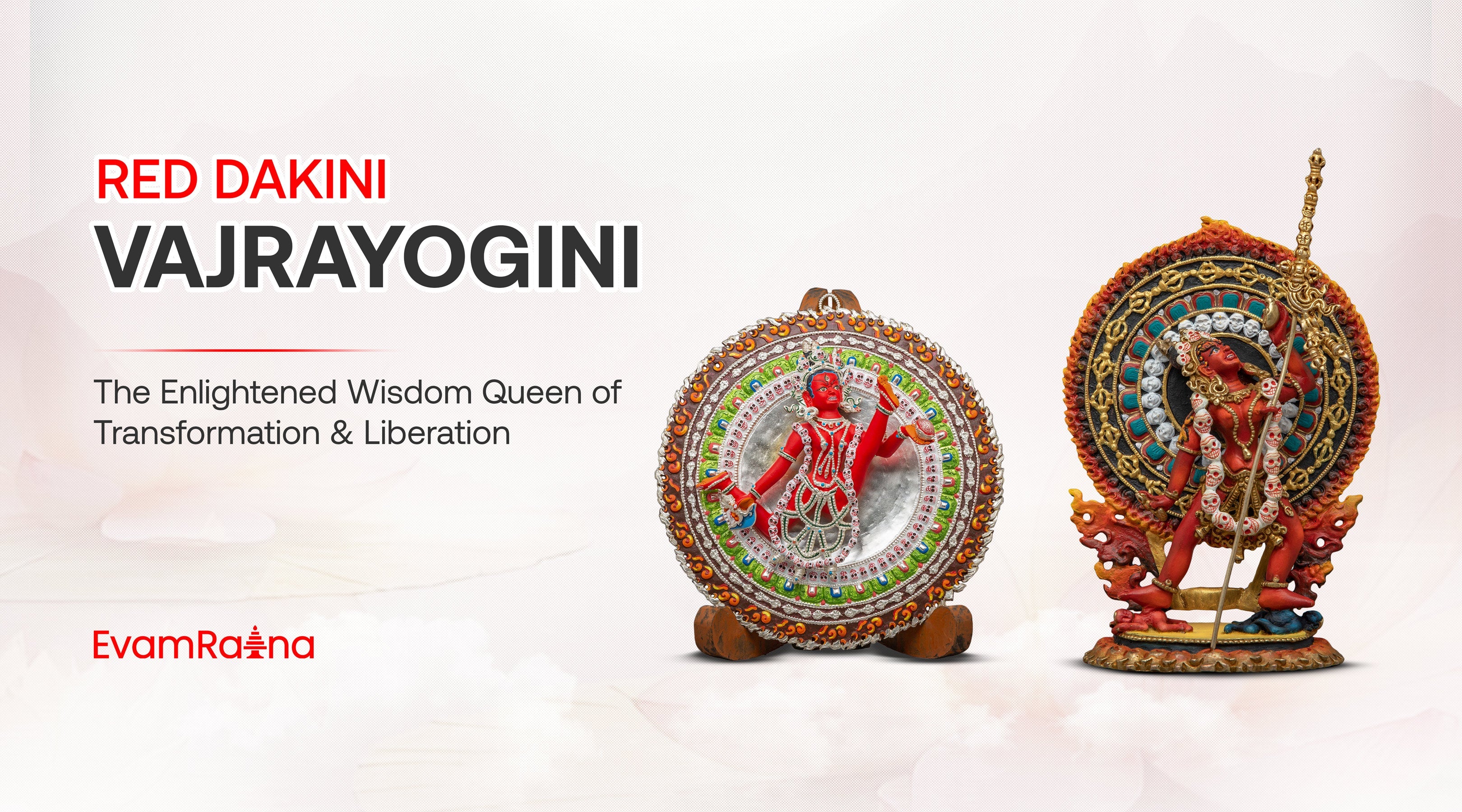
Every detail of Vajrayogini's iconographic form is a teaching. She is portrayed with a brilliantly luminous, deep blood red-coloured body, and her body blazing amid the multi-coloured flames of primordial awareness.
- Red Body: Symbolises the fiery energy of transformation, passion transformed into wisdom, and the fierce compassion that destroys delusion. Red is the colour of great passion, purified from the ego's delusions.
- Three Eyes: The three eyes symbolise the enlightened vision that sees the past, present, and future. That her eyes look upward indicates her dwelling in the pure Dakini realm and points the way for practitioners.
- Curved Chopper (Kartika): The flaying knife (kartika) in her right hand, marked with a vajra, cuts through worldly attachments and ignorance, the destructive wisdom that liberates. It symbolises the cutting of all ego-clinging.
- Skull Cup (Kapala): The skull cup (kapala) in her left hand, filled with blood or nectar, represents the transformation of ignorance into wisdom. She drinks from it, taking in all defilement and converting it to bliss.
- Khatvanga Staff: Resting in the crook of her left elbow, this ritual staff represents her inseparable consort Heruka Chakrasamvara and encodes the entire Chakrasamvara mandala, the axis mundi of Mt. Meru, and all 62 deities.
- Crown of Five Skulls: She wears a crown of five human skulls. These skulls represent the five Buddha wisdoms; each skull represents the transformation of one of the five poisons (ignorance, anger, desire, jealousy, pride) into wisdom.
- Skull Necklace: She wears a necklace of fifty skulls (or fifty fresh heads in certain lineages). The fifty skulls represent the letters of the Sanskrit alphabet, symbolising the purification of all speech and mantra.
- Stance on Kalarati & Bhairava: She stands triumphant upon the figures of Kalarati and Bhairava, not actual beings but emanations of her own qualities representing contaminated desire, hatred, and ignorance. Her stance proclaims their complete subjugation.
Her completely unbound black hair flows upward like fire, a symbol of the unchanging nature of the enlightened truth body (dharmakaya). Her upturned eyes look toward the land of the dakinis, showing her power to guide practitioners toward her pure realm. She is sixteen, permanently youthful, her energy neither exhausted by time nor diminished by the weight of samsara.
The Three Great Lineages of Vajrayogini
Vajrayogini practice is universal to all Tibetan Buddhist lineages. The tradition traces back to the original teachings of Vajradhara and is formally divided into three principal transmission lineages, each named for the great Indian master through whom Vajrayogini herself transmitted the practice:
|
Lineage |
Transmission Source |
Primary School |
Key Characteristic |
|
Narokhacho |
Transmitted directly from Vajrayogini to Naropa |
Sakya / Kagyu / Gelug |
Most widespread lineage in Tibetan Buddhism; Naro Kacho form; necklace of fifty dry skulls (Sakya) or fifty fresh heads (Kagyu) |
|
Maitrikhacho |
Transmitted from Vajrayogini to Maitripa |
Various traditions |
Associated with the "Flying Vajrayogini" (Maitri Kacho) form; emphasises the union of bliss and emptiness |
|
Indrakhacho |
Transmitted from Vajrayogini to Indrabodhi |
Various traditions |
The third great lineage, less widespread in contemporary practice but equally authentic in origin |
Today, the Naro Kacho (Naropa's Sky-Farer) is the most popular. This was passed from Naropa to the Pamthingpa brothers to the Sakya lineage, and from Naropa to Marpa Chokyi Lodro to the Kagyu lineage (where Tilopa, Naropa, and Marpa are considered the first three masters). This practice is strongly encouraged today by modern Kagyu teachers, such as Chogyam Trungpa and H.E. Garchen Rinpoche.
The Vajrayogini Mandala: Sacred Geometry of Awakening

The mandala of Vajrayogini is a unique one in the Vajrayana tradition. Whereas most mandalas are square and have four doors like a palace, the Vajrayogini mandala uses the double tetrahedron - also known as the dharmodaya or "reality source", a three-dimensional triangle that symbolises the source of all things. This distinctive form emphasises her feminine and non-conceptual nature.
The mandala also has four pink bliss swirls, dynamic spirals representing the experience of bliss expanding in all directions. Every aspect of the mandala's composition, the geometry, colour, symbolism, and composition, teaches a particular and powerful lesson about the nature of reality and how to attain liberation.
The khatvanga staff held by Vajrayogini in the crook of her left arm represents the entire Chakrasamvara mandala (with its symbolism representing Mt. Meru as the axis mundi, the four continents, eight islands, five elements, and all sixty-two deities of that mandala). She carries the entire cosmos lightly in her left arm.
Read More About Vajrayogini Mandala Thangka: A Complete Sacred Universe of Wisdom & Transformation
The Practice: Transformation Through Bliss and Emptiness
The Vajrayogini practice belongs to the most advanced level of Vajrayana meditation. It is reserved for those who have received the full empowerment (wang), oral transmission (lung), and practical instruction (tri) from a qualified lineage master. Without these three, the practice cannot be properly engaged. With them, it is claimed to be able to bring a practitioner to the state of full Buddhahood in a single lifetime, a rare claim indeed in the Buddhist canon.
The structure of the practice involves complex visualisation of Vajrayogini's form, recitation of her mantra, engagement with subtle body practices (working with winds, channels, and drops, the inner yoga system), and the integration of bliss-emptiness into all experience. The Naro Kacho practice in particular is famed for the depth and speed of the realisations it can generate.
The great Mahasiddha Naropa is the supreme exemplar: through his vision of and practice with Vajrayogini, he attained full realisation. His biography and the transmission lineage that flows from him stand as the living proof of the practice's efficacy.
Benefits of Vajrayogini Practice

- Purification of Negative Karma: Vajrayogini practice helps to purify negative karma accumulated over many lifetimes. This is essential in Buddhist practice, as karma influences our present experiences and spiritual progress. By engaging in Vajrayogini's sadhana, practitioners transform past actions that may otherwise hinder their spiritual path.
- Transformation of Passions into Enlightened Wisdom: Vajrayogini represents the transformation of ordinary, uncontrolled desires and passions into the energy of enlightened wisdom. Practicing with Vajrayogini helps convert our mental afflictions, such as attachment, anger, and desire, into a higher, purer form of wisdom and compassion.
- Protection from Obstacles on the Spiritual Path: Vajrayogini's practice is said to offer protection against various obstacles on the path to enlightenment. This includes both external challenges and inner distractions that prevent spiritual growth. The practice serves as a shield, helping practitioners overcome difficulties with more ease and grace.
- Development of Bliss-Emptiness Awareness: Through Vajrayogini's practice, practitioners develop the direct experience of the nature of mind, often referred to as bliss-emptiness awareness. This state allows one to experience the inseparability of bliss and emptiness, a core realization in Buddhist practice that leads to a deeper understanding of reality and ultimate freedom.
- Possibility of Rebirth in the Dakini Realm (Khacho): Practicing Vajrayogini is believed to offer the possibility of being reborn in her pure land, known as Khacho, or the Dakini realm. This is considered a favorable rebirth for further spiritual development, as it is a realm that supports continued progress toward enlightenment.
- Liberation in a Single Lifetime: One of the most extraordinary benefits of Vajrayogini practice is the possibility of attaining full Buddhahood in a single lifetime. Vajrayogini is seen as a path that accelerates spiritual progress, allowing practitioners to reach enlightenment more swiftly than through conventional means.
- Swift Action in Cutting Through Delusion: Vajrayogini's practice is especially effective in cutting through delusion and mental distractions, even in the midst of modern life's busy and chaotic nature. Her fierce and transformative energy helps clear away illusions and false perceptions, allowing practitioners to stay focused on their spiritual path.
- Connection to an Unbroken Living Lineage: Vajrayogini practice is part of an unbroken lineage that stretches back to Vajradhara, the primordial Buddha. This living lineage connects practitioners to the wisdom of generations of enlightened beings, ensuring that they receive authentic teachings and blessings directly from the lineage holders.
The practice of Vajrayogini is considered the secret practice of Lama Tsongkhapa himself, the great fourteenth-century Tibetan scholar-saint who founded the Gelug tradition. This fact alone speaks to the extraordinary depth of the transmission and the calibre of practitioners who have carried it forward across the centuries.
Conclusion:
Vajrayogini, the Red Dakini and Enlightened Wisdom Queen, is a transformative and potent path to enlightenment in Vajrayana Buddhism. Practicing her involves purifying negative karma, turning worldly passions into wisdom, and removing spiritual distractions. Offering the possibility of enlightenment in one lifetime, Vajrayogini’s practice leads to rapid progress, promotes the mind of bliss-emptiness, and enables practitioners to experience the inseparable union of wisdom and compassion. Her blessings are said to lead to liberation and the prospect of rebirth in her pure Dakini realm. With a direct lineage, Vajrayogini's teachings remain a source of inspiration and guidance for generations of practitioners, making her one of the most revered deities in Tibetan Buddhism.