The Sacred Instruments of the Buddhist Monastery: A Complete Guide to Rhythms of the Ritual
Monastic Instruments are an important part of Tibetan Buddhist rituals, prayers, and monastery ceremonies. In the Himalayan Buddhist tradition, sound is not only used for music. It is used as an offering, a blessing, and a way to support meditation and spiritual practice. These sacred sounds help create a sacred atmosphere inside the monastery. They invite awareness, devotion, and focus, while also symbolizing the presence of Buddhas, bodhisattvas, deities, protectors, and dakinis. For practitioners, these instruments are not ordinary musical tools. They are sacred ritual objects connected with wisdom, compassion, protection, and transformation.
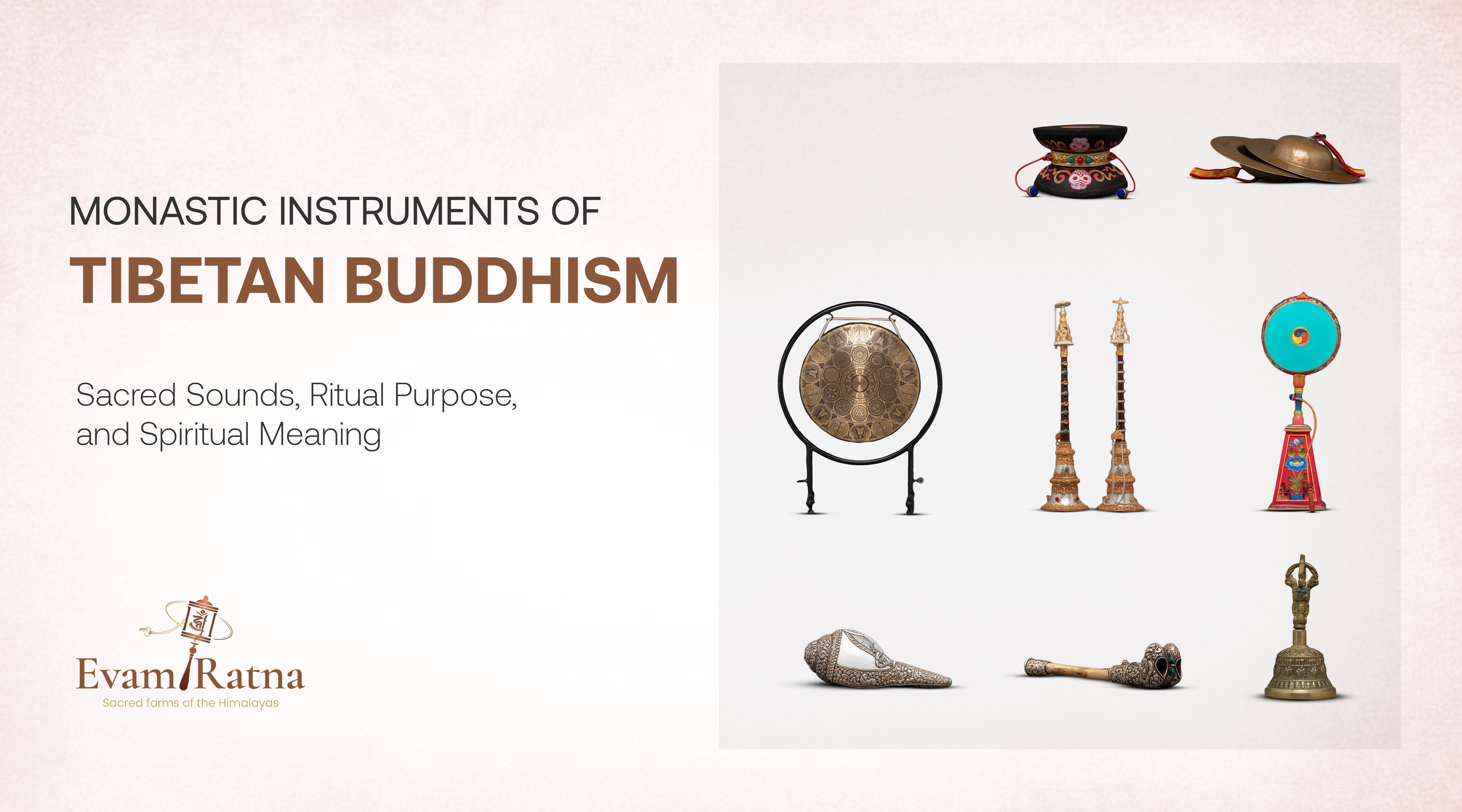
In Tibetan monasteries, instruments such as the Bell, Damaru, Dhyangro, Gangsa and Ganglu, Gong, Gyaling, Jhyamta, and Kangling are played during puja, chanting, protector rituals, offerings, and special ceremonies. Each instrument has its own sound, purpose, and spiritual meaning. Some create deep and powerful vibrations, while others produce sharp, clear, or rhythmic sounds that guide the ritual.
History and Origins of Tibetan Monastic Music
The origins of Tibetan sacred music are traced, in the tradition itself, beyond human history. It is said that the unique vocal chanting and ritual music of Tibet was originally transmitted by the dakinis (Tib. mkha' 'gro ma), the realised female yoginis of the pure realms whose voices encoded the sound-patterns of awakened reality. The earliest Tibetan Buddhist masters received this transmission and gradually codified it into the elaborate musical liturgies that survive to this day.
On the historical level, Tibetan monastic music draws from at least three deep streams. The first is the pre-Buddhist Bon tradition of Tibet and the ancient shamanic musical practices of the Himalayas and Central Asia, which contributed the frame drum, the skull drum, the thighbone horn, and the foundational use of sound as a vehicle for the transformation of consciousness. The second is Indian Buddhist tantric traditions; it includes esoteric rituals, various chant styles, and unique instrumentation, such as the damaru skull-drum and trilbu handbell, which were introduced by scholars from India. The third is the fully developed Vajrayana Buddhist liturgical tradition, which arrived in Tibet principally through Guru Padmasambhava and his disciples in the eighth century, systematising and sacramentalising everything that came before.
Over the centuries following the great translation period of the eighth and ninth centuries, each of the major Tibetan Buddhist lineages, Nyingma, Kagyu, Sakya, Gelug, and the various sub-schools, developed its own specific ritual repertoire. Each monastery maintains a distinct musical canon, with different modal systems, different instrumental combinations, and different ceremonial protocols for the rites of peaceful deities, wrathful protectors, lamas, yidams, and dakinis. The notation for each instrument was traditionally handwritten in elegant Tibetan calligraphy, the curves of the script itself visually suggestive of the wave-motion of the music.
In Nepal and the Newar Buddhist tradition, closely related sacred instruments, the dhyangro, the gangsa, the jhyamta, developed along parallel but distinct lines, reflecting the rich synthesis of Hindu Tantra and Vajrayāna Buddhism that characterises the Kathmandu Valley's living tradition. The Newar bajaṃ (musical ensemble) remains one of the most remarkable living examples of this ancient synthesis.
Damaru: The Sacred Hand-drum

The damaru (Tib. da chung or cang te'u) is a small, double-sided hand drum played by twisting the wrist, with two small beaters striking each drumhead in turn. Despite its size, it is a powerful ritual instrument, representing the voice of enlightened consciousness and symbolizing the universe itself. Its appearance in the hands of deities like Machig Labdron, Niguma, Padampa Sangye, Shiva, and many more deities marks it as an instrument of the highest tantric significance.
History and Origins of Damaru in Buddhism
The damaru's roots extend deep into the pre-Buddhist shamanic traditions of India and the Himalayas. In its earliest forms, it was associated with the Bön tradition of Tibet and with the drum-wielding siddhas of the Indian tantric lineages. The instrument reached the Tibetan plateau around the eighth century CE and was subsequently absorbed into the full ceremonial life of Vajrayana Buddhism. Accounts in the terma (treasure text) tradition describe the great master Guru Padmasambhava himself wielding a damaru in his terrifying manifestations as a subjugator of malevolent forces.
Deep Symbolism
The two drumheads of the damaru represent the union of opposites that is the philosophical heart of tantra: male and female, method and wisdom, form and emptiness, samsara and nirvana. The waist of the hourglass represents the point of non-duality where these apparent polarities dissolve. In the most esoteric teachings, the two heads are said to represent the two truths, conventional and ultimate reality, and the sound they produce is the sound of their inseparability.
The skull damaru (Tib. thod pa'i cang te'u), made from two human cranial cups joined at the crown, carries the most intense symbolic charge. Here, the drumheads are literally the remains of death, and the sound they produce is the sound of impermanence reverberating through space. Such instruments are most closely associated with the Chöd (gcod) practice of Machig Labdrön and with the charnel ground sadhanas of the wrathful yidams.
Materials and Craftsmanship
Damarus are made from several materials. The most common monastic damaru uses a wooden body, typically teak, rosewood, or hardwood, with two goatskin or cow-hide drumheads stretched and laced across the openings. The body is often decorated with carved or painted auspicious symbols, silk tassels in the five tantric colours, and metal fittings. The beaters are usually leather pellets or small balls of wrapped cloth attached to short leather cords.
The bone damaru is carved from a human femur or from sections of two human skull-caps. Such instruments require the bones of specific categories of individual, in the tradition, those who died suddenly, at the height of their powers, or in spiritually auspicious circumstances. The preparation of such an instrument is itself a sacred act accompanied by ritual purification and consecration.
Role in Rituals
The damaru is used across virtually the full spectrum of Vajrayana ritual. In individual practice (sadhana), it is the quintessential instrument of the practitioner, shaken while chanting seed syllables and visualising the yidam deity. In group pujas, it accompanies the hand bell (dril bu); the two are always used together, bell in the left hand and damaru in the right, representing wisdom and method respectively. In Chöd practice, the damaru and thighbone horn (kangling) together comprise the entire instrumental complement, the practitioner alone in wilderness or charnel ground, drumming and blowing through the night.
Read More About The Sacred Damaru: A Comprehensive Guide to Its Origins, Symbolism, and Ritual Use
Dhyangro: Tibetan Shaman Drum

The dhyangro (also spelled dyangro or dyangra) is a large, single-headed frame drum used primarily in the Newar Buddhist and Bön-influenced shamanic traditions of Nepal and the broader Himalayan region. Struck with a curved wooden beater, it produces a deep, resonant boom that forms the sonic backbone of Newar ritual music and the ceremonial practices of Tibetan-influenced shamans (jhakri) across the region.
History and Origins
The dhyangro is one of the most ancient instruments in the Himalayan world, with clear precedents in the shamanic drum traditions of Central Asia, Siberia, and the pre-Buddhist cultures of the Tibetan plateau. In Nepal, it is most prominently associated with the Newar Buddhist tradition and with the jhakri shamanic practice, a living synthesis of Bön, Hinduism, and Vajrayana that persists in many mountain communities. The instrument's form, a shallow wooden frame strung with animal hide, is essentially identical across these diverse traditions, suggesting extremely ancient common roots.
Deep Symbolism
In the Newar tradition, the dhyangro is understood as a cosmic axis: its circular frame represents the full disc of the universe, its single head the membrane between the seen and unseen worlds. When the shaman or ritual musician strikes the drum, he is not merely making sound but traversing the boundary between ordinary reality and the realm of spirits, deities, and the dead. The curved beater, shaped like a sickle or crescent moon, corresponds to the lunar principle and to the curve of the dakini's chopper (kartika) in Vajrayāna iconography.
Materials and Craftsmanship
The dhyangro is crafted from a circular wooden frame, traditionally made from bent hardwood or bamboo, across which a single head of goatskin or buffalo hide is stretched and secured with leather lacing or tacks. The frame may be decorated with painted symbols or left plain. The beater is carved from a single piece of hardwood, curved and smoothed to produce an even strike. Fine instruments may have the frame wrapped in coloured cloth or adorned with ritual knots.
Role in Rituals
In the Newar Buddhist context, the dhyangro is central to the charya nritya (devotional dance) ceremonies and to the group deity propitiation rites performed by guthi (community religious organisations). In jhakri practice, it is the primary vehicle of the shaman's journey, beaten continuously through long night rituals of healing, exorcism, and spirit communication. Its role in Tibetan-influenced monastic contexts is secondary but present, particularly in Nyingma and Bön ceremonies that retain older shamanic elements.
Gong: The Resonant Disc

The gong (Tib. dril chen in larger forms) is one of the most recognisable instruments in the monastic world. A large, flat or slightly convex metal disc suspended in a wooden frame and struck in the centre with a padded mallet, it produces a massive, sustained, all-pervasive tone that fills even the largest temple hall. In monastic contexts, the gong serves as both a ritual instrument and a time-keeper, marking the divisions of the liturgical day and calling monastics to practice.
History and Origins
The gong is one of Asia's oldest and most widespread acoustic instruments, with origins traceable to ancient China and Southeast Asia. Its arrival in the Tibetan and Himalayan Buddhist world came primarily through the influence of Chinese and East Asian Buddhist monasticism, which had long used hanging metal percussion instruments, the bianzhong bell-chime, the bronze zhong, and ultimately the flat gong, for liturgical purposes. In the Newar and Tibetan traditions, gongs were also independently developed as larger versions of the bowl-bell and disc-percussion traditions native to the region.
Deep Symbolism
The circular form of the gong is a mandala in sound, a complete cosmos, a perfect wheel of dharma. Its single centre point, where the mallet strikes, corresponds to the bindu, the seed of all arising. The radiating wave of sound that follows the strike is the unfolding of the dharmadhātu, the expanse of reality, from that single point. The gradual cessation of the tone corresponds to the dissolution of phenomena back into emptiness. In this way, a single stroke of the gong enacts the entire cosmological cycle of arising, abiding, and ceasing.
In protective ceremonies and Mahākāla pujas, the gong is associated with the intimidating presence of the dharmapāla. Its sound is understood to repel malevolent influences, clear the space of negative energies, and establish the perimeter of a sacred enclosure.
Materials and Craftsmanship
Temple gongs are typically cast or hammered from bronze or bell metal, ranging in diameter from a few inches for small altar instruments to several feet for great monastery gongs. The finest instruments are cast with carefully proportioned alloys to achieve a specific fundamental tone and a rich spectrum of overtones. After casting, extensive hand-hammering and tuning work shapes the acoustic profile of the instrument. Many Himalayan gongs feature engraved or relief-cast imagery on their faces, deity forms, mantras, or auspicious symbols, which further consecrate the instrument as a sacred object.
Role in Rituals
The gong is struck at specific junctures within liturgical ceremonies to mark transitions between phases of practice, to signal the arrival or departure of the presiding lama, and to punctuate the recitation of key mantras. In some traditions, a large gong is sounded at the beginning and end of each meditation session, its resonance serving as both a temporal boundary and an acoustic field of support for the practice. The gong also plays a role in funeral rites and in the ceremonies for the dead, where its pervasive sound is understood to penetrate all the bardos and support the consciousness of the deceased.
Read More About The Mystical Power of Tibetan Metal Gongs: Types, Uses, Symbolism, and Benefits
Gyaling (Rgya Gling): The Tibetan Shawm

Introduction
The gyaling (Tib. rgya gling; also romanised as gyaling) is the principal melodic wind instrument of the Tibetan monastic orchestra. A double-reed oboe of extraordinary sonic presence, it produces a piercing, nasal, yet hauntingly beautiful tone that is unlike any instrument in the Western classical tradition. In monastery courtyards, its sound cuts through wind and altitude with startling clarity; in enclosed ritual halls, it fills every cubic inch of space.
History and Origins
The rgya gling descends from the north Indian shenai (also shennai or shahnai), which is itself of Arabic origin, the name likely deriving from the Persian surnā or surna, a term for double-reed shawms found across a vast arc from North Africa to Central Asia. The instrument entered Tibet through India via the Nepalese Terai and the trade routes of the Himalayan passes, where it was adopted and adapted by Tibetan monastery musicians, likely in the medieval period. Its name in Tibetan, rgya gling, meaning roughly 'the Indian wind instrument", preserves this memory of foreign origin.
Deep Symbolism
The gyaling's penetrating tone is associated with the power of speech, specifically with the speech of awakening, the roaring proclamation of the Dharma that cuts through the noise of samsara and reaches even beings in remote or difficult circumstances. Like the conch shell (dung dkar), whose sound is the classic metaphor for the Buddha's teaching pervading all realms, the gyaling is understood to carry the seed syllables and melodic invocations it plays into the furthest reaches of the cosmos.
The elaborately decorated copper bell-end of the gyaling, often fashioned in the shape of a makara or adorned with repoussé lotus and jewel patterns, embodies the sambhogakāya richness of the offering being made. The instrument is never played casually; its sound is always ritual, always intentional, always an act of offering.
Materials and Craftsmanship
The body of the rgya gling is bored from a hardwood, typically teak, black rosewood (Dalbergia latifolia), or another dense tropical hardwood, and has six or seven fingerholes plus an upper back-hole for the thumb. Notably, unlike the Western recorder or oboe, it is played with the hands reversed: the left hand fingers the lower notes and the right hand the upper. The holes are stopped with the middle pad of the finger rather than the fingertips. Copper wire is coiled between each hole as decoration and reinforcement.
The lower section of the instrument ends in an elaborate, gilded copper bell fashioned in a trumpet shape, often with intricate repoussé work depicting sacred imagery. The mouthpiece consists of a double reed seated in a small metal resonator (pirouette), which also facilitates the technique of circular breathing, the practice of inhaling through the nose while simultaneously exhaling through the mouth, allowing extended unbroken passages of melody. The gyaling is always played in pairs, with two musicians alternating phrases to create a continuous melodic flow.
Role in Rituals
The gyaling features prominently in peaceful deity rites, played alongside the flat cymbals (sil snyan) and the conch horn (dung dkar). It is also essential in ceremonial processions, at festival dances (cham), and at important liturgical events such as the installation of lamas, great empowerment ceremonies (dbang), and the anniversaries of important masters. The variable-pitched tuning of the rgya gling, combined with its demanding technical requirements, means that gyaling players are specialists who may study the instrument for a decade or more before performing in formal settings.
Read More About Gyaling: Key Instrument in Tibetan Buddhist Ceremonies
Jhyamta: The Monastic Cymbals

Introduction
The jhyamta (also cyamta) are the large, high-domed cymbals of the Newar and Tibetan Buddhist monastic orchestra, corresponding to the Tibetan rol mo or sbug chal. Unlike the smaller flat cymbals (sil snyan/tingshas), the jhyamta feature a pronounced dome or boss at their centre, held horizontally rather than vertically, and are associated primarily with the rites of wrathful deities, protectors, and the dramatic ceremonial climaxes of puja sequences. Their sound is powerful, metallic, and arresting, a controlled explosion of bronze that stops thought in its tracks.
History and Origins
Large domed cymbals have been used in the ritual music of South Asia and Tibet for over a thousand years. Their specific form, the high central dome, the horizontal playing position, and the cloth or rope handles, is distinctive to the Himalayan and Tibetan Buddhist world and reflects the specific acoustic and ritual requirements of Vajrayāna ceremony. The jhyamta tradition in Nepal is part of the ancient Newar bajaṃ system, where different cymbal sizes and playing techniques are associated with different deities and different phases of the liturgical cycle.
Deep Symbolism
The jhyamta is an instrument of cutting and clarity. Its crash, in the context of wrathful deity rites, represents the ferocious compassion of the dharmapalas, the dharma protectors, whose terrifying appearance and overwhelming sound are themselves expressions of awakened wisdom in its most dynamic, forceful mode. The domed shape of the cymbal is said to resemble a skull-cap, linking it symbolically to the skull ornaments of wrathful deities and to the transformation of death into enlightened display.
In the Tibetan classification system, the rol mo are associated with the element of fire and with the magnetising and destroying activities. Their brilliance and intensity correspond to the quality of discriminating wisdom (pratyavekṣaṇajñāna), which sees each phenomenon in its precise individuality without confusion.
Materials and Craftsmanship
Jhyamta are cast from high-quality bell bronze or pancha dhātu, with a composition carefully tuned to produce both a sharp attack and a sustained, complex sustain. The dome is formed during casting and further shaped by hammering. The playing surfaces may be engraved with protective mantras, deity seed syllables, or auspicious imagery. The cloth handles sewn or laced through the central boss must be sturdy enough to withstand the considerable forces of repeated clashing. Fine instruments are considered heirlooms and may be in continuous use in a monastery for generations.
Role in Rituals
In monastic puja sequences, jhyamta are played together with drums to accompany vocal chanting, particularly in the sections dedicated to wrathful deities, protectors, and obstacle-clearing rites. Different playing techniques, clashing, rolling (where one cymbal is rotated while in contact with the other), and muting (damping the sustain with cloth), are used to create different sonic effects appropriate to different ritual moments. The jhyamta player must have internalized the entire rhythmic vocabulary of the ceremony and be sensitive to the chant-master's signals that indicate shifts in tempo, mode, and intensity.
Kangling (Rkang Gling): The Ritual Trumpets

Introduction
The kangling (Tib. rkang gling, literally 'leg flute') is one of the most sonically distinctive and symbolically charged instruments in all of Vajrayāna Buddhism. In its original and most potent form, it is made from a human thighbone (femur), a fact that immediately announces its association with the most radical and transformative aspects of tantric practice: the charnel ground, death, impermanence, and the fearless confrontation with the nature of the body and mind.
History and Origins
The use of human bone as a ritual instrument is ancient, predating Buddhism in the shamanic traditions of the Himalayan world. Within Buddhism, the kangling appears in its fully developed form in the tantric corpus of the Cakrasaṃvara and related traditions, which incorporate the symbolism and imagery of the charnel ground (śmāśāna), one of the eight or twenty-four power places associated with Heruka deities. The instrument is most famously associated with the Chöd (gcod, 'cutting') practice transmitted by the Tibetan female master Machig Labdrön (1055–1149 CE), who synthesised elements of Prajñāpāramitā philosophy with the charnel ground practices of the Indian mahāsiddhas. In Chöd, the kangling is the primary wind instrument, blown at the four directions to invoke the assembly of guests, buddhas, bodhisattvas, hungry ghosts, and demonic forces, to whom the practitioner offers the visualised feast of their own body.
Deep Symbolism
The symbolism of the kangling operates on multiple levels simultaneously. Most fundamentally, it embodies the Vajrayāna insight into the nature of the body: what we habitually cherish as 'self', as precious and permanent, is revealed as impermanent, empty of inherent existence, and ultimately no different from the bones in a charnel ground. The practitioner who plays the thighbone trumpet is literally holding death in their hands and blowing awakening out of it, transforming the ultimate object of fear into an instrument of liberation.
The kangling is associated with Vajrayoginī and the other ḍākinīs, whose bone ornaments and charnel ground activities represent their transcendence of conventional fear and their mastery of the bardo (intermediate state). The sound of the kangling is understood as the voice of the ḍākinīs, piercing, urgent, and wild, calling the practitioner beyond conceptual limits.
As a monastic instrument, the kangling, while still made from brass or copper rather than bone, retains these associations and is used in the rites of wrathful deities and in funerary ceremonies, where its sound helps guide the consciousness of the deceased.
Materials and Craftsmanship
The human-bone kangling is made from the shaft of a human femur, with one end left as the natural bone opening (serving as a bell) and the other fitted with a mouthpiece of metal or bone. The bone surface is often encased in elaborate metalwork, silver or gilt copper with semi-precious stone inlays, coral and turquoise in particular, creating an instrument of both terrifying and exquisite appearance. The finest examples from the great Tibetan workshops are works of art that integrate the raw material of mortality with the beauty of skilled craftsmanship.
The monastic kangling (Tib. rkang gling in its brass form) is fashioned from beaten brass with a makara-head decoration near the bell end and either a rounded mouthpiece resembling the bone form or a circular-lipped mouthpiece. Like the long horns and the gyaling, the monastic kangling is always played in pairs.
Role in Rituals
The kangling is used in wrathful deity rites, in the sadhana practices of Mahākāla, Yamāntaka, and the Heruka deities, and in funerary ceremonies. In Chöd, as noted, it is the primary melodic instrument. It is blown at the four cardinal directions, upward and downward, to invoke the full assembly of beings across all realms. The sound of the kangling at the start of a ceremony has the function of clearing the space, awakening the protectors, and announcing the practitioner's fearless intention to engage with the fullest scope of reality.
Read More About Buddhist Kangling: Sacred Tibetan Thighbone Trumpet and Its Role in Buddhist Rituals
Supporting Instruments of the Full Monastic Ensemble
Dung Chen: The Long Horns
The dung chen (Tib. rags dung or dung chen) are the great long brass trumpets, typically ten to twelve feet in length, that are among the most immediately recognisable sounds of Tibetan monastic music. Always played in pairs, they are made of five or six telescoping sections for portability. Their deep, gravelly moan, compared by one writer to 'the singing of elephants', is used at the openings and closings of major ceremonies and in ceremonial processions, where the bell ends of the horns rest on the shoulders of monks walking ahead of the musicians. When played stationary, a vertical wooden frame supports the trumpet ends.
Dril Bu: The Hand Bell

The dril bu (Skt. ghanta) is the sacred ritual bell of Vajrayana practice, present on virtually every altar and in the hands of virtually every practitioner during puja. Held in the left hand and rung in coordination with the vajra (held in the right), it represents the wisdom of sunyata. Its clear, sustained tone purifies speech and creates an atmosphere of sacredness in the ritual space. Monastic dril bu are among the most finely crafted of all Tibetan metalwork objects, with the face of the bell typically depicting the yidam deity of the monastery or tradition.
Dung Dkar: The Conch Shell Horn

The dung dkar (Skt. sankha), the sacred white conch, spiralling to the right, is among the oldest of all Buddhist ritual instruments and one of the eight auspicious symbols (astamangala). Its sound, described in the sutras as the voice of the Buddha's teaching penetrating all realms, is used to call practitioners to assembly, to mark the opening of ceremonies, and to accompany the rites of peaceful deities (alongside the gyaling and flat cymbals). Conch shells are also used as vessels for consecrated water during abhiṣeka (empowerment) ceremonies.
Read More About Exploring the Engraved Conch Shell: Sacred Art, Rituals, and Spiritual Significance
Conclusion: Sound as the Path
The sacred instruments of the Tibetan Buddhist monastery are not decorations of religious life. They are its living voice, the means by which the Dharma resonates across time and space, by which the enlightened qualities of the buddhas and bodhisattvas are invoked into the human world, and by which the practitioner's own mind is shaped, opened, and ultimately liberated.
From the deep thunder of the dung chen to the piercing sound of the kangling, from the bright shimmer of the jhyamta to the rattling urgency of the damaru, each instrument carries an entire world of meaning, historical, cosmological, psychological, and devotional. To understand these instruments is to understand something of the profound sophistication with which the Vajrayana tradition approaches the question of how sound, carefully cultivated and precisely directed, can become a vehicle for awakening.
At Evamratna, we are honoured to offer these sacred objects, handcrafted by skilled artisans in Nepal and the broader Himalayan world, to practitioners, collectors, and those drawn to the beauty and depth of this living tradition. Each instrument we offer is made with the traditional materials, techniques, and, where possible, consecrated with appropriate blessings, so that it may fulfill the purpose for which these remarkable objects have always been intended: to be an offering of sound to the infinite, and a door through which the infinite may speak.