The Two Great Devas Who Witnessed the Buddha's Awakening
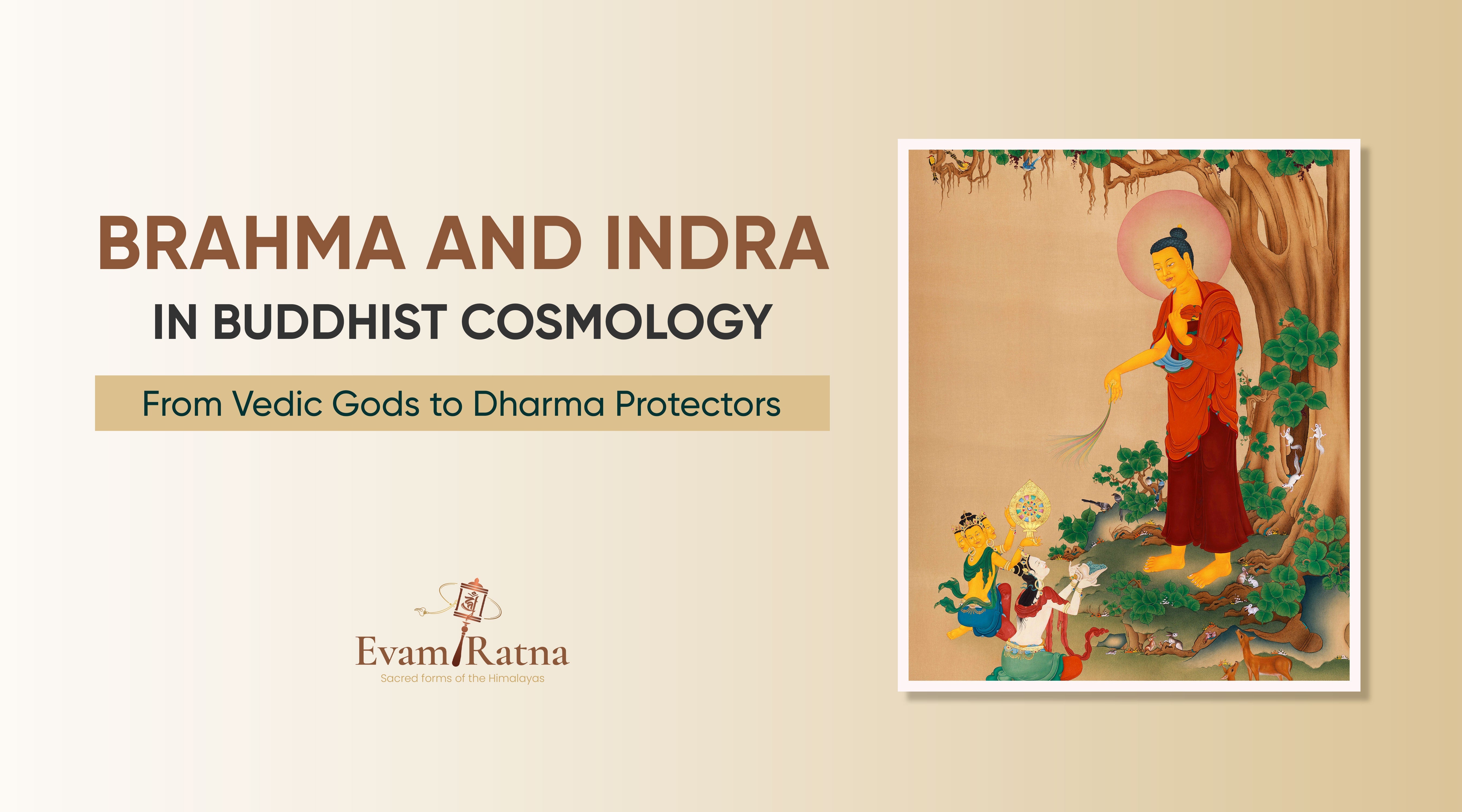
In Buddhist cosmology, Brahma and Indra are two important devas who witnessed and honored the awakening of Shakyamuni Buddha. Although they originated in the Vedic tradition as powerful gods, Buddhism reinterpreted their roles in a new spiritual framework. They are not seen as supreme creators or ultimate sources of refuge, but as divine beings who recognize the Buddha’s enlightenment and support the unfolding of the Dharma in the world.
Brahma is associated with purity, renunciation, and depth of meditation in Buddhist art, and Indra, also known as Sakra, is associated with royal power, protection, and devotion to the Buddha. Together, they appear in many scriptures and sacred artworks as attendants, witnesses, and protectors of the Dharma. Their presence shows a central Buddhist teaching: even the highest gods remain within the cycle of rebirth, while the awakened wisdom of the Buddha stands beyond all worldly and heavenly power.
Brahma Sahampati: The Deva of the Great Invitation

In Buddhism, Brahma is typically seen as a high celestial being rather than an ultimate creator god. The most significant figure in this category is Brahma Sahampati, who played a critical role immediately following the Buddha's enlightenment. Brahma Sahampati is often associated with tranquility, complete purification, and freedom from desire. This reflects his nature as a pure practitioner who embodies the meditative states known as the Brahmaviharas (benevolence, compassion, empathetic joy, and equanimity).
According to Buddhist texts, after Siddhartha Gautama attained enlightenment, he initially hesitated to share his profound realization, fearing it was too deep for others to understand. It was Brahma Sahampati who appeared before him and urged the Buddha to teach for the sake of those with "little dust in their eyes".
Indra (Sakra): The King of Gods and Shield of the Dharma

Indra, referred to in Buddhist texts as Shakra Devanam Indra or simply Sakra, is the ruler of the heavens and a devoted defender of the faith. According to Buddhist lore, when Siddhartha was starving himself, Sakra appeared and played a three-stringed lute. One string was too tight and snapped; one was too loose and made no sound; the third was perfectly tuned and made beautiful music. This divine intervention gave Siddhartha the realization of the Middle Way.
Indra is also credited with venerating the Buddha’s holy relics, such as hair and fingernail trimmings, and enshrining them in stupas within the heavenly realms. Unlike the priestly Brahma, Indra retains his identity as a heroic warrior-king who battles Asuras and upholds cosmic order through the power of his vajra (thunderbolt).
Cosmological Realms: Brahmaloka and the Trayastrimsa Heaven
The standing of these deities is defined by their residence within the complex Buddhist cosmology, which divides the cosmos into various celestial realms.
Brahmaloka: Brahma is the lord of the heavenly realm of rebirth called the Brahmaloka. Buddhist texts define seventeen or more Brahma realms, where beings are reborn based on their monastic achievements and accumulated karma.
Trayastrimsa Heaven: Indra resides atop Mount Sumeru, the cosmic mountain at the center of the universe, in the Trayastrimsa Heaven (Heaven of the Thirty-Three). This realm represents a higher plane of existence, though it remains within the cycle of samsara and is subject to impermanence.
Iconography of the Devas: Identifying Bonten and Taishakuten

In East Asian traditions, particularly in Japan and Korea, these deities are known as Bonten (Brahma) and Taishakuten (Indra). Identifying them requires looking at their attire, posture, and specific attributes.
Attributes of Brahma (Bonten)
Bonten is often rendered with a sense of calm dignity and contemplation rather than martial power.
-
Attire: He typically wears layered, refined courtly or priestly robes (sometimes monk-like kasaya).
- Face and Hands: While Indian iconography may show him with four faces, Japanese traditions often favor a human-like presentation. He is frequently depicted holding a fly whisk in his right hand and a water vase (kundika or kamandalu) in his left.
- Symbolism: His appearance mirrors that of a Brahmin ascetic, symbolizing purity and the sacred.
Attributes of Indra (Taishakuten)
Taishakuten is depicted with the visual language of a heavenly ruler and protective warrior.
- Attire: He is often shown wearing armor-like elements over a long-sleeved robe, suggesting active guardianship.
- Weapons and Mount: His primary attribute is the vajra (thunderbolt), representing divine might and authority. He is also famously associated with the celestial white elephant, Airavata, which he uses as a mount (vahana).
- Symbolism: He represents the secular mode of protection and the leadership that defends the Dharma.
The Power of Position Placed:
In temple art and relief carvings, Brahma and Indra are rarely standalone figures; they almost always appear as a matched pair, Brahma standing on one side (usually right) and Indra standing on the other side (left) with a central Buddha or Bodhisattva. Brahma signifies the sacred and the attainment of enlightenment through cultivation, while Indra signifies the secular and the saving of all beings.
Their presence signals that all levels of existence, even the highest gods, are oriented toward the Dharma. By flanking a central figure like Shakyamuni (Shaka), they express a complete world where power bows to wisdom.
Witnessing the Awakening: Historical and Cultural Masterpieces

Two significant historical examples of this divine pairing can be found in East Asia:
- Seokguram Grotto (Korea): Built in the 8th century, this grotto features unparalleled iconography of Brahma and Indra. They are carved on both sides of the entrance to the circular main chamber, standing on rug-like pedestals called guyu. Brahma holds a kundika vase and Indra holds a five-pronged vajra, both wielding fly whisks.
- Nara Period Art (Japan): Early surviving images are also found in Japan from the Nara period (710-794). These statues, often made of wood or dry lacquer, established the standard for Bonten and Taishakuten as watchful, steady protectors who honor the teaching.
Ritual Significance and Home Placement: A Guide for Practitioners
For those wishing to include these protector deities in a home altar or practice space, traditional hierarchy and respect are key.
- Visual Hierarchy: The most common mistake is choosing attendants that overpower the central Buddha image. To maintain a traditional reading, select Brahma and Indra statues that are slightly smaller or place them slightly lower than the central figure.
- Placement Etiquette: Statues should be placed on a clean, elevated surface away from shoes, clutter, or casual foot traffic. They should never be placed directly on the floor or in a bathroom.
- Intent and Care: In a home setting, their presence provides a calm, protective atmosphere. Care should be practical: dusting with a soft brush, avoiding harsh chemicals, and lifting from the base rather than the delicate crown or arms.
Regional Traditions: India, East Asia, and the Tibetan World

The figures of Brahma and Indra have travelled with the Dharma across centuries and continents, adapting their iconographic forms while preserving their essential functions.
In Gandhara and early India, they appear prominently in narrative relief, the life story of the Buddha in stone and schist, often depicted in Hellenistic-influenced forms reflecting the cultural synthesis of the region.
In China, Brahma (Fantian) and Indra (Dishitian) were integrated early. From the late eighth century, images of Brahma and Indra dressed in the form of Chinese emperors began to appear on Dunhuang murals. In their place, the earlier Brahma-Sikhin iconography (characterised by conch-shaped hair) rapidly declined during the Tang dynasty.
In Japan, they became Bonten and Taishakuten. They are most commonly encountered as attendant or flanking figures near a central Buddha or bodhisattva, and appear in temple guardian programmes where multiple protective deities form a network of defence around the Dharma.
In Korea, the Seokguram tradition established a unique iconographic lineage: the Brahmā and Indra iconography established at Seokguram continued to appear on stone pagodas and stupas of the late Unified Silla period, creating a unique Korean convention for depicting Brahmā and Indra, setting it apart from those of China and Japan.
In the Tibetan tradition, Tshangs pa (Brahma) that witness teachings or n paintings and ritual contexts, often in the heavenly assemblies, and Brgya byin (Indra/Sakra) appear in thangka painting and ritual contexts, often in the context of the heavenly assemblies that witness teachings or the cosmic battles between Sakra and the Asuras that serve as backdrops for moral teaching. Indra's identity partly merges in Vajrayana iconography with Vajrapani, the holder of the thunderbolt, a transformation that speaks to the way Buddhist tradition continually reinterprets the power symbolised by the vajra.
Read More About Lord Indra: Is It the Same in Buddhism as in Hinduism?
Conclusion:
The presence of Brahma and Indra in Buddhist cosmology is a powerful reminder that true status is most admirable when it is used to protect wisdom and compassion. By transitioning from supreme Vedic sovereigns to humble Dharma protectors, they symbolize the universal appeal of the Buddha’s message. Whether viewed as historical artifacts in a grotto or as protective guardians on a home altar, these "Hindu gods" remain vital, living symbols of the realization that all beings can be aligned with the path of awakening.