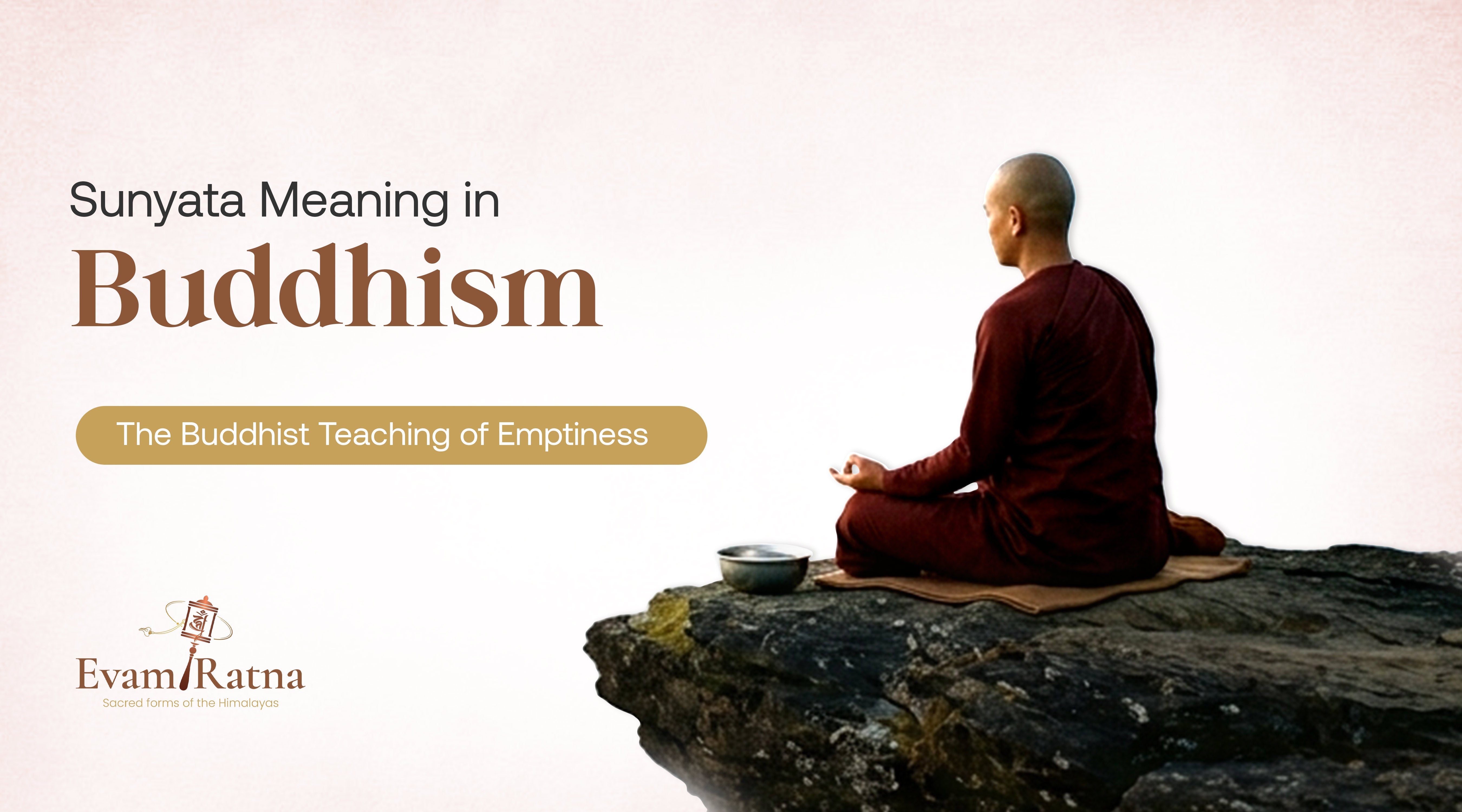
Emptiness Is Not Nothingness: The Buddhist Path to Sunyata and Liberation
The word Sunyata (Pali: sunnata; Tibetan: stong pa nyid) is usually translated as "emptiness" or "voidness," but it does not refer to empty spaces or nothingness; it refers to an ultimate reality of the nature of phenomena: that there is no independent, inherent, fixed existence for anything, including the self. Far from being a nihilistic declaration that nothing matters, Sunyata is, in the words of the great Buddhist philosopher Nagarjuna, the very ground that makes everything possible. As he wrote: "When emptiness is possible, everything is possible. Were emptiness impossible, nothing would be possible." To understand emptiness is to start to dissolve the root of all suffering, the illusion of a fixed permanent self clinging to a world that it falsely believes in.
What is Emptiness in Buddhism?

In Buddhism, emptiness is a fundamental philosophical idea central to understanding the nature of reality, the self, and the path to liberation from suffering. The term does not denote a blank absence or a cosmic void. Rather, as the tradition explains, to say phenomena are "empty" is to say they lack solid, separate, and permanent existence, that they are impermanent, always changing, and entirely dependent on causes and conditions.
Over the 2,600-year history of Buddhist thought, the word sunyata has accumulated at least five distinct layers of meaning, from the early teaching of no-self, to the Mahayana doctrine that all phenomena lack inherent existence, to the non-dual realization of luminous awareness in Vajrayana practice. Each layer deepens the preceding one rather than replacing it.
The Buddhist Teaching of Emptiness:
The core of emptiness is to see that the world is not empty, but rather that every phenomenon is empty of an inherent, independent, or permanent essence (svabhava). This teaching can be seen in several layers:
- No Subject (No-Self): The historical Buddha taught that the world is "empty of self and of what belongs to self". What we experience in our consciousness (hearing, seeing, thinking) is the result of an automatic chain of cause and condition (but not the result of something permanent: the "I" or the "ego") directing the process.
- No Object: The philosopher Nagarjuna expanded this, explaining that just as there is no "you" experiencing things, there are no "things" being experienced in isolation. All things are made up of causes and conditions: an apple is not an apple without the tree, the soil, and the sun.
- Dependent Origination: This is the principle that everything arises in dependence upon other factors. Nothing in experience can exist apart from everything else.
Emptiness and No-Self (Anatman): The Buddha's Original Teaching

The historical Buddha was the first to use the word sunyata, and he did so in a specific and radical way. In the Sunna Sutta of the Pali Canon, he declared: "It is because it is empty of self and of what belongs to self that it is said, 'Empty is the world.'" The world is empty not because it doesn't exist, but because nowhere in it can a fixed, permanent, autonomous self be located.
The Buddha illustrated this through the six sense spheres. Take the act of hearing: a pianist plays, producing sound (a sense object); the sound meets the ears (sense organs); the experience of hearing arises (consciousness). This entire chain unfolds through cause and condition. There is no separate, unchanging "hearer" standing behind it. The ear is empty of a self; sounds are empty; ear-consciousness is empty; even ear-contact is empty of anything belonging to a self.
This is the teaching of anatman, no permanent self, which forms the bedrock of Buddhist psychology and practice. To realize, through direct investigation rather than intellectual assent, that one's felt sense of "I" does not correspond to any findable, fixed entity is the insight the Buddha called the path out of suffering. In this early sense, emptiness and no-self are nearly synonymous.
Nagarjuna and the Madhyamaka School: Emptiness as the Middle Way

The Indian philosopher Nagarjuna (approximately 2nd - 3rd century CE) is arguably the single most important figure in the history of Buddhist philosophy after the Buddha himself. His Mulamadhyamakakarika (Fundamental Verses on the Middle Way) systematically demonstrates that all phenomena, causation, motion, time, the self, nirvana itself, are empty of svabhava: inherent, self-grounded existence.
For Nagarjuna, to say a thing has svabhava is to say it exists independently, without dependence on anything else, that it carries its own essence within itself. His entire philosophical project is a proof by reductio ad absurdum: assuming anything has such inherent existence leads to irresolvable contradictions. Therefore, all things are empty of svabhava; all things exist conventionally, dependently, relationally.
This is the "Middle Way" of Madhyamaka, not a compromise between extremes, but the refusal of both eternalism (things exist permanently and inherently) and nihilism (things do not exist at all). Things exist conventionally but not ultimately. At the ultimate level, they are empty. At the conventional level, they function, cause effects, and matter. The two truths are not contradictory; they are two perspectives on the same reality, like looking at water and seeing wetness at the same time.
Nagarjuna's most celebrated formula identifies sunyata directly with dependent origination: "Whatever is dependently arisen, that is emptiness." Things do not exist despite being empty; they exist because they are empty, open to being constituted by causes and conditions. This equation of emptiness and dependent origination is the philosophical heart of Madhyamaka.
Emptiness in Theravada Buddhism

The Theravada tradition, while often associated primarily with the no-self (anatta) teaching, has its own rich engagement with emptiness. In the Pali Canon, the Buddha describes an advanced meditative practice called "abiding in emptiness" (sunnatavihara), in which the practitioner progressively simplifies perception, releasing attention from its habitual objects until awareness rests in a state of great clarity and peace.
In the Culasunnata Sutta and Mahasunnata Sutta, the Buddha describes a graduated meditation through emptiness: from the perception of earth to forest to the ground of infinite space, infinite consciousness, nothingness, and finally neither-perception-nor-non-perception, each stage progressively "more empty" than the last. This is not philosophical analysis but a practice instruction, pointing toward liberating stillness.
Theravada Abhidharma analysis also addresses emptiness through its breakdown of persons into streams of momentary dhammas (basic factors of experience), none of which constitutes a permanent self. The "person" is a conventional designation applied to a flowing process; the process itself is empty of anyone who owns it.
Emptiness in Mahayana Buddhism: The Two Truths Doctrine

In Mahayana Buddhism, the doctrine of two truths (saṃvṛti-satya and paramartha-satya, conventional truth and ultimate truth) provides the conceptual scaffolding within which emptiness is understood. Conventional truth is the world of ordinary experience: tables, persons, cause and effect, suffering and liberation. Ultimate truth is the emptiness of all these, their lack of inherent, independent existence.
Crucially, Mahayana thinkers insist that the two truths are not two worlds. Nagarjuna writes: "The ultimate truth is not taught without depending on conventional practice; without understanding the ultimate truth, nirvana is not attained." This means that the path to liberation moves through the conventional world, not away from it, that sunyata is realized in the midst of dependent, conventional existence, not by escaping it.
The Yogacara school (Mind-Only), founded by Asaṅga and Vasubandhu, approaches emptiness differently: the fundamental emptiness is that external objects are empty of being anything other than mental events. The "things" we perceive are mental constructions; their apparent externality is an illusion. This is sunyata understood through the lens of mind rather than through the deconstruction of inherent existence.
Emptiness in Vajrayana and Tibetan Buddhism

In Vajrayana, the tantric vehicle of Buddhism preserved primarily in Tibetan lineages, sunyata receives its most elaborate and experientially charged expression. Here, emptiness is not only an object of philosophical analysis but the very nature of mind: rigpa (pure awareness) in Dzogchen, or the mahamudra recognition of the nature of mind, is simultaneously empty and luminous (stong gsal), void and cognizant.
Tibetan Buddhism distinguishes several increasingly subtle understandings of emptiness across its four major schools. The Gelug school, following Tsongkhapa's interpretation of Mādhyamika Prāsaṅgika, insists on the rigorous negation of inherent existence without falling into the denial of conventional existence. The Kagyu and Nyingma schools, while accepting this analysis, additionally emphasize the positive luminous quality of mind, often described through the Yogācāra-Madhyamaka synthesis, as an inseparable companion of emptiness.
In deity yoga practice, the practitioner dissolves ordinary appearances into emptiness and then arises in the form of the deity, a union of emptiness and appearance that trains the practitioner to recognize all phenomena as the display of empty, luminous awareness. The deity is not a real external being; nor is the emptiness into which all dissolves a blank nothing. They are inseparable: appearance arising within emptiness, emptiness expressed through appearance.
The Kagyu lineage teaching from the 17th Karmapa emphasizes that the path of seeing, the third stage of the bodhisattva's path, is precisely the moment of directly perceiving all phenomena as empty. "There is not one phenomenon they do not see as empty. There is not one phenomenon for which they cannot recognize its emptiness." This is not a gradual insight but a sudden, all-encompassing recognition.
Common Misconceptions: Emptiness Is Not Nihilism
The most common misreading of sunyata, both within Buddhism's history and in contemporary Western encounters with Buddhist philosophy, is nihilism: the view that emptiness means nothing exists, nothing matters, and there is no basis for ethics or engagement. Buddhist teachers across traditions unanimously reject this reading.
Nagarjuna himself was acutely aware of this danger. He wrote that emptiness, when wrongly grasped, "destroys the dull-witted, like a snake wrongly grasped, you reach for the head, and the tail loops around to bite you." The wrong grasp is taking emptiness as a thing, a philosophical position to be asserted, a view of nothingness to be held. Correctly understood, sunyata is not a view, it is the dissolving of all fixed views.
The Middle Way between eternalism and nihilism is precisely the teaching of emptiness correctly held: things exist conventionally and function causally, but they do not exist inherently or permanently. "Everything is possible" because nothing is fixed. Suffering is real; compassion is real; the path is real. None of this requires phenomena to have inherent existence. The freedom offered by sunyata is not freedom from reality but freedom within it.
Conclusion
Emptiness (sunyata) is the very essence of Buddhist insight; all phenomena, including the self, are empty of intrinsic nature. Correctly understood, emptiness is not nihilism. Understanding emptiness helps dissolve attachment, ego, and suffering, guiding practitioners toward freedom, compassion, and wisdom. From early Theravāda teachings on no-self to Mahāyāna’s two truths and Vajrayāna’s tantric realization, emptiness is central to meditation, deity yoga, and the path to enlightenment. Correctly grasped, it allows one to navigate life with clarity, seeing reality as it truly is while engaging with the world with awareness and compassion. It allows one to walk toward the Middle Way, embrace conventional reality without attachment, and awaken the mind to freedom and wisdom.