The Complete Guide to Dhyangro: Nepal's Ancient Shaman Drum and Its Buddhist Roots
Among the many sacred sound instruments of the Himalayas, few carry as much weight literally and spiritually as the dhyangro. At first glance, it looks like a large, weathered frame drum: a circular wooden shell, two taut heads of goat hide, and a long carved handle jutting from one side. But for the jhakri, the shamans of Nepal's hill and mountain communities, the dhyangro is far more than a musical instrument. It is a vehicle. When the drum is struck, and the jhakri begins to chant, the drum becomes a vessel for the soul's journey between the human world, the realm of spirits, and the world of the ancestors.
When struck and accompanied by chants, the drum becomes a vessel for spiritual journeys, bridging the human world, the realm of spirits, and the world of ancestors. It is an essential tool for ritual ceremonies, healing practices, and communication with supernatural forces, embodying centuries of indigenous Himalayan shamanic traditions.
What is a Dhyangro?

The term dhyangro comes from local Tibetan and Nepali linguistic roots in which “Dhyang” can be understood as “mind” or “awareness,” reflecting the instrument’s role in ritual practices that engage consciousness, focus, and spiritual insight. “Gro” refers to “drum” or “circular frame instrument,” indicating the physical structure of the instrument. Thus, the dhyangro is literally a “mind drum”, a sacred object designed to align the practitioner’s awareness with the spiritual energies invoked during ritual.
The dhyangro sits at a fascinating crossroads of cultures. It belongs to the indigenous shamanic traditions of peoples such as the Tamang, Sunuwar, Limbu, Magar, and Kirati. Its handle is often carved in the form of a phurba (kila), one of the most potent ritual implements of Vajrayāna Buddhism. In this single object, two living spiritual worlds, the pre-Buddhist shamanism of the Himalayan foothills and the tantric Buddhism that spread from Tibet, meet, overlap, and continue to coexist to this day. This single instrument reflects a living spiritual synthesis that continues to coexist in the region today.
Dhyangro Across Himalayan Cultures
The word dhyangro (also written dhangro or jhyangro) is most widely used in Nepali to describe this frame drum, but the instrument and its names shift slightly as you move across ethnic groups and regions. Among Tibetan Buddhist musicians, a related drum is known as the nga, and scholars of ethnomusicology have long noted the close kinship between the dhyangro of Himalayan shamans and the ritual drums used in Tibetan monastic and tantric contexts.
It's worth noting early on that "dhyangro" is not a single, fixed object; it is closer to a category of frame drum that varies by community, construction, and use. Some are double-headed with an elaborate carved handle; others are single-headed with metal ornaments. What unites them is their role as the central instrument of trance, invocation, and ritual sound across the Himalayan shamanic landscape.
Origins: The Jhakri and the Himalayan Shamanic Tradition

To understand the dhyangro, you have to understand the jhakri, the shaman-healer found throughout the hill regions of Nepal, particularly among the Tamang, Sunuwar, Limbu, Magar, Kirati, and several other ethnic communities. Jhakri practice predates the arrival of Buddhism in these regions and represents one of the oldest continuous spiritual traditions in the Himalayas, rooted in animism, ancestor veneration, and direct communication with spirits.
For the jhakri, the dhyangro is the primary tool of the trade, as a vajra and ghanta (bell) are essential to a Vajrayana practitioner, or a damaru is essential to practitioners of Chöd. The drum is used to enter an altered state of consciousness, to summon protective deities and ancestral spirits, to communicate with the dead, to diagnose and treat illness (both physical and spiritual), and to guide lost or wandering souls back to their proper place.
In the Himalayas, jhakri shamanism and Vajrayana Buddhism are not completely separate; instead, they have influenced each other for hundreds of years. You can see this in dhyangro drums that have handles carved like a phurba; this means a traditional shamanic drum also includes Buddhist spiritual symbols, blending the two traditions together.
The Tibetan Ritual Dhyangro (Nga) in Monastery Practice

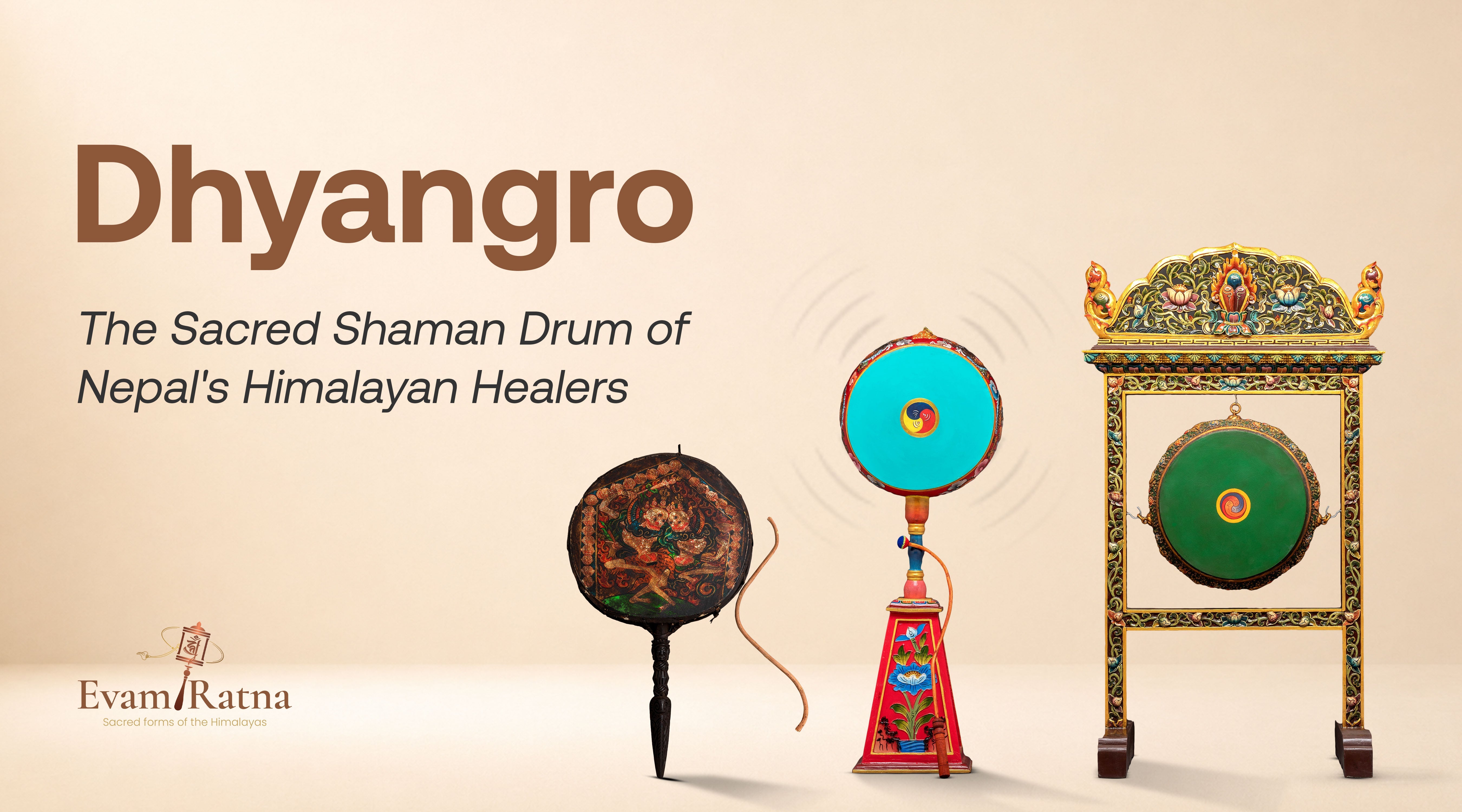
Inside a Tibetan Buddhist monastery, the dhyangro takes on a far more architectural form. Here it is generally known as the nga, or more specifically as the chö nga "dharma drum" or choe-pai-nga, a large double-headed drum mounted within an elaborately carved and painted wooden frame, often crowned with a canopy of lotus blossoms, flame finials, and auspicious scrollwork, and set on a sturdy stand within the assembly hall.
Unlike the handheld dhyangro of the jhakri, the monastery nga is struck with a pair of long, sickle-shaped (S-curved) wooden drumsticks, often padded at the striking tip, allowing one or two monks to produce a deep, room-filling boom. These drums are central to yangröl, the combined chanting and ritual music (rölmo) that accompanies Tibetan Buddhist pujas. Far from being mere accompaniment, this music is itself understood as an offering (chöpa), performed to be both pleasing to the ear and skillfully executed.
The painted frames of these temple drums are frequently decorated with clouds and dragons, imagery directly tied to the sound of thunder, linking the drum's resonance to the rolling voice of the dharma moving across the sky. In Buddhist teaching, this is the literal meaning behind the phrase "sounding the drum of the dharma", the spreading of the Buddha's teaching to all directions. At the same time, the drum's booming tone, which rises and then dissolves into silence, is read as a teaching on impermanence and emptiness, every strike a small lesson in arising and passing away.
The monastery nga is used in rituals for both peaceful and wrathful deities, in cham (ritual masked dances), and in temple processions, where its sound marks transitions in the ceremony and calls the assembly to attention. A richly gilded, canopy-framed temple dhyangro, gold leaf, carved lotus crowns, painted dragons and scrollwork, represents this monastic tradition at its most refined: an instrument built not only to be played, but to anchor and elevate the entire ritual space around it.
The Dakini Drum: A Standing Drum of the Dakinis

A particularly striking member of the dhyangro family is the Dakini Drum, a large frame drum mounted upright on a tall, ornately painted pedestal, often finished in vivid colors such as turquoise, red, and gold, with floral motifs and auspicious symbols covering the base and shaft.
The name "dakini drum" is sometimes used for the small, hourglass-shaped damaru central to Chöd practice, where the drum is considered the very "abode of the dakini" and its sound the sound of impermanence itself. The standing Dakini Drum represents a larger expression of the same underlying idea: its circular drumhead is read as a symbol of the cosmos, and its struck rhythm is said to echo the vibrations of enlightened activity, calling forth the presence of the dakinis, the dynamic, wisdom-embodying female forces of Vajrayāna Buddhism.
In practice, the standing Dakini Drum is used within monastery ceremonies, tantric sādhanas, and group practices such as tsok (feast offerings), where its sound, together with damaru, bell, and other ritual instruments, helps invoke the maṇḍala of deities and dakinis associated with the practice being performed. It is also valued for personal meditation practice and as a focal point on a home shrine or altar, where its tall stand allows it to anchor a sacred space much as a standing gong would.
Taken together, the hand-held damaru, the shamanic dhyangro of the jhakri, the canopy-framed monastery nga, and the standing Dakini Drum are best understood not as separate instruments but as branches of a single lineage of sacred Himalayan drums, varying in size, mounting, and specific ritual role, yet united by the same core understanding: that the drum's circular form is a map of the cosmos, and its sound is the voice through which the unseen is called into the present moment.
Construction and Materials: Wood, Goat Hide, and Rudraksa Seeds
A traditional dhyangro is built almost entirely from natural materials sourced from the surrounding Himalayan environment:
-
Wooden shell/frame: carved from a single piece or assembled from curved sections of hardwood, forming the circular body of the drum.
-
Goat hide drumheads: stretched over both openings of the frame (in double-headed variants) and secured with wooden hoops.
-
Cane and leather lacing: wooden hoops are bound and tightened using leather strips or cane, which also allow the tension, and therefore the pitch, of the drumheads to be adjusted.
-
Rudraksa seeds: placed inside the drum's hollow body. When the drum is struck or shaken, these seeds rattle against the interior, adding a distinctive textured resonance beneath the drum's main tone. Rudraksa seeds carry their own deep symbolic weight across Himalayan and Indic spiritual traditions, often associated with Śiva and with protective, purifying qualities; their inclusion inside the dhyangro is not incidental, but part of the instrument's ritual charge.
The drum is played with a distinctive S-curved cane beater. To perform, the jhakri holds the drum by its carved handle in the left hand, raising the frame so it sits roughly level with the face, while the right hand strikes the outer head with the curved stick. This playing posture is itself significant; the drum becomes an extension of the body, held close to the head and heart rather than at arm's length, reinforcing its role as something the shaman enters into rather than simply plays.
Dhyangro and Tibetan Buddhist Music: The Nga Connection
The dhyangro's reach extends beyond shamanic ritual and into Tibetan Buddhist musical life as well. Ethnomusicologists have drawn direct comparisons between the dhyangro and the nga, a frame drum used in Tibetan Buddhist ritual and monastic music; both are unusual among frame drums in featuring a handle, a feature most frame drums elsewhere in the world lack.
This connection underscores something important about the dhyangro: it is not an isolated curiosity confined to remote shamanic practice, but part of a wider family of Himalayan and Tibetan ritual drums that share construction techniques, playing postures, and, in the case of the phurba-handled examples, iconography. The dhyangro stands as a living example of how musical instruments can carry theological and cosmological meaning across cultural and religious boundaries.
Conclusion
The dhyangro is far more than a drum; it is a meeting point of two of the Himalayas' deepest spiritual currents: the ancient, animist shamanism of the jhakri, and the tantric symbolism of Vajrayāna Buddhism. In its wooden frame, goat-hide heads, rattling rudrākṣa seeds, and, in many cases, its carved phurba handle depicting the three worlds and the wrathful protectors of the Dharma, the dhyangro carries an entire cosmology within a single object.
Whether heard in the trance-inducing rhythms of a shamanic séance, in the festive ensembles of Nepali folk music, or held quietly as a piece of sacred Himalayan craftsmanship, the dhyangro remains a powerful reminder of how sound, symbol, and spirit continue to intertwine across the roof of the world.