Yab & Yum (The Father and Mother): Meaning, Symbolism, and Visual Guide
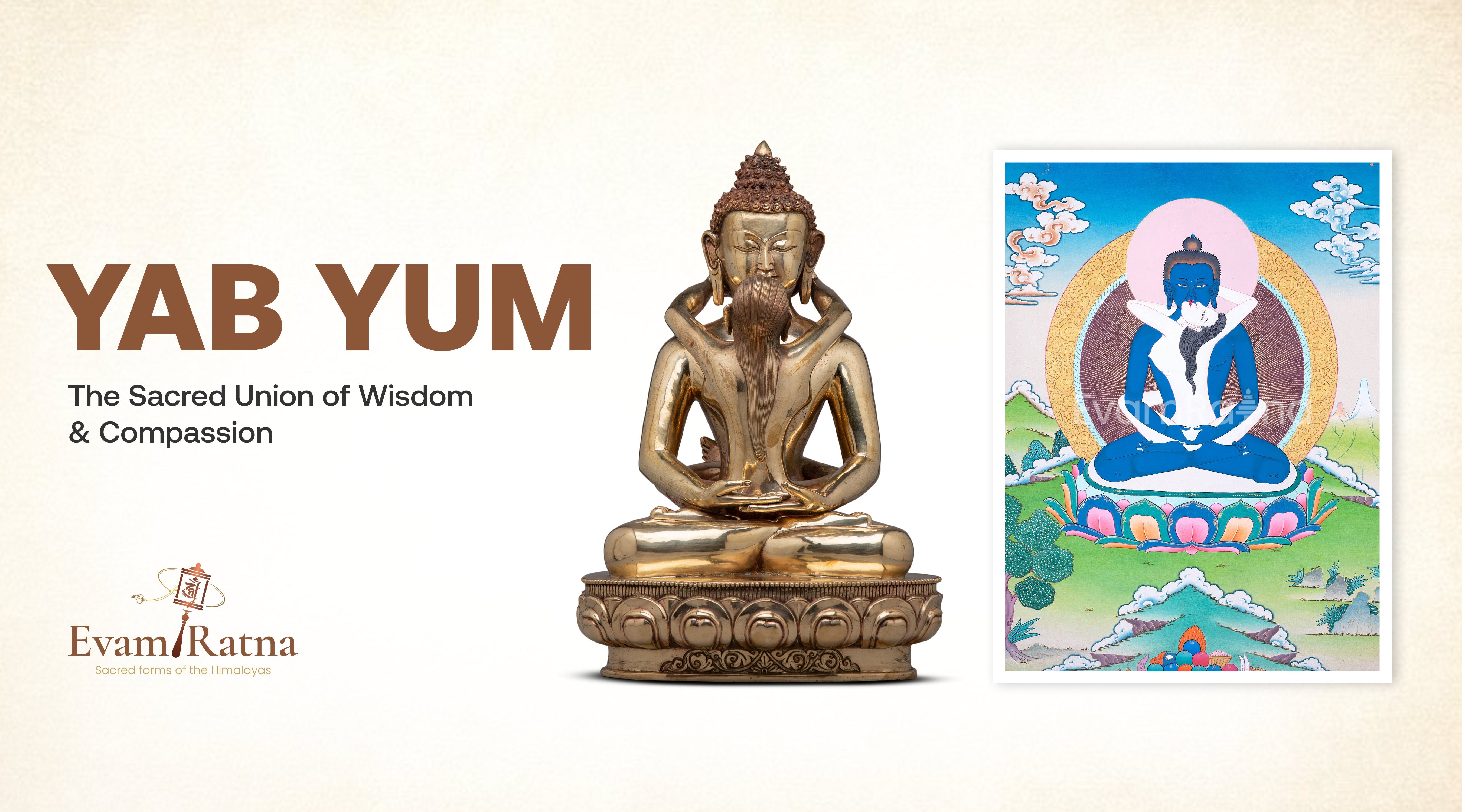
Few images in Himalayan sacred art provoke as much curiosity and as much misunderstanding as Yab Yum. To an unfamiliar eye, a thangka or statue showing a deity locked in close embrace with another deity can look startlingly literal. Yet within Vajrayana Buddhism, this image is one of the most carefully guarded and profoundly philosophical teachings in the entire tantric canon. It is not an illustration of desire; it actually holds significant meaning in the esoteric practices of Tibetan Buddhism, symbolizing the profound union of compassion and wisdom, which is a central concept in Vajrayana teachings.
Yab Yum Meaning

In Tibetan, Yab means "father" and Yum means "mother." Together, "Yab Yum" translates literally as "father-mother." The term doesn't refer to parentage in any biological sense; instead, it is an honorific pairing used throughout Tibetan religious vocabulary to describe two complementary principles that, joined, give rise to something greater than either alone.
In iconography, Yab Yum refers to a specific compositional form: a male deity, typically seated in a meditative posture, closely embracing a female consort deity. This pairing is seen across Vajrayana lineages, ranging from the peaceful, luminous forms of primordial Buddhas to the fierce, multi-armed depictions of wrathful protectors. However, in every instance, the fundamental structure remains consistent. The male and female figures each symbolize one half of a single, indivisible truth, and their union illustrates that truth in its entirety.
Historical Origins: From Indian Tantra to the Himalayan Plateau
Roots in Vajrayana and the Yab Yum Tantra Texts
Yab Yum imagery emerged within the esoteric current of Indian Buddhism that crystallized into Vajrayana, the "Diamond Vehicle", during the latter half of the first millennium CE. This was a period of intense cross-pollination between Buddhist tantric communities and the broader tantric movements of the Indian subcontinent, including currents from Shaiva traditions that also explored the union of masculine and feminine cosmic principles. Within Buddhism, this symbolism found its fullest expression in the Anuttarayoga Tantra ("Highest Yoga Tantra") class of teachings, texts such as the Chakrasamvara, Hevajra, Guhyasamaja, and Kalachakra tantras, which use the language of union, bliss, and embrace to point toward states of consciousness that ordinary language cannot describe. Collectively, this body of literature is often referred to as Yab Yum Tantra, reflecting how central the union motif is to its symbolic vocabulary.
Transmission to Tibet, Nepal, and Bhutan
Buddhism arrived in Tibet in earnest between the 7th and 9th centuries CE, during the reigns of kings such as Songtsen Gampo and, later, through the activity of master tantric teachers including Padmasambhava, who is credited with firmly establishing Vajrayana practice on the plateau. The Nyingma school, as the earliest of the Tibetan traditions, preserved many of these tantric transmissions in their original form, and Yab Yum imagery became deeply woven into its art and ritual. As Buddhism continued to develop in Tibet, the Kagyu, Sakya, and Gelug schools each incorporated Yab Yum iconography into their own tantric systems, particularly within the "completion stage" practices reserved for initiated practitioners. From Tibet, the imagery spread throughout the wider Himalayan cultural sphere, into Nepal, Bhutan, Sikkim, Ladakh, and Mongolia, becoming a recurring presence in thangka painting, temple murals, and ritual bronze sculpture.
The Heart of Yab Yum: Prajna and Upaya in Union

To understand Yab Yum is to understand two Sanskrit terms that sit at the very center of Mahayana and Vajrayana thought: prajna (wisdom) and upaya (skillful means, or method).
The Yab: Compassion and Skillful Means (Upaya)
The male figure, the Yab, embodies upaya, compassionate activity in the world. This is the dimension of practice concerned with method: the active, engaged, world-facing capacity to respond to the suffering of beings with appropriate action. In the visual language of thangka and sculpture, the Yab is frequently shown holding a vajra, the symbol of indestructible method and skillful means cutting through ignorance.
The Yum: Wisdom and Emptiness (Prajna)
The female consort, the Yum, embodies prajna, the wisdom that directly perceives shunyata, or emptiness: the understanding that all phenomena are without fixed, independent existence. Where upaya is active and engaged, prajna is the ground of insight that makes that activity wise rather than blind. The Yum is often shown holding a bell (ghanta) or a lotus, symbols of emptiness, receptivity, and the sound of the Dharma resonating through space.
Union as the Realization of Non-Duality
Neither principle is complete without the other. Tibetan teachers have long emphasized that compassion without wisdom can become misguided, even harmful, while wisdom without compassion risks collapsing into cold detachment, disengaged from the suffering of beings. The embrace of Yab and Yum is the visual resolution of this problem: it depicts the moment at which method and wisdom are no longer two separate things to be balanced, but a single, seamless reality. This is non-duality (Tibetan: gnyis med), the realization that the apparent oppositions structuring ordinary experience (self and other, samsara and nirvana, form and emptiness, masculine and feminine) are not ultimately separate at all. The embrace is not the union of two beings so much as the dissolution of the boundary that made them appear to be two in the first place.
Key Yab Yum Deities in Vajrayana Art
|
Male Deity (Yab) |
Principle Embodied |
Female Consort (Yum) |
Principle Embodied |
Symbolic Union |
|
Chakrasamvara |
Great bliss, skillful means |
Vajravarahi |
Wisdom realizing emptiness |
Union of bliss and emptiness (mahasukha) |
|
Hevajra |
Compassionate method, transformative energy |
Nairatmya |
Selflessness (anatman), penetrating insight |
Liberation through method and wisdom |
|
Vajradhara |
The Dharmakaya, primordial awareness |
Vajradhatvishvari |
All-pervading wisdom of space |
The non-dual essence underlying all Buddhas |
|
Samantabhadra |
Primordial enlightenment, unadorned awareness |
Samantabhadri |
Pure, unconditioned awareness |
The innate, original nature of mind |
|
Kalachakra |
Mastery over time and inner energies |
Vishvamata |
The wisdom pervading all phenomena |
Realization of the cycles of time and existence |
|
Guhyasamaja |
The body, speech, and mind of all Buddhas united |
Sparshavajra |
The wisdom of secret union |
The "Secret Assembly", total integration of enlightened qualities |
|
Yamantaka (Vajrabhairava) |
Wrathful conquest of death and ego-clinging |
Vajravetali |
Ultimate insight, mastery over fear |
Victory over impermanence through wisdom |
Tantric Yab Yum: Its Role in Practice and Deity Yoga
Within living Vajrayana practice, Yab Yum is a focal point for deity yoga (Tibetan: lha'i rnal 'byor), a category of meditation in which the practitioner visualizes themselves as the deity, complete with all of its symbolic attributes. The purpose of this visualization is not self-aggrandizement but the opposite: by identifying with a form that embodies the inseparability of wisdom and compassion, the practitioner works to dissolve the rigid sense of an isolated, separate self.
These practices are traditionally approached only after a practitioner has received the appropriate empowerment (abhisheka) from a qualified teacher, and they are typically transmitted within the context of an ongoing guru-disciple relationship rather than through casual exposure. This is part of why Yab Yum imagery, despite its prominence in Himalayan art, has historically been treated with a degree of discretion, not because the image is shameful, but because its full meaning is considered to unfold properly only within a structured framework of study, ethical conduct, and direct guidance.
Read More About Samantabhadra: The Primordial Buddha of Universal Peace in Tibetan Buddhism
Yab Yum in Thangka, Sculpture, and Himalayan Sacred Art

Across centuries of Himalayan artistic production, Yab Yum has remained one of the most recurring and revered compositions in thangka painting, copper sculpture, and temple murals. From the radiant, minimally adorned forms of Samantabhadra and Samantabhadri associated with the Dzogchen teachings, to the elaborately ornamented, multi-armed forms of Chakrasamvara, Hevajra, and Kalachakra found in the highest tantric mandalas, Yab Yum compositions showcase the full range of Himalayan artistic vocabulary, fine linework, symbolic color, ornamentation, and composition all working together in service of the teaching they convey.
For those drawn to this iconography, encountering it through authentic thangka paintings, ritual bronzes, and consecrated statuary offers a way to engage with these teachings as generations of practitioners have, as objects of contemplation, devotion, and daily practice, created within the same lineages of artistic transmission that have carried this symbolism for centuries.
Read More About Yab-Yum: The Sexual Union of Male & Female in Buddhism
Conclusion
Yab Yum is one of Vajrayana Buddhism's most condensed teachings, an entire philosophy of enlightenment expressed not in words, but in a single embrace. To look at a Yab Yum thangka or statue with informed eyes is to see, simultaneously, the active compassion that engages with the suffering world, the penetrating wisdom that sees through to emptiness, and the non-dual reality in which these two are revealed never to have been separate at all. Far from a curiosity at the margins of Buddhist art, Yab Yum stands near its very center, a reminder that the path to awakening unites, rather than divides, the fullness of what we are.