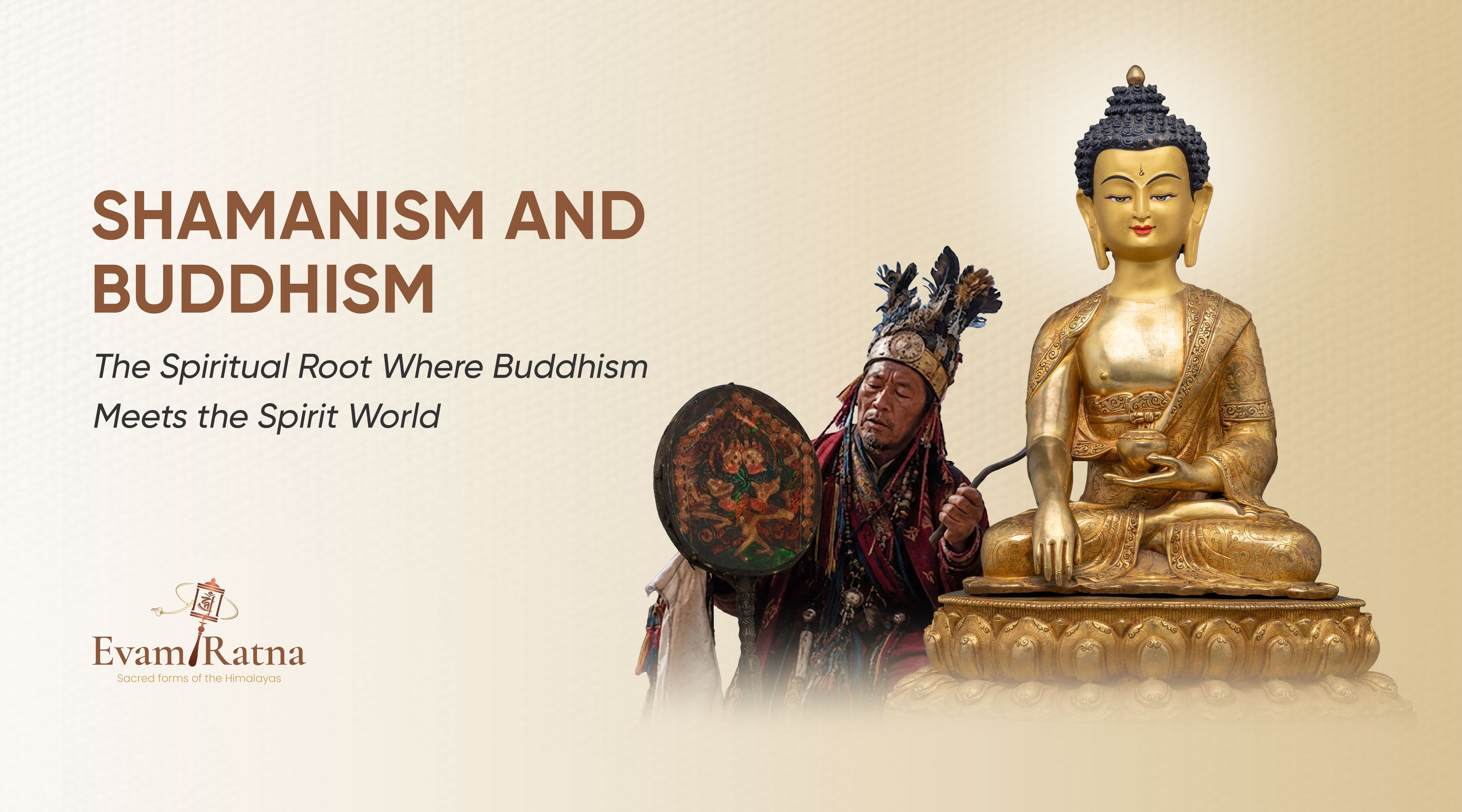
Shamanism in Tibetan Buddhism: How Bon Shaped a Living Tradition
Long before monasteries, sutras, or formal philosophy, humans were already alive with shamanic traditions rooted in nature, spirits, ancestors, and healing rituals. They drummed, chanted, and entered trance to speak with the spirits of mountains, rivers, and ancestors. This impulse, what we now call shamanism, is older than any organized religion on earth. When Buddhism eventually arrived in places like Tibet, it didn't simply replace these older ways of relating to the unseen world. It absorbed them, transformed them, and merged them into a tradition, creating one of the most unique spiritual landscapes in the world.
What is Shamanism? Origins, Etymology and Core Practice

Shamanism in the Himalayas refers to ancient spiritual practices centered on communication with spirits, nature forces, and ancestral realms. It isn't a single religion but a practice found across nearly every continent. At its core is the shaman, a person trained to enter altered states of consciousness, often through drumming, chanting, fasting, or trance, to travel into what practitioners call the spirit world. There, the shaman negotiates with spirits, retrieves lost soul-fragments, or seeks guidance on behalf of the community.
The word itself traces back to the Tungusic saman, but its deeper linguistic root may connect to the Sanskrit term sramaṇa, meaning one who strives or exerts effort toward spiritual liberation. This is the same root that gives us the word for the wandering ascetics of ancient India, the spiritual milieu the Buddha himself emerged from. The overlap is more than etymological curiosity; it hints at a shared inheritance between the shaman's path of disciplined inner effort and the renunciate's path toward awakening.
Core Practices of Shamanism
The shaman is distinguished by a specific specialty: the trance during which their soul is believed to leave the body to ascend to the sky or descend to the underworld. The shamanic practice is centered on the management of the sacred through direct, ecstatic experience.
1. The Ecstatic Journey: The core of shamanism is the soul's ability to safely traverse three cosmic zones: sky, earth, and underworld. The shaman is a specialist in the human soul; they alone "see" it and know its destiny.
2. Initiation through Death and Resurrection: A shaman’s career typically begins with a spiritual crisis often called "initiatory sickness," characterized by dreams or trances where the candidate is symbolically dismembered by spirits, their organs renewed, and their bones gathered back together to be "born again" as a consecrated vessel.
3. Ritual Implements:

- The Dhyangro: Known as the "shaman's horse," it is the vehicle for the ecstatic journey. Its shell is often symbolically made from the wood of the World Tree, projecting the shaman to the "Center of the World".
- The Costume: Adorned with iron "bones" representing a skeleton and feathers symbolizing magical flight, the costume allows the shaman to transcend profane space and acquire a superhuman mode of being.
4. Social Functions: The shaman serves the community as a healer (finding and capturing strayed souls), a psychopomp (guiding the dead to the underworld), and a mediator who conveys sacrifices and prayers to the gods.
The Crossroads: How Shamanism and Buddhism Met in Tibet
When Buddhism entered Tibet in the seventh century, it encountered a culture already saturated with shamanic practice: a world of mountain gods, lake spirits, sky burial customs, and ritual specialists who mediated between human and spirit realms. Rather than erasing this older layer of belief, Tibetan Buddhism, especially through the influence of Padmasambhava, the tantric master credited with subduing Tibet's local spirits and binding them as protectors of the dharma, absorbed it into its own cosmology. Local deities became dharma protectors. Mountain spirits became guardians of sacred valleys. The shamanic vocabulary of spirit-taming, binding, and negotiation became part of the Buddhist ritual repertoire itself.
Connection with Buddhism

Shamanism and Buddhism, particularly in the forms of Tantrism and Lamaism, share a deep historical and structural relationship in Central Asia and Tibet.
1. Mutual Stimulation: Shamanism in regions like Mongolia and Manchuria is often described as "shamanism stimulated by Buddhism". While shamanism existed as an archaic tradition long before Buddhism, the latter decisively influenced it, particularly in the techniques used to master and incarnate spirits.
2. Structural Parallels:
- The Seven Steps: The legend of the Buddha's Nativity, where he takes seven strides to reach the summit of the world, mirrors the shamanic (and Vedic) ritual ascent of seven or nine levels to reach the highest heaven.
- Cosmology: Both systems rely on a "Center of the World" often identified as a Cosmic Mountain (Mount Meru) or a World Axis, which serves as the site for breakthroughs between planes of existence.
- Tantric Rites: The Tibetan rite of Chöd, where a practitioner offers their own flesh to be devoured by demons, is a highly spiritualized version of the archaic shamanic initiation involving dismemberment and mystical death.
3. Magical Powers (Siddhis): Many Buddhist arhats and saints are credited with shamanic abilities, such as magical flight, becoming invisible, or producing "mystical heat" (tapas or tum-mo) to resist extreme cold.
Buddhism's View of the Spirit World
Buddhism, particularly in its Vajrayana and Tibetan forms, never described the universe as inert matter. The cosmology inherited from early Buddhist texts includes devas, nagas, hungry ghosts, local earth-spirits, and countless classes of non-human beings who experience suffering and benefit from compassion just as humans do. There's a well-known account of monks meditating in a forest who became disturbed by tree spirits, until the Buddha taught them the practice of loving-kindness, after which the spirits settled, and the forest became hospitable again. This shows that, far from dismissing spirit-belief as superstition, early Buddhism treated the unseen world as a real part of the moral and meditative landscape.
This worldview created fertile ground for shamanic traditions to merge with Buddhist practice wherever Buddhism traveled into already-animist cultures, and nowhere is this more visible than in Tibet.
Shared Ground: Trance, Journeying and Ritual Tools
Both traditions rely on altered states of consciousness as a method of accessing deeper truth, whether that's the shaman's drum-induced trance or the tantric practitioner's visualization and mantra recitation. Both use sound as a technology of transformation. The repetitive beat of the shaman's drum has its parallel in the Tibetan damaru, the small ritual hand-drum used in tantric practice to mark rhythm during invocation and to symbolize the union of wisdom and method. Bells, too, carry shared symbolic weight: calling spirits to attention, marking the boundary between ordinary and non-ordinary reality, or signaling the presence of wisdom in ritual. Ritual daggers like the phurba, used in Tibetan Buddhist practice to pin down and transform obstructive forces, echo the shamanic practice of confronting and transmuting harmful spiritual energies rather than simply banishing them.
Oracles and Protectors: The Living Cosmology of Vajrayana
Few elements illustrate this fusion better than the oracle tradition. State oracles like the Nechung Oracle enter deep trance states, allowing a protector deity to speak through them, a practice structurally identical to shamanic spirit-possession found across Central Asia and Siberia. Surrounding this is an entire pantheon of dharmapalas, or dharma protectors, many of whom were originally local nature spirits or mountain gods later "tamed" and bound into service of the Buddhist teachings. This isn't a relic of the past; oracle consultations and protector deity rituals remain active parts of Tibetan Buddhist life today, a living demonstration of shamanism's enduring presence within an ostensibly philosophical religion.
Compassion as the Bridge: The Healer and the Bodhisattva
Beneath the ritual overlap lies a shared ethical core. The shaman's traditional role is to heal, to restore balance for an individual or community, often at personal cost. The bodhisattva ideal in Buddhism asks for something structurally similar: a vow to work for the liberation of all beings before one's own final release. Both figures position themselves as intermediaries who absorb difficulty on behalf of others. Both operate from the premise that the universe is alive, relational, and responsive to care. This shared ethic of other-centered healing is arguably the deepest point of connection between the two traditions, more enduring than any specific ritual technique.
Why This Ancient Connection Still Matters Today
Understanding shamanism's role within Tibetan Buddhism reframes how we look at ritual objects that might otherwise seem purely decorative or symbolic. A dhyangro isn't just an instrument; it's a tool descended from millennia of trance-inducing percussion. A phurba isn't only a ceremonial dagger; it carries the shamanic logic of transforming rather than destroying obstruction. Recognizing this lineage deepens both the historical understanding and the personal practice of anyone drawn to Tibetan Buddhist ritual culture, connecting present-day practitioners to a continuous thread stretching back to the earliest human attempts to speak with the unseen.
Read More About Dhyangro: The Sacred Shaman Drum of Nepal's Himalayan Healers
Conclusion
Shamanism and Buddhism arose from different soils, one rooted in the drum-beats of Siberian and Central Asian trance practice, the other in the renunciate traditions of ancient India, yet in Tibet these two paths didn't just cross, they fused into something inseparable. The oracle who speaks in trance, the damaru that marks the rhythm of invocation, the phurba that transforms rather than destroys, the mountain god turned dharma protector: each is a quiet testament to a world that was never treated as dead matter, but as alive, relational, and worthy of compassion. To understand Tibetan Buddhism without its shamanic root is to see only half the picture. The other half is older, wilder, and still very much alive in the rituals practiced today, a reminder that the boundary between the seen and unseen has always been thinner than it appears, and that the work of healing, whether undertaken by a shaman or a bodhisattva, has always been an act of care extended toward a living, listening world.