Celebrating Indra Jatra: A Foreigner's Guide to Witnessing the Grand Celebration
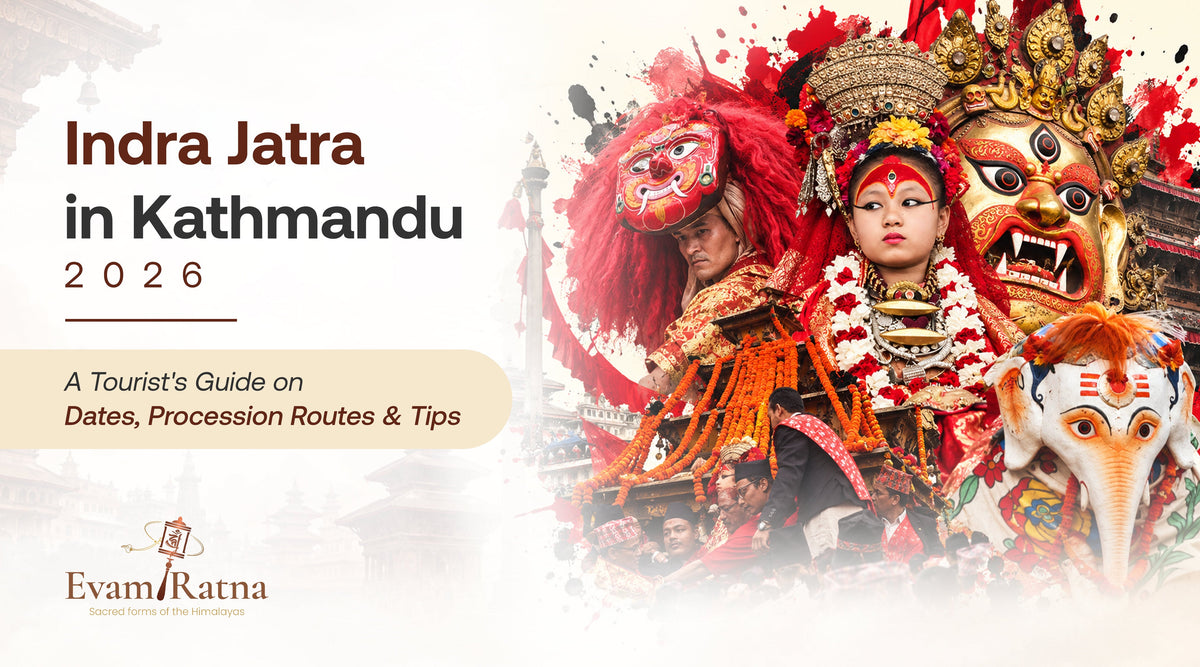
Experience the vibrant heartbeat of Kathmandu's ancient heritage, Indra Jatra in Kathmandu Valley 2026 which transforms the historic alleys of Durbar Square into a living theater of gods, demons, and dynamic cultural pride. Each year, as the monsoon loosens its grip on the Kathmandu Valley and the rice fields ripen, the old city wakes to the sound of drums. A tall wooden pole is raised before the former royal palace. Masked gods and demons spill into the lanes. A young girl, revered as a living goddess (Kumari), is drawn through the crowds in a towering wooden chariot, while small butter lamps flicker in memory of the departed. For a foreign traveler, Indra Jatra offers something rare: a devotion practiced in the same streets for centuries. It belongs first to the people of the valley, and the reward for arriving with patience and respect is a glimpse of Kathmandu at its most alive and most sacred.
Who Is Indra?

Indra is the king of the gods (devas) in Hindu mythology and the deity of rain, thunder, lightning and storms. In the Rigveda, the oldest Hindu scripture, he is one of the most praised gods, a warrior-king who wields the thunderbolt (vajra). His most famous deed is slaying the serpent Vritra, which releases the waters and ends drought, so he is closely tied to rain and a good harvest. Traditionally he rides Airavata, a white elephant, rules the heavenly realm of Svarga, and is married to Indrani (Shachi).
In Buddhism he is also known as Shakra (Sakka), a devoted protector of the Buddha's teachings. In the Kathmandu Valley, both Hindus and Buddhists honor him in Indra Jatra as the giver of rain. The festival's central story is his capture in Kathmandu while picking flowers for his mother.
What Is Indra Jatra?

Indra Jatra honors Indra, the Hindu king of the heavens and the deity who controls rain and the fertility of the harvest. It always falls as the summer monsoon retreats, when the rice is in bloom and heavy rain could still harm the crop. Farmers give thanks for the season's water, and the festival is also a time to remember family members who died in the past year.
Among the Newars, the indigenous people of the Kathmandu Valley, the festival is called Yenya Punhi. In Nepal Bhasa, ye refers to Kathmandu, ya means celebration and punhi means full moon, so the name can be read as the full-moon celebration of Kathmandu. Tradition credits the 10th-century king Gunakamadeva with founding the festival to mark the establishment of the city. Two celebrations are woven together. Indra Jatra proper is marked by masked dances, displays of sacred images and decorations in honor of Indra. Kumari Jatra is the chariot procession of the living goddess Kumari, which began in 1756 CE during the reign of King Jaya Prakash Malla. Both Hindus and Buddhists take part, a reminder that in Newar culture the two traditions are intertwined.
The festival is also linked with 1768 CE, the year Prithvi Narayan Shah of Gorkha conquered the Kathmandu during Indra Jatra (Spotlight Nepal). The rituals were reshaped afterward so the celebration could belong to the whole nation and not only to the Newar community. The result is the layered festival visitors see today: royal, communal, Hindu, Buddhist and deeply local.
Indra Jatra 2026: Dates at a Glance
Indra Jatra follows the lunar calendar, so its Gregorian dates shift every year. An eight-day festival, from the twelfth day of the bright fortnight to the fourth day of the dark fortnight of the Newar lunar month of Yanla. For 2026 (Bikram Sambat 2083), the Nepali calendar listing for Ashoj and several festival guides point to this pattern:
- Wednesday, 23 September 2026: The Yosin pole is raised at Hanuman Dhoka, opening the festival.
- Friday, 25 September (Ashoj 9): Kwaneya, the first chariot procession and the main day of the festival.
- Saturday, 26 September: Full moon, Yenya Punhi, and the second chariot procession (Thaneya).
- Wednesday, 30 September: The pole is lowered, marking the end of the celebrations (the Nepali calendar lists this as Indra Dhwajpatan).
The third chariot procession, Nanicha, is held later in the festival; in 2025 it fell on 11 September, days after the first two pulls (Around Trail). One guide lists a slightly different window for 2026 (25 September to 2 October), so treat all dates as provisional. Exact routes and start times are announced locally shortly before the festival, so confirm them with the Kathmandu Metropolitan City or the Guthi Sansthan once you arrive.
The Legend: Indra, the Parijat Flower, and a Mother's Search
Every ritual of Indra Jatra echoes one story. Indra, king of the gods, once descended to earth disguised as a farmer. His mother needed the white parijat flower, the night jasmine, for a ritual, and he came to the valley to gather it. While he was plucking blossoms at Maruhiti, a sunken water spout in the Maru neighborhood, the townspeople mistook him for a thief, caught him and bound his hands. He was displayed in the town square at Maru.
Indra's mother, alarmed by his long absence, came down to Kathmandu and wandered the city looking for him. His sacred elephant also searched for its master through the streets. When the townspeople finally realized whom they had bound, they were horrified and released him at once. In gratitude, Indra's mother promised to provide dew through the winter months to ensure a rich crop. The misty mornings that begin in Kathmandu around this time are traditionally said to be that promise kept.
You can see the story acted out across the city. An image of Indra with his hands tied is displayed on a raised platform at Maru and at Indra Chowk. The mother's search is remembered in the Dagin procession, and the searching elephant lives on in the wicker figure of Pulu Kisi. Nearly everything you see is a chapter of this one long retelling.
How Indra Jatra Unfolds: A Day-by-Day Guide
Raising the Yosin Pole

The festival opens with Yosin Thanegu, the erection of the Yosin, also called the Lingo, before the Hanuman Dhoka palace in Kathmandu Durbar Square. The pole is a tree stripped of its branches and bark, brought from a forest near Nala, about 29 kilometers east of Kathmandu, and hauled to the square in stages by men pulling on ropes. Once it stands upright, Indra's banner is unfurled from it. It remains in place for the full eight days as a sign of the god's presence. Crowds gather early around the palace square to watch.
Upaku Wanegu: A Walk of Remembrance
On the first day, families walk a circuit of the old city carrying lit incense, visiting shrines to honor relatives who have died. They place small butter lamps along the way, and some sing devotional hymns. The start of this procession is at about four in the afternoon. It is a quiet counterpoint to the noise that follows, and a reminder that Indra Jatra is as much about memory as spectacle.
Kwaneya: The First Chariot Procession

Kwaneya, the first day of Kumari Jatra, is the festival's busiest day. Three chariots set out from Basantapur: one for the Kumari, and two for Ganesh and Bhairav. Traditional musical rhythm accompany them. On this first day the chariots are pulled through the southern part of the old city, passing Maru, Jaisidewal, Lagan and Bhimsensthan before returning to Basantapur, per the routes recorded. High-ranking government leaders and international dignitaries (like the President and Prime Minister of Nepal) arrive at the palace square in Basantapur to pay their respects to the Living Goddess, then the chariot procession actually start moving into the streets.
Thaneya and Nanicha: The Second and Third Processions
The second day falls on the full moon. In this procession, Thaneya, the chariots travel through the northern part of the old city as far as Asan and return by way of Indra Chowk. The third, Nanicha, takes a central route through Kilagal. Since 2012 the Kumari's chariot has been pulled by an all-women team on this third day, a modern change within an ancient rite.
Evening Rituals: Mata Biye, Dagin and Bau Mata
Kwaneya evening carries a solemn beauty. In Mata Biye, the offering of butter lamps, Newars honor family members who died in the past year by placing small lamps along the processional route and presenting lamps to relatives and friends. The Dagin procession follows, re-enacting Indra's mother's search: a masked figure with a band moves through the city, followed by people who have lost family members that year. Bau Mata, a long snake of reeds bearing rows of oil lamps carried on shoulders, then winds along the same route.
The Final Day: Lowering the Yosin
The festival closes with Yosin Kwathalegu, the taking down of the pole. The lowering of the pole bearing Indra's flag is accompanied by religious ceremonies. Kathmandu then turns toward the next chapter of the festival year.
Kumari: The Living Goddess at the Heart of the Festival

For many visitors, the Kumari is the emotional center of Indra Jatra. She is a young Newar girl from the Shakya clan, venerated as the living embodiment of the goddess Taleju Bhawani, a form of Durga. The Living Goddess is strictly chosen from the Shakya or Bajracharya clans of the Newar community, who are devout Vajrayana Buddhists. The Kumari lives at Kumari Ghar beside Durbar Square, inside she is cared for by a special family of guardians (Chitaidars). Her education and childhood play happen entirely within these walls.
The current Royal Kumari of Kathmandu, Aryatara Shakya, was enthroned on 30 September 2025 at the age of two years and eight months, replacing Trishna Shakya. That would make Indra Jatra 2026 the first in which she rides the grand chariot through the streets of Kathmandu as the Living Goddess. Tradition holds that the goddess leaves the girl's body when she reaches puberty, and she then returns to ordinary life.
Bhairav and Indra: The Sacred Faces of the Festival
Throughout the eight days, giant masks of Bhairav, the fierce aspect of Shiva, are unveiled. The largest are Sweta (White) Bhairav in Durbar Square and Akash Bhairav at Indra Chowk. A pipe protruding from Sweta Bhairav's mouth dispenses alcohol and rice beer on different days as a sacred offering, and the unveiling of his face draws large crowds at Hanuman Dhoka. Spotlight Nepal adds that the mask is displayed in public only during this festival.
Akash Bhairav's origins are debated. Wikipedia notes that his mask is linked with the Mahabharata by some, while others believe it represents the head of Yalambar, the first king of the Kirat dynasty. Each night, groups gather at Indra Chowk to sing hymns. In Newar sacred space, the terrifying and the tender often share a doorway.
Masked Dances and Sacred Theatre

The streets of Kathmandu become a stage during Indra Jatra. These are the performances you are most likely to meet:
- Majipa Lakhey: A red-faced demon dancer, accompanied by musicians, who moves with remarkable agility through squares and lanes. This is the only time of year the dance is seen. Lakhey is believed to protect the children of the valley, despite his fearsome appearance.
- Pulu Kisi: The wicker elephant (Pulu Kisi), said to be Indra's own mount searching for its master. Performed by residents of Kilagal, it charges playfully through the crowds. Pulu Kisi and Lakhey also help clear the way for chariot processions.
- Sawa Bhakku: A troupe from Halchowk in which Bhairav, dressed in blue and carrying a sword, is flanked by two red-clad attendants. It pauses at major squares to dance and receive offerings.
- Dee Pyakhan, Mahakali Pyakhan and Khyah Pyakhan: Dance-dramas with masks of gods, goddesses and mythical beings, including the tumbling, ape-like Khyah.
- Dasavatar: Each night, residents of Kilagal enact the ten incarnations of Vishnu on the temple steps in front of Kumari Ghar.
- Dabu Pyakhan: Open-air theatre staged at market squares, often with satire and social comment, a tradition centuries old.
Indra Jatra Beyond Kathmandu Durbar Square
Kathmandu's old city is the heart of the celebration, but the festival is also observed in Lalitpur, Bhaktapur, Dhulikhel and Dolakha. The poles representing Indra, called Yambodyah, are also erected at various localities, with masked dances and Pulu Kisi performances. If you have a second day, do visit Patan's Kumari Ghar and the Hiranya Varna Mahavihar (Golden Temple), where Buddhist rituals sit alongside the Hindu celebrations. Give each site its own day rather than crossing the valley in the middle of a procession.
A Foreign Visitor's Guide: How to Watch Indra Jatra
- Where to go: The center of the celebration is Kathmandu Durbar Square, or Basantapur, with the Hanuman Dhoka palace, Kumari Ghar and the Yosin pole. The chariot routes follow the old festival circuit through Maru, Indra Chowk, Asan and Kilagal. Staying in or near the old city helps, since streets close to traffic and walking is often the only practical way to move.
- When to arrive: Processions usually begin in the afternoon, but the best viewing spots fill hours earlier. Plan to arrive well ahead of the start time and be patient with delays. The Longest Way Home recommends early morning for a calmer visit to the square, which is a good time to see the pole, Kumari Ghar and the masks before the crowds build.
- Tickets and access: Foreign visitors currently pay NPR 1,000 to enter Kathmandu Durbar Square, valid for one day, according to The Longest Way Home's 2026 guide. Buy tickets only at the official booths at the main entrances. Carry your passport, and check on arrival whether festival crowd controls change how the square is entered.
- What to wear and carry: Dress modestly, with shoulders and knees covered. The monsoon is only retreating, so pack a light rain layer. Wear sturdy closed shoes, as the lanes can be wet, crowded and strewn with offerings. Bring water and keep your bag secure and in front of you.
- Getting a good view: Choose a corner or temple plinth with a clear sightline rather than the center of the square, keep clear of chariots and ropes, and follow local barriers.
Festival Flavors: Bhoj and Samay Baji
Indra Jatra is also a family occasion. Bhoj feasts where friends and relatives share samay baji, a traditional Newar platter. If a Newar family or shopkeeper offers you a plate or a cup of tea, it is a gesture of welcome. Accept with a namaste.
Respecting the Sacred: Etiquette Essentials
Around Trail's visitor guide stresses that Indra Jatra is a living ritual, not a staged show. These practices, drawn partly from that guide, will help you be a welcome guest:
- Ask before photographing people up close especially Faces of worshippers, dancers and priests.
- Be especially careful around the Kumari. Photography restrictions may apply near her and inside palace areas, so follow the guidance of caretakers and signs.
- Keep doorways and shrine fronts clear. Do not sit on or lean against sacred structures.
- Give way to remembrance processions. Families walking with incense and butter lamps are honoring their dead and should never be interrupted.
- Treat offerings as sacred. If you are offered prasad, including from Sweta Bhairav, receive it with respect and do not turn it into a spectacle.
Bringing the Spirit of Indra Jatra Home

The masks, chariots and icons of Indra Jatra belong to a living tradition of Newar craftsmanship, the same heritage that inspires the sacred art we present at Evamratna. Our statues, thangkas and ritual objects are sourced from Newar artisans in Patan, who carry forward skills passed down through generations. A visit during Yenya Punhi shows why this art matters: it is made to be prayed with, carried through the streets and lived alongside.
If the festival moves you, consider a quiet keepsake, such as a small statue for a home shrine or a piece of sacred art that carries the memory of Kathmandu's streets into daily life. Choose it as the Newars choose their offerings: with attention, gratitude and respect for the hands that made it.
Conclusion
Indra Jatra is more than a date on the Kathmandu calendar. It is a living conversation between the people of the valley and the gods they honor: the raising of the Yosin pole, the chariot of the Living Goddess Kumari, the masks of Bhairav and Lakhey, and the butter lamps offered in memory of the departed. If you plan to witness Indra Jatra 2026 at Kathmandu Durbar Square, arrive early, dress modestly, confirm the procession dates locally, and watch with the patience of a guest. Yenya Punhi rewards those who observe quietly and ask before they photograph.
The masks, chariots and icons of the festival come from a Newar craft heritage that Evamratna carries forward through our artisans in Patan. To bring a piece of that devotion home, explore our collection of traditional Indra statues and sacred Himalayan deity face masks, each made to be revered, not merely displayed.