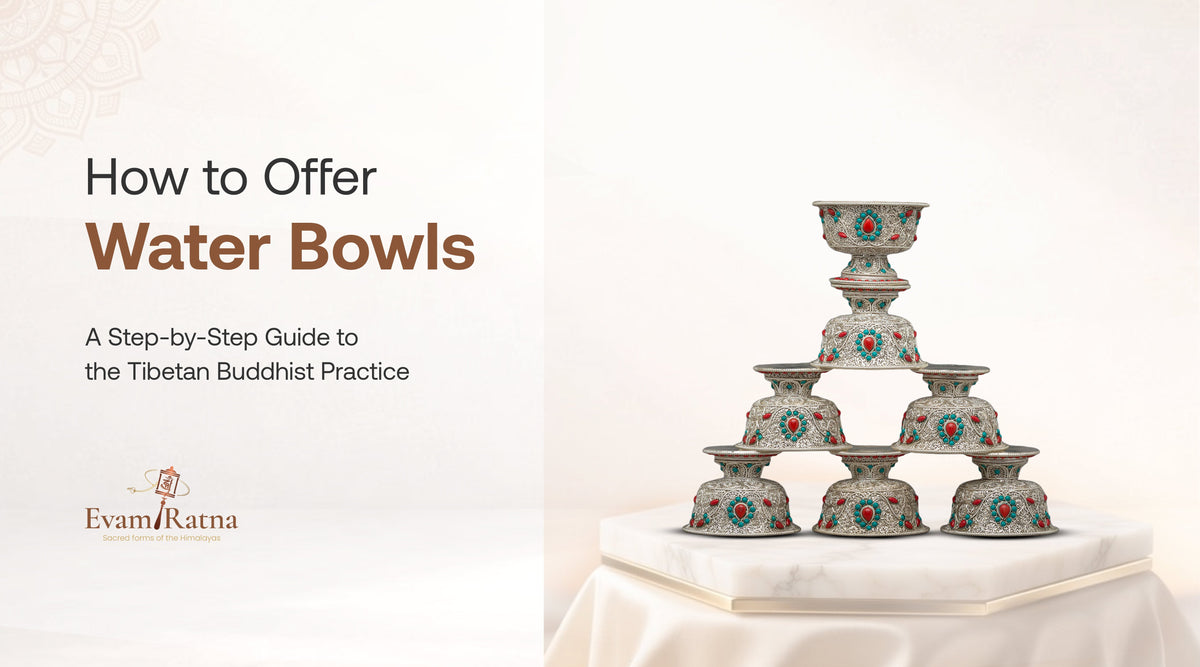
The Seven Water Bowl Offering: Meaning, Mantras, and How to Perform It
If you've ever wondered how to offer water bowls on a Buddhist altar, you're taking up one of the oldest and most accessible rituals in Himalayan Buddhism. Practiced daily across Tibetan Buddhist households and monasteries: a row of small bowls, gleaming with fresh water, set just below the images of the Buddha. This is the water bowl offering, one of the oldest, humblest, and most widely practiced rituals in the Himalayan Buddhist tradition. It requires no expensive ingredients, no elaborate preparation, and no special initiation. All it asks for is water, a little time, and a sincere heart.
For those newer to the practice, the steps can feel unfamiliar at first, which bowl gets filled first, how much water to use, what to recite. This guide walks through the meaning of the offering, how to gather what you need, and the traditional sequence for offering and later removing the bowls.
What Are Water Bowl Offerings?

In Tibetan, the water offering bowls are called ting or yonchab, and the practice of offering water in this way is one of the most common daily rituals on a Himalayan Buddhist altar. Most practitioners use seven bowls, though eight is also traditional in some lineages.
The seven bowls are generally understood to correspond to the seven-limbed practice at the heart of Mahayana devotion: prostrating, making offerings, confessing wrongdoing, rejoicing in the goodness of oneself and others, requesting the buddhas to continue teaching, beseeching them to remain in the world, and dedicating the merit generated to all beings. Each bowl, in other words, is a physical stand-in for an inner gesture of the mind.
Water was chosen as the offering substance for a very practical reason. In Tibet, unlike gold, silk, or rare incense, water was something almost everyone could access freely. Offering something so ordinary, but offering it with full attention and an open hand, became a way of practicing generosity without the obstacle of scarcity. The teaching behind it is simple: if you can learn to give freely with something as common as water, you loosen the grip of attachment and stinginess a little further each day.
Why Seven Bowls? The Meaning Behind the Number
Teachers across multiple lineages explain that the seven bowls correspond to the seven-limb prayer (Skt. saptanga-puja), a structure found at the opening of countless Mahayana and Vajrayana practice texts. The late Tibetan master Serkong Tsenshab Rinpoche taught that offering seven water bowls creates the cause for eventually achieving the seven enlightened qualities associated with the state of a fully awakened being, and that offering more bowls, or offering with greater elaboration, is never a hindrance to this aim.
The seven limbs are usually explained as follows:
- Prostration: Paying respect with body, speech, and mind to the Buddha, Dharma, and Sangha, as an antidote to pride.
- Making offering: Both physical offerings placed on the altar (water, light, flowers, food) and offerings imagined in the mind, filling the whole of space with beautiful things. Teachers such as Venerable Thubten Chodron explain that this limb is the direct antidote to miserliness, since the act of offering trains us to take delight in giving rather than holding on.
- Confession: Acknowledging negative actions accumulated over countless lifetimes, regretting them, resolving not to repeat them, and restoring damaged relationships, whether with holy beings or with ordinary people we have wronged.
- Rejoicing: Taking joy in our own virtuous actions and in the virtuous actions of others, including the achievements of buddhas and bodhisattvas, as a way of multiplying merit without effort or expense.
- Requesting the buddhas to turn the wheel of Dharma: Asking enlightened teachers to continue giving teachings, which keeps the path to liberation alive in the world.
- Beseeching the buddhas to remain: Requesting that realized teachers not pass into final nirvana but continue to remain accessible to beings who still need guidance.
- Dedication: Offering up whatever merit has been generated through the previous six limbs for the benefit and eventual enlightenment of all sentient beings, rather than keeping it for oneself alone.
Each of the seven water bowls, then, is a physical stand-in for one of these seven inner gestures. Filling and offering the bowls is less about the water itself and more about rehearsing, in miniature, an entire structure of ethical and spiritual cultivation, purifying negative tendencies on one hand, and building up positive potential on the other.
What You Need to Gather
Before setting up the offering, gather the following:
- A set of offering bowls: traditionally seven, made of brass, copper, bronze, or silver. Handcrafted repoussé bowls, like those still made by Newar artisans in Patan, are especially treasured for the fine auspicious symbols worked into their surfaces.
- Clean water: any fresh drinking water is suitable.
- A soft, clean cloth, for wiping each bowl before use.
- A small pitcher or jug, for pouring water in a controlled stream.
- A clean, elevated space on your altar, just below your Buddha images or other representations of the Three Jewels.
- Nothing here needs to be costly. What matters far more than the material value of the bowls is the clarity of intention behind the offering.
How to Offer Water Bowls: Step by Step

1. Clean the bowls
Begin by wiping each bowl with your cloth. As you do, it is traditional to reflect that you are symbolically clearing away the mental obscurations of yourself and of all beings, using the cleaning itself as a small meditation.
2. Never place an empty bowl on the altar
Once clean, the bowls are stacked and held in one hand, ready to be filled. An empty bowl is never set upright on the altar, the same way you would not invite a guest into your home and offer them nothing. A small amount of water goes into each bowl before it takes its place.
3. Fill and place the bowls in sequence
Pour a little water into the first bowl, then tip most of that water into the second bowl, leaving only a trace in the first. Set the first bowl down on the altar. Repeat with the second bowl into the third, and so on, moving from left to right as you face the shrine, spacing each bowl roughly a grain's width from the next.
4. Fill each bowl to the brim
Once all the bowls are in place with a little water in each, return to the first bowl and fill it nearly to the top, traditionally leaving a hair's width of space below the rim, rather than overflowing. Fill the remaining bowls the same way, one after another.
5. Recite the consecration mantra
While filling the bowls, many practitioners recite Om Ah Hum, a short mantra representing the enlightened body, speech, and mind of the Buddha, to bless the offering. Others recite mantras connected to a particular deity, such as Avalokiteshvara's Om Mani Padme Hum or Tara's Om Tare Tuttare Ture Soha, or simply a prayer of their own choosing.
6. Hold the visualization
As you fill each bowl, visualize that the water is transforming into vast, luminous offerings, oceans of pure nectar, filling the whole of space, presented to every buddha and bodhisattva. Imagine that they receive this offering joyfully, and that the generosity in your own heart grows a little more spacious with every bowl you fill.
7. Dedicate the merit
After the bowls are arranged and filled, take a moment to dedicate whatever goodness has come from the practice, not to yourself alone, but to the benefit of all sentient beings, wishing them freedom from suffering and its causes.
Removing the Offering
Water bowl offerings are traditionally removed before sunset, in Tibet this is often done in the early afternoon, though it can be done at any point before dark. Empty the bowls one at a time, this time working from right to left, drying each one with a clean cloth as you go. Once emptied, the bowls are stacked upside down again, ready for the next day. Where possible, the used water is given to plants rather than poured somewhere it might be stepped on or treated carelessly, since it has been offered to the Three Jewels and is regarded with a degree of respect even after the ritual is complete.
A Few Common Mistakes to Avoid

- Placing an empty bowl on the altar, even briefly. As described above, this is considered inauspicious and is one of the most frequently corrected errors among beginners.
- Filling bowls to the very brim, or overflowing them. Traditional instruction leaves a small margin of space at the rim of each bowl.
- Letting the bowls touch one another. They should sit close together but with a small, visible gap between each one.
- Rushing through the mantra recitation without any accompanying visualization, which teachers describe as reducing the practice to a mechanical task rather than a genuine offering.
- Neglecting to dedicate the merit at the end. This final step is considered an essential part of the seven-limb structure, not an optional add-on.
Conclusion: A Living, Daily Practice
Traditionally, water bowls are offered fresh every morning, though the guidance most teachers give beginners is simply: do it as often as you sincerely can. The ritual is forgiving of imperfect technique. What it asks for consistently is presence, cleaning the bowls, filling them with attention, and letting the small physical act train a bigger, more generous state of mind. It is common to place a butter lamp between the third and fourth bowls, or the fourth and fifth, so that the light of wisdom sits alongside the water of generosity, two of the most accessible offerings in the entire tradition, side by side on the same altar.
When you are ready to bring water bowl offerings into your own practice, the bowls themselves matter less than the sincerity behind them, but a well-made set, cared for over years of daily use, becomes a small, quiet companion to the practice itself. Many practitioners choose hand-repoussé bowls from Himalayan artisan lineages for exactly this reason: each one carries the same attention to detail as the ritual it is made to serve.