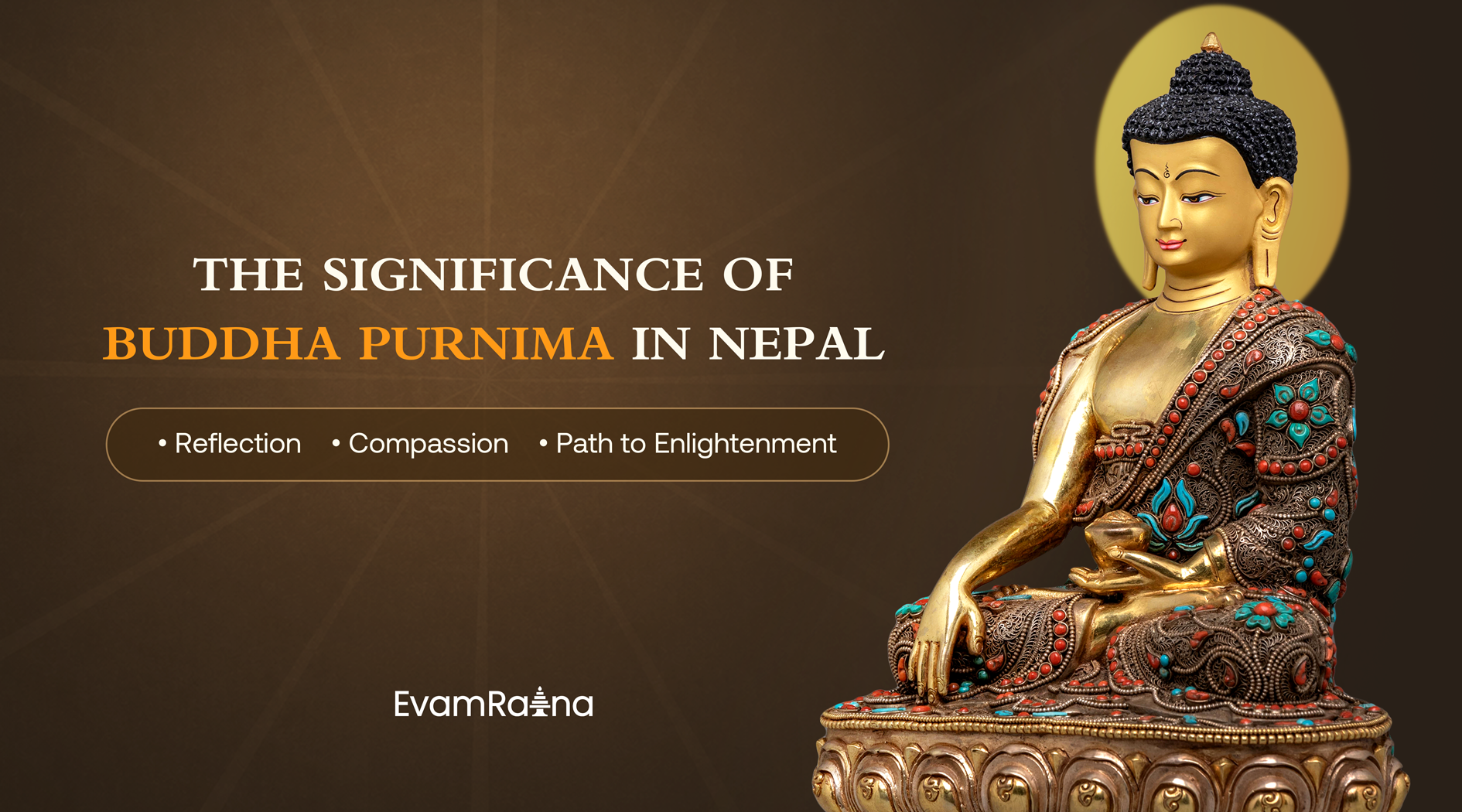
Buddha Jayanti 2026 in Nepal: Date, Celebrations, and Sacred Sites
Buddha Purnima, also known as Buddha Jayanti, is celebrated on the full moon day (Purnima) in April or May as the thrice-blessed day, as all the important events in the life of Lord Buddha, his birth in Lumbini, his attainment of Enlightenment in Buddhagaya, and his entering into Mahaparinirvana in Kusinagar, took place on this eventful day. It is the most Auspicious day for Buddhists. It is a very significant day
Known variously as Buddha Jayanti, Vesak, Baishakh Purnima, and Swanya Punhi among the Newar people, this sacred full moon day in the month of Baisakh is observed by millions across Nepal, Asia, and the world. It is a national moment of stillness, a day when Nepal, the very birthplace of the Enlightened One, pauses to remember the life, wisdom, and compassion of Gautam Buddha.
When is Buddha Purnima Celebrated in Nepal?
Buddha Purnima is celebrated on the full moon day (Purnima) of the Nepali month of Baisakh, which typically falls in late April or May according to the Gregorian calendar. Because the lunar calendar determines the date, it shifts each year slightly.
In 2026, Buddha Purnima in Nepal falls on Friday, 1 May 2026, corresponding to Baisakh 18, 2083 in the Bikram Sambat (BS) calendar. The Purnima tithi begins at 9:12 PM on April 30, 2026, and ends at 10:52 PM on May 1, 2026.
The government of Nepal recognises Buddha Purnima as a national public holiday. Across the country, from Kathmandu's ancient stupas to the sacred garden of Lumbini, temples, monasteries, and streets are filled with devotees dressed in traditional dresses, bearing offerings of flowers, incense, and sweet kheer. In recent years, the dates have been: May 23 in 2024 and May 12 in 2025, reflecting the shifting nature of the lunar cycle.
Nepal Holds a Special Place in Buddhist History

(Swambhunath, Lumbini and Boudhanath)
Nepal has the honour of celebrating Buddha Purnima, as Lumbini, in the Terai plains of southern Nepal, is the confirmed birthplace of Siddhartha Gautama, the prince who would become the Buddha. This makes Nepal the physical origin point of one of the world's great spiritual traditions, followed today by an estimated 500 million people.
Among the Newar people of Nepal, particularly the Shakya clan, to whom the Buddha's own family belonged, the day carries a uniquely personal resonance. They celebrate it as Swanya Punhi, the "full moon day of flowers," considering it a continuation of the living legacy of the Sakyas. Both Buddhists and Hindus participate in the celebrations, reflecting Nepal's deep tradition of religious harmony.
Archaeologists from Durham University, working in Nepal in 2022, uncovered evidence of a structure at Lumbini dating to the sixth century BCE, further reinforcing Nepal's role at the very inception of Buddhist history. The UNESCO-listed site today features the Maya Devi Temple, a sacred garden, ancient ruins, the Ashokan Pillar from 249 BCE, and monasteries representing dozens of Buddhist nations from around the globe.
The Triple Significance: Birth, Enlightenment, and Mahaparinirvana
What makes Buddha Purnima uniquely sacred and distinct from most religious birthdays is that it is believed to mark three transformative events in the life of Gautam Buddha, each occurring on the same full moon day of Baisakh in different years of his life.
Birth at Lumbini:

Siddhartha Gautama, who would become the Buddha, was born around 623 BCE in Lumbini, Nepal. He was born into the royal Shakya clan, son of King Suddhodana. His birth, assisted by Queen Maya Devi while she held a sal tree branch, was surrounded by auspicious signs, including a divine dream of a radiant white elephant. The sage Asita said that the child she carried would become either a great king or a supreme spiritual teacher. To ensure Siddhartha's future as a king, his father kept him sheltered from all suffering, aging, and death, allowing him to grow up in a life of grandeur, comfort, and pleasure within the palace walls.
This UNESCO World Heritage Site, located in the Rupandehi District, attracts thousands of visitors annually. The Maya Devi Temple, dedicated to Buddha's mother, marks the birth spot and serves as the centerpiece for the celebrations, despite past earthquake damage. The Ashokan Pillar, dating back to 249 BCE, stands as a historical testament to Buddha's birth and the enduring legacy of Buddhism.
Enlightenment at Bodh Gaya

Yet no palace wall could indefinitely hold back the truth of human existence. Siddhartha, upon venturing beyond the palace gates, encountered the Four Sights: an old man, a diseased person, a corpse, and a serene ascetic. These experiences shattered his sheltered life. At 29, in a profound act known as the Great Renunciation, he left his palace, devoted wife Yashodhara, infant son Rahula, and royal life to become a wandering seeker. Over the years, he studied under prominent spiritual teachers and engaged in extreme asceticism, ultimately discovering that neither indulgence nor self-mortification provided answers. This led him to the Middle Path, a balanced approach to living and meditating. At 35, through years of asceticism and deep meditation, Siddhartha attained full enlightenment beneath the Bodhi Tree in Bodh Gaya, India, becoming the Buddha, the Awakened One.
Mahaparinirvana at Kushinagar
Siddhartha, sitting under a Bodhi tree in Bodh Gaya, India, engaged in profound meditation and vowed to remain until he discovered the truth. On a full moon night, he achieved enlightenment, becoming the Buddha, the Awakened One. This moment granted him insight into the Four Noble Truths: the existence of suffering, its origin in craving and attachment, the possibility of its cessation, and the Eightfold Path leading to liberation through ethical conduct, mental discipline, and wisdom. For 45 years, the Buddha traveled throughout northern India, teaching with compassion to diverse audiences, including kings, merchants, and monks, irrespective of social class. His teachings, known as the Dharma, became a cornerstone of a significant spiritual tradition across Asia. At the age of 80, he reached Mahaparinirvana in Kushinagar, marking his final release from the cycle of rebirth.
Read More About Shakyamuni Buddha, The Founder of Buddhism: A Beginner’s Guide to the Buddha’s Life Story
The Swan and the Prince: A Tale of Compassion on the occasion of Buddha Jayanti

Once, in the royal gardens of Kapilavastu, young Prince Siddhartha was walking quietly among the flowering trees when he heard a sharp, painful cry pierce the morning air.
He looked up.
A white swan was falling from the sky, an arrow lodged in its wing, its graceful body tumbling toward the earth. He rushes to catch the bird to prevent its fall, carefully removes the arrow, cleans its injury with water from a nearby stream, and comforts the trembling creature by holding it close and whispering soothing words until it calms down.
Moments later, his cousin Devadatta came storming through the garden, bow in hand, eyes bright with the pride of a successful shot.
"Give me the swan," Devadatta demanded. "I shot it. It belongs to me."
Siddhartha looked at his cousin calmly and shook his head.
"A life belongs to the one who saves it," he said quietly, "not to the one who tries to take it."
Devadatta took his dispute to the royal court, where wise ministers debated the matter. Ultimately, the eldest respected minister delivered the final verdict.
"A life must belong to the giver of life, not the taker. The swan lives because of the Prince. The swan belongs to the Prince."
Siddhartha smiled with relief as he cared for an injured swan, nursing it back to health. Once its wing healed and feathers gleamed, he released it into the sky, watching it vanish yet still feeling its presence.
This simple tale from Siddhartha's childhood holds the seed of everything the Buddha would one day teach the world:
That true ownership of anything comes not from the power to take, but from the willingness to care, to heal, and ultimately, to let go. On Buddha Jayanti, we remember that even before Siddhartha became the Buddha, before the Bodhi tree, before the Dharma, before the long years of wandering, there was already, in the heart of a young prince, a boy who ran forward to catch a falling bird.
That instinct: to protect, to heal, to love, was always the beginning.
"Compassion is not a relationship between the healer and the wounded. It is a relationship between equals."
- Buddhist Teaching
Read More About Siddhartha and the Wounded Swan: A Lesson in Compassion
How is Buddha Purnima observed across Nepal?
Across Nepal, the day begins in the early morning hours, well before dawn. Devotees bathe, wear traditional clothes such as bakhu, etc, and make their way to local monasteries, viharas, and stupas. The atmosphere is one of gentle, collective spiritual seriousness, serene and contemplative.
Key observances across the country include:
Butter Lamp Offerings (Dipdan):

Click Here to View Our Collection of Butter Lamps for Your Altar
Thousands of butter lamps are lit at stupas and monastery courtyards, from Lumbini to Boudhanath, symbolising the light of the Dharma dispelling the darkness of ignorance.
Flower & Incense Offerings
Devotees carry flowers, incense sticks, and fruits to offer at shrines and Bodhi trees as gestures of reverence, purity, and gratitude for the Buddha's teachings.
Kheer: The Sacred Sweet Rice Pudding
Kheer (sweet rice cooked in milk) is prepared in homes and offered at monasteries, evoking the story of Sujata, who offered the weakened Siddhartha a bowl of milk porridge just before his enlightenment.
Scripture Readings & Dharma Talks
Monks lead full recitations of the Dhammapada and other sutras, while Dharma talks bring the Buddha's teachings on compassion, impermanence, and the Middle Path to laypeople.
Dana: The Practice of Generous Giving
Food, clothes, and essentials are distributed to the poor, sick, and homeless. Blood donation camps are organised at major stupas. In some communities, caged animals and birds are released as a direct expression of ahimsa (non-violence).
Kora: Sacred Circumambulation
Devotees walk clockwise around stupas such as Boudhanath in a practice called Kora, spinning prayer wheels and chanting mantras as an act of devotion and accumulation of merit.
In the Himalayan regions, including Mustang, Manang, Namche Bazaar, and the Khumbu Valley, communities deeply shaped by Tibetan Buddhism celebrate with prayers, butter sculpture offerings (torma), and communal teachings that reflect a way of life built entirely around Buddhist philosophy.
Celebrations at Boudhanath and Swayambhunath Stupa

For those in the Kathmandu Valley, Buddha Purnima converges at two of the most magnificent Buddhist monuments in the world: Boudhanath Stupa and Swayambhunath Stupa. Both are UNESCO World Heritage Sites, and both have extraordinary energy on this sacred day.
Boudhanath Stupa
One of the largest stupas in the world, Boudhanath, is the spiritual heart of Tibetan Buddhism in Nepal. On Buddha Purnima, its circumambulation path fills with thousands of devotees performing Kora, spinning prayer wheels, chanting "Om Mani Padme Hum," and lighting butter lamps that ring its massive dome. Blood donation drives, Dharma talks, and relic displays are also held here throughout the day.
Swayambhunath Stupa
Perched on a hilltop west of Kathmandu, Swayambhunath, the "Monkey Temple," is considered one of the holiest sites in Nepal for both Buddhists and Hindus. Its all-seeing eyes of the Buddha gaze across the valley as devotees climb its 365 steps to offer prayers, flowers, and butter lamps on this most sacred of days.
Prayers, Offerings, and Meditation at Monasteries
The soul of Buddha Purnima in Nepal is found in the quiet practice of communal prayer and meditation. Monastery courtyards fill before dawn, the air heavy with incense and the low resonance of chanted sutras.
Monks in their saffron and ochre robes conduct long readings of the Dhammapada and other Buddhist texts, not as performances for visitors but as acts of genuine communal practice passed down through generations. The monastery halls embody the principles of Buddhism, characterized by stillness, intentionality, and compassion.
Laypeople contribute offerings such as flowers, fruits, incense, oil for lamps, and Kheer, which are placed with respect before Buddha images. Many individuals adopt the Panchasheel, committing to uphold the Five Precepts of Buddhist ethics, including abstaining from taking life, stealing, sexual misconduct, false speech, and intoxicants.
The observance of Buddha Purnima serves as a day to renew moral commitment. During the month of Baisakh, practitioners traditionally avoid non-vegetarian food, culminating in peak observance on the full moon day, where vegetarian meals are prepared and shared, reflecting the principle of ahimsa in daily life.
Practicing Mindfulness and Meditation on Buddha Jayanti

At its core, Buddha Purnima is an invitation to embrace the path that Siddhartha Gautama, the Buddha, traversed, beginning with an introspective journey of the mind. The Buddha's fundamental insight emphasizes that human suffering stems from cravings, aversions, and delusions. He suggests that true liberation can be achieved through a mindful, present-focused awareness. On this significant day, meditation takes precedence as a form of observance. Throughout Nepal, in monasteries, yoga centers, and homes, individuals dedicate time to meditation, often for several hours, delving deep into the nature of their minds with the same inquisitiveness and bravery exemplified by Siddhartha during his enlightenment under the Bodhi Tree.
"Peace comes from within. Do not seek it outside."
- Gautama Buddha
On Buddha Purnima, this teaching is not merely quoted. It is practised, in breath, in silence, in the willingness to sit with what arises and let it pass.
The Eightfold Path: Right Understanding, Right Intention, Right Speech, Right Action, Right Livelihood, Right Effort, Right Mindfulness, and Right Concentration, provides a complete framework for ethical and contemplative living. On Buddha Jayanti, practitioners across Nepal recommit to this path as a lived daily practice.
The United Nations globally recognizes Vesak Day, emphasizing the Buddha's teachings on inner peace, compassion, and non-violence as crucial to addressing modern challenges such as conflict, inequality, mental health issues, and environmental sustainability. In 2026, the festival is anticipated to focus on mindfulness and compassion as essential tools for navigating a rapidly changing and often turbulent world.
Conclusion:
Buddha Jayanti, or Buddha Purnima, is a deeply sacred occasion celebrated across Nepal and beyond, marking the birth, enlightenment, and Mahaparinirvana of Siddhartha Gautama, the Buddha. This full moon day in the month of Baisakh serves as a reminder of the Buddha’s timeless wisdom, compassion, and the profound teachings of the Dharma. In 2026, Nepal will honor this day with a variety of rituals, including offerings, prayers, and meditation. Celebrating Buddha Jayanti by remembering the life of the Buddha and also engaging in practices that promote peace, mindfulness, and spiritual awakening. As millions gather at sacred sites like Lumbini, Boudhanath, and Swayambhunath, the collective devotion reflects the ongoing relevance of the Buddha’s teachings in fostering compassion, inner peace, and non-violence in today's world.