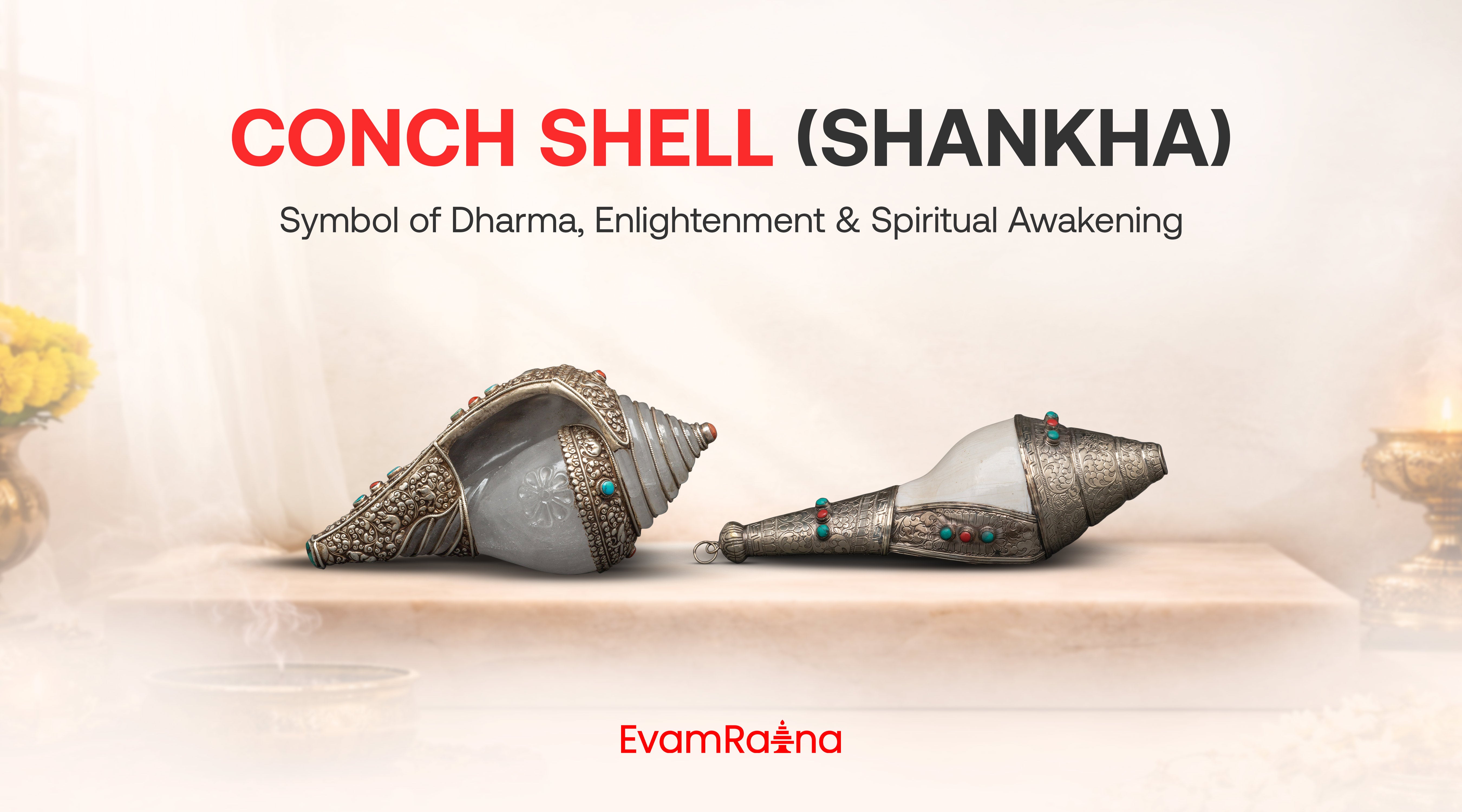
The Sound of Spirituality Conch Shell: History, Ritual Use & Spiritual Significance
In Sanskrit, the conch shell is called "shankha." It is a ritual tool that is very important in both Buddhism and Hinduism. The conch is a powerful symbol of the Buddha's teachings, which are shown in rituals. It is a ritual tool used in ancient Buddhism, such as the Pali Canon and Mahayana Sutras. The sound of it travels a long way, and its resonance represents the Dharma's great distance and permanence, as well as the spread of knowledge and light to all living things around the world. This sacred symbol encapsulates the expansive nature of Buddhist teachings, echoing across time and space, touching hearts and minds wherever they may be.
Introduction to Conch Shell:

Conch Shell, known as Shankha in Sanskrit, is composed of two syllables: 'Sha,' meaning auspicious, and 'Kham,' meaning water. Together, they describe the conch as a shell holding sacred water, an object that unites the purity of the ocean with the auspiciousness of the divine. In Buddhism, the conch shell is a living symbol of the voice of the Buddha, the spread of the Dharma, and the awakening of every sentient being from the deep sleep of ignorance.
Biologically, the Shankha is the shell of Turbinella pyrum, a large sea snail found in the Indian Ocean. What makes it spiritually extraordinary is its form: a natural spiral that winds from a broad, open mouth to a delicate, pointed spire. This spiral, found throughout nature, in galaxies, in DNA, in sunflowers, is the same pattern ancient sages recognised as the geometry of creation itself.
In Buddhist texts, the conch shell is first referenced in the Pali Canon. It appears throughout the Mahayana Sutras, where it serves both as a ceremonial instrument and a rich metaphor for the reach and depth of the Buddha's teachings.
"Just as the sound of the conch travels far and wide, so too does the wisdom of the Buddha reach every corner of the world."
Historical and Cultural Significance of the Conch Shell
The conch has served as the original horn trumpet since ancient times, long before its adoption into Buddhist ritual. In ancient India, the conch was blown like a battle horn, much like a bugle, with each hero carrying their own unique shell. In Buddhist culture, specifically within the Tibetan tradition, the conch was absorbed as a symbol of power and authority. While naturally obtained from the Indian Ocean, ancient shells are also frequently unearthed in the Himalayan region and the Tibetan plateau, which was once an ancient ocean floor. Today, these shells are often highly ornamented with gold, silver, or copper casings embellished with auspicious designs for use as ritual musical instruments.
The Conch Shell as a Symbol of Dharma

In Buddhism, Dharma refers to the teachings of the Buddha, the truth about the nature of suffering, the path to liberation, and the interdependence of all life. The Shankha is, above all else, a symbol of Dharma in its most expansive sense.
When a monk raises a conch shell and blows, the sound that emerges is non-directional. It spreads all around and everywhere at the same time, near and far, without any selectivity. This quality made the conch a perfect metaphor for how the Buddha's teachings were understood to work: not limited to one people, one place, or one era, but spreading in all directions, equally for all beings.
Ancient Buddhist scriptures describe the proclamation of the Dharma as a 'lion's roar', fearless, commanding, and undeniable. The blowing of the conch shell embodies this same fearless proclamation. It announces: the truth has arrived. The path is open. All who hear are invited to awaken.
The Sacred Right-Turning White Conch

Not all conch shells are equal in Buddhist tradition. The rarest and most sacred is the Dakshinavarti Shankha, the right-turning, or clockwise-spiralling, white conch. In nature, the vast majority of conch shells spiral counterclockwise. A right-turning conch occurs in perhaps one in a million shells, which is precisely why it is considered so extraordinary.
In Tibetan Buddhism, this rare shell is called Dung Dkar, and its clockwise spiral mirrors the auspicious clockwise direction in which monks circumambulate stupas, in which prayer wheels are turned, and in which sacred mandalas are drawn. The right-turning spiral is associated with positive energy, divine grace, and the very motion of the cosmos as perceived in Buddhist cosmology.
The white conch in particular symbolises purity, the purity of the Buddha's intention, the purity of the Dharma, and the purity that practitioners aspire to cultivate within themselves. Its brilliant whiteness, contrasted against the richly coloured world, speaks to the clarity of an enlightened mind.
The Shankha in the Eight Auspicious Symbols (Ashtamangala)

The Shankha is one of the Ashtamangala, the Eight Auspicious Symbols of Buddhism. These eight symbols, which also include the lotus, the dharma wheel, the endless knot, the victory banner, the treasure vase, the parasol, and the golden fish, together represent the completeness of the Buddha's enlightened qualities and his path to liberation.
Within this sacred group, the conch shell holds the specific role of representing spiritual authority, the power of truthful speech, and the omnidirectional spread of the Dharma. Where the dharma wheel represents the turning of the teachings, the conch represents the sound of those teachings, the actual moment when wisdom enters the world and touches the ears, the mind, and the heart of the listener.
Notably, the conch shell also appears on the body of the Buddha himself. The three conch-like rings on the Buddha's throat are an auspicious mark symbolising his deep, resonant, and irresistibly beautiful voice, a voice through which perfect truth was spoken.
Spiritual Awakening: The Call from Ignorance to Wisdom
Perhaps the most profound role of the Shankha in Buddhist thought is as the instrument of spiritual awakening. In Buddhist cosmology, ignorance is the root cause of all suffering. We are described as beings asleep, dreaming in a world of delusion, attachment, and craving, unaware of our own buddha-nature.
The sound of the conch shell is the wake-up call. When it is blown at the start of a ritual, a teaching, or a ceremony, its intention is not merely to mark time; it is to pierce through the veil of ordinary mind and remind all who hear it that they are capable of awakening. The deep, penetrating tone of the conch is described in texts as cutting through ignorance as a sword cuts through fog, leaving clarity in its wake.
"The sacred white conch shell awakens disciples from the deep slumber of ignorance and urges them to accomplish their own welfare and the welfare of others."
This is why, in monasteries across Nepal, Tibet, Sri Lanka, and beyond, the conch is blown not just as a ritual but as a daily reminder to practitioners: the opportunity to wake up is always now.
The Conch Shell Across Buddhist Traditions
While the Shankha is universally revered across Buddhist traditions, its specific use and symbolism vary beautifully between schools.
In Theravada Buddhism, practiced widely in Sri Lanka, Thailand, and Myanmar, the conch shell is commonly kept in temples and used during processions and major ceremonial events. Its use is relatively restrained and dignified, emphasising the solemnity of the Buddhist precepts.
In Mahayana Buddhism, particularly in Nepal, China, and Japan, the conch shell frequently appears in religious art, painted in the hands of bodhisattvas and carved alongside other Dharma symbols on temple walls. In these traditions, the conch is often associated with the compassionate dimension of the Buddha's teachings, extending wisdom and kindness to all sentient beings.
In Vajrayana Buddhism, the conch takes on its most elaborate ritual role. Known as Dung Kar, it is used alongside bells, drums, and horns in complex ceremonial music, and it serves as a vessel for sacred liquids used in initiations and offerings. Tibetan conch shells are often adorned with ornate metal casings of copper, silver, or gold, engraved with auspicious symbols.
Ritual Uses of the Buddhist Conch Shell

The Buddhist Shankha is an active ritual tool with a range of specific, purposeful applications across different Buddhist traditions.
- As a Trumpet and Call to Assembly: The most familiar use of the conch shell is as a trumpet. Blown at the start of ceremonies, teachings, and monastic assemblies, its sound serves as an auditory gateway, marking the transition from ordinary time into sacred time. In Tibetan monasteries, the conch announces the beginning of morning prayers and calls monks to gather, functioning as both alarm clock and spiritual compass.
-
As a Purification Instrument: The deep, penetrating vibrations of the conch are believed to cleanse the environment of negative energies and harmful influences. This is why it is blown before rituals, preparing the space and the practitioners for what is to come.
-
As an Offering Vessel: Horizontal conch shells, placed on their sides, serve as sacred vessels in Tibetan ritual. They are filled with precious liquids, saffron water, sandalwood essence, musk, camphor, or consecrated water, and presented as offerings on altars during puja ceremonies and initiations. This dual function of the conch, as both sound instrument and liquid vessel, reflects its deep connection to both air and water, sound and purity.
-
Abhishekam and Blessings: In both Hindu and Buddhist traditions, water poured through a conch shell is considered especially sanctified. Priests and lamas use the conch to sprinkle holy water over devotees as a form of blessing, the shell amplifying the spiritual potency of the liquid that passes through it.
Why the Conch is Blown at New Beginnings?
The act of blowing the conch at the start of rituals and it is deeply symbolic and serves several spiritual purposes:
-
Invoking Blessings: The sound is believed to attract the attention of the divine and invoke blessings upon a new undertaking or a higher state of awareness.
-
Purification and Protection: The sound that it produces banishes evil spirits, averts natural disasters, and cleanses a space of negativity, creating an auspicious environment for a new start.
-
Awakening and Focus: The powerful resonance is intended to awaken the awareness of practitioners, helping them focus their intentions and ground their energies with clarity.
- Calling the Assembly: In a practical sense, it is beneficial to call monks and devotees together for religious assemblies and rituals.
Conclusion:
The conch shell, or Shankha, is a ritual object with a profound symbol of awakening, purification, and the expansive reach of the Buddha’s teachings. Across various Buddhist traditions, it represents the voice of the Buddha, spreading wisdom and light far and wide, guiding beings towards enlightenment. Whether used as a ceremonial instrument or a sacred vessel for offerings, the conch continues to play a vital role in connecting the spiritual world with the material world. Its deep, resonant sound serves as a constant reminder to practitioners: the opportunity to awaken is always now.