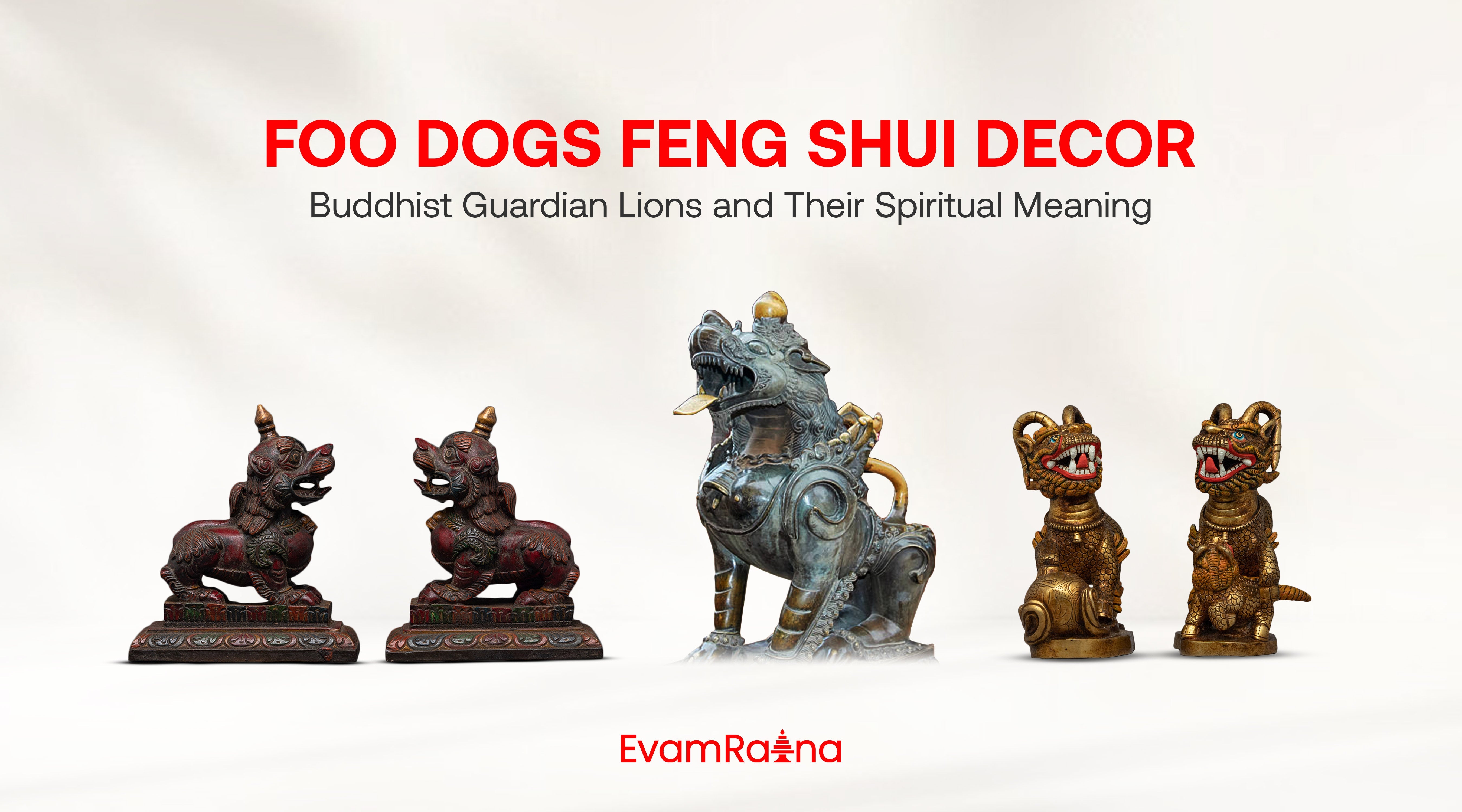
Foo Dogs in Buddhism: History, Symbolism & Spiritual Power of Guardian Lions
A Foo Dog is a Western mispronunciation and misidentification that stuck over centuries of trade and cultural exchange. They are not actually a dog. In truth, Foo Dogs are stylized depictions of lions, mythical, idealized, and deeply spiritual in nature. In Chinese, they are called Shishi (Stone Lions) or sometimes Rui Shi (Auspicious Lions). They appear in pairs: one male, one female, always seen in an entrance, always facing outward, always displayed as a guard.
Their muscular bodies, their curly manes, their wide open mouths, their alert postures are not the characteristics of any real animal. These are characteristics of a guardian, a mythical beast powerful enough to ward off evil, and noble enough to represent the protection of sacred space.
Foo Dogs, Fu Dogs or Shishi: Understanding the Names

The broad scope of their cultural impact is shown in the many names given to these guardians. “Foo Dog” and “Fu Dog” are phonetic interpretations of the Chinese word “Fu,” which means good fortune or Buddha. In Japanese and formal Chinese, the term is "Shishi." In Korea, they are known as Haetae or Haitai. Snow Lions are versions of the guardian lion in Tibet. Each tradition adapted the figure while preserving its essential protective function.
Why Foo Dogs Are Called "Dogs" When They Depict Lions
The lion was not native to China, and Chinese artists who created early Shishi statues worked from descriptions, small tribute gifts, and artistic imagination rather than direct observation. The resulting creatures looked, to Western eyes, more like large dogs than lions, leading traders and travelers to call them "lion dogs" or simply "Foo Dogs." The name persisted even as the true nature of these sculptures as stylized lions became widely understood.
The Ancient Origins of Foo Dogs: Han Dynasty and the Silk Road

(Image from East Asia Cultures)
The story of Foo Dogs begins in the Han Dynasty (206 BCE – 220 CE), a period of remarkable Chinese expansion, trade, and cultural exchange. Real lions arrived in the imperial capital for the first time in China’s history, not as wild beasts but as extraordinary diplomatic gifts. In recognition of the symbolic significance of presenting such a rare and awe-inspiring creature, rulers from Central Asia, Persia, and the distant western reaches of the Silk Road sent lions as tribute to the Chinese emperor.
In a civilization which had never seen a lion, the beast was immediately mythologized. Almost at once its power, mane, and commanding presence were absorbed into the Chinese spiritual and artistic consciousness. These lions left such strong impressions that they were transformed through art and Buddhist influence into protective statues known as Shi Shi or stone lions. They were placed before doors or palaces and temples.
The Role of Buddhist Missionaries in Transforming Lions into Spiritual Statues
The lion was already a sacred symbol in Indian Buddhism, where the Buddha himself was known as the Lion of the Shakya clan, and his teachings were called the “Lion’s Roar” (Simhanada), a proclamation of truth that could silence all opposition.
As Buddhism took root in China, the lion absorbed this spiritual significance and merged with the already-developing Chinese tradition of guardian lion statues. And the Foo Dog was born, a creature that is a cultural symbol, a Buddhist emblem, and a guardian of sacred space all at once.
From Real Lions to Mythical Guardians: The Artistic Evolution
Over the centuries of the Han, Tang, and Song dynasties, the artistic representation of guardian lions evolved considerably. The early figures were relatively naturalistic. Later models became more and more stylized, with elaborate curly manes, exaggerated musculature, ornamental collars and bells, and the distinctive facial expression combining ferocity with dignity. When these statues travelled across East Asia, they had become something uniquely Chinese; powerful, beautiful, and profoundly spiritual.
Sacred Spiritual Purpose of Foo Dogs in Buddhism

The Guardian Lion as a Sacred Symbol
The lion has an important role in Buddhist scriptures and art. The Buddha, Siddhartha Gautama, was born in the Shakya family, the symbol of which was the lion. In every Buddhist art tradition, the Buddha's seat of enlightenment, or lion throne, is represented. The lion symbolises fearlessness, sovereignty, and awakened wisdom. The practice of having lion-guardian statues to shield the Buddhist temples was not only a practical matter, but also had a theological significance in this context.
The Spiritual Role of Shi Shi (Stone Lions) in Buddhist Temples
Shishi statues are literal and symbolic gatekeepers in Buddhist temples throughout China, Japan, Korea, and Southeast Asia. They are located at entrances, along stairways, and as a way to signal a change from the mundane world to the spiritual world. Their outward-facing posture suggests their awareness: They are always alert to what is going on outside the temple, watching for anything that might disrupt the peace within.
In some Buddhist traditions, the Foo Dog is understood to embody the fierce compassion of the Dharma protectors, beings who, out of love for all sentient creatures, stand guard against the forces of ignorance and harm.
Protectors Against Evil Spirits and Negative Influences
Foo Dog statues were originally and primarily made for protection. Placed at the entrances of temples, palaces, and government buildings, they were believed to ward off evil spirits, malicious energies, and negative influences before they could cross the threshold. This protective function was taken seriously; the placement, orientation, and pairing of the statues all followed specific spiritual guidelines designed to maximize their effectiveness as guardians.
The Connection Between Foo Dogs and Buddhist Dharma
In many Buddhist teachings, the lion's roar is a metaphor for the proclamation of the Dharma (Buddha's teachings). A pair of Foo Dogs on either side of a temple entry thus carries a layered meaning: they protect the physical space, but they also symbolically proclaim the truth that is taught within. To enter through their guardianship is to pass from the realm of confusion into the realm of clarity.
The Symbolism of Foo Dogs: Meaning Behind Every Detail
Male and Female Foo Dogs: Yin and Yang in Stone
Foo Dogs are always placed in pairs, and the distinction between the male and female figure is fundamental to their symbolism. They represent the principle of yin and yang – the duality that is a core part of Chinese philosophy and Buddhist cosmology. Both are equal, and both are needed. The male represents active, outward, yang energy. The female represents receptive, nurturing, yin energy. Together, they create a complete and balanced guardian presence.
The Ball Under the Male Foo Dog's Paw: Worldly Authority Explained

The male Foo Dog is typically depicted with one paw resting on a decorative ball, sphere, or globe. This ball has multiple layers of meaning. Most directly, it represents the world, and the guardian's authority over it. It can also represent the precious jewel of the Buddha's teachings, held safe under the protection of the guardian. Some interpretations see the ball as representing the sun, or as a symbol of wealth and abundance kept secure within the protected space.
The Cub Under the Female Foo Dog's Paw: Nurture and Continuity of Life

The female Foo Dog is depicted with a cub beneath her paw, or sometimes holding a cub in its mouth. This imagery is rich with meaning: it represents maternal protection, the continuation of life, the nurturing of the next generation, and the preservation of all that is valuable and living within the protected space. Where the male guards the world in its abstract and cosmic sense, the female is a symbol of maternal protection, life's continuance, nurturing of the next generation, and the saving of anything valuable or alive in the protected space.
Facial Expressions, Postures, and Hidden Meanings
The distinctive facial expression of a Foo Dog, part roar, part smile, is intentional and meaningful. One figure typically has its mouth open (representing the pronunciation of the sacred syllable "Ah," the beginning of the Sanskrit alphabet). The other has its mouth closed (representing the final syllable "Un" or "Om"). Together, they encompass the full range of sacred sound, from beginning to end, another layer of Buddhist cosmological symbolism built into the stone.
Foo Dog Colors and Their Spiritual Significance
The material and color of Foo Dog statues carry their own symbolism. Stone, especially white marble or gray granite, conveys a sense of purity, permanence, and incorruptibility. The figures that are cast in bronze or gold indicate authority and divine power. Green jade figures are associated with healing and harmony. In more recent decorative traditions, black Foo Dogs are associated with protection and banishing negative energy, while gold ones attract wealth and abundance.
Why Foo Dogs Are Always Placed in Pairs

The Yin-Yang Principle Behind the Paired Guardian Lions
The pairing of Foo Dogs is non-negotiable in traditional practice. A single guardian would be spiritually incomplete, like one hand clapping. They represent yin and yang, male and female, activity and receptivity, strength and nurture, and wholeness. They form a spiritual circuit of protection that they cannot achieve if they were to work independently. This is why Foo Dogs are rarely seen or sold individually in traditional contexts; to separate the pair is to break the protective balance.
Male on the Left, Female on the Right: The Correct Pairing Rule
When placing Foo Dogs, orientation matters enormously. The traditional rule is: stand inside the entrance facing out. The male (with the ball) goes to your left, which is the right side as seen from outside, traditionally considered the more active, protective position. The female (with the cub) goes to your right, the left side as seen from outside, considered the more nurturing, interior position.
This arrangement follows principles drawn from both Feng Shui and Buddhist spatial symbolism. Reversing the placement is considered to neutralize or even invert the protective benefits of the statues.
What Happens When Foo Dogs Are Placed Incorrectly?
In traditional belief, the improper placement of Foo Dogs, for example, a Foo Dog facing the other way or a separated Foo Dog, is not able to ward off evil and can upset the energy of the space. While this is a matter of spiritual belief rather than empirical fact, the placement rules reflect a coherent and internally consistent system of spatial and energetic thinking that has guided Asian architecture and sacred art for millennia.
Foo Dogs Are Originally Placed For:

Guarding Palaces, Temples, and Government Offices
Shishi statues were symbols of rank as well as religion in Imperial China. The size, material, and elaborateness of the guardian lions at an entrance communicated the importance of the building and the power of those within. Imperial palaces featured massive stone Shishi of extraordinary craftsmanship. Buddhist temples had guardian lions at each of the important entrances. Shishi were set up as emblems of good government and divine protection at government buildings and offices of high-ranking officials.
The Original Purpose: Warding Off Evil at Entrances
The entrance of any building or space is the most vulnerable, the most spiritually exposed location, the place where one crosses the threshold between inside and outside, protected and unprotected. For traditional Chinese and Buddhist space semantics, the entrances should be given special attention to be protected. Foo Dogs at entrances are not simply for decoration along the approach path but actually serve as a barrier, blocking the access of that which is not meant to come in.
How Placement Traditions Spread Across Asia
The guardian lion tradition was carried across Asia along trade and pilgrimage routes, evolving into various styles and forms influenced by the local art and religious contexts while retaining its core protective role. In Japan, guardian lion figures became the Komainu (Korean Dog), found at Shinto shrines as well as Buddhist temples. In Korea, the Haetae became associated with protection from fire. In Tibet, the Snow Lion served similar guardian functions in a distinctly Himalayan context.
Foo Dogs and Feng Shui: Spiritual Protection for Homes and Businesses

(Image From Pokhara Monasteries Sightseeing Tour)
The Feng Shui Power of Foo Dog Statues
In Feng Shui, the Chinese system of spatial arrangement and energy flow, Foo Dogs are among the most powerful protective symbols available. They are believed to ward off negative chi (energy), prevent the intrusion of sha qi (harmful energy), and create a stable, protected energetic environment within the space they guard. Correct placement and orientation of the statues, as well as using authentic, good-quality statues (not just decorative copies), is crucial.
Correct Foo Dog Placement at Your Front Door
The front door is the primary point of Feng Shui focus for Foo Dog placement. The statues should be facing outwards, towards the street or approach, looking for and rejecting negative influences. They should be installed at about the level of the door, not raised up so high that they look down on any potential dangers and not lowered so far that their presence is diminished.
The key steps for traditional placement are:
- Stand in your home or business, back to the interior and facing the open front door.
- Place the male Foo Dog (with ball) on your left side.
- Position the female Foo Dog (with cub) on the right side.
- Make sure that both figures are pointing outwards towards the approach.
- The statues are all of a similar size and are proportionate to the entry.
How Foo Dogs Attract Prosperity, Protection, and Positive Qualities
In Feng Shui, Foo Dogs are also used to attract positive qualities such as prosperity, authority, good fortune, and harmonious relationships. The male's ball represents abundance that is secure, and the cub symbolizes the continuation and growth of what is precious. Together, they create conditions in which positivity can flow freely within the protected space.
Foo Dogs in the Home vs. Garden: Placement Best Practices
While the front entrance is the traditional and most powerful placement, Foo Dogs can also be used effectively within gardens, particularly at garden gates, along pathways, or flanking a significant garden feature. Garden Foo Dogs are traditionally made of stone (granite, sandstone, or marble) for their durability and for the appropriate gravitas they lend to outdoor spaces. Indoor Foo Dogs are made from a wider range of materials, including bronze, jade, porcelain, and resin.
Conclusion: The Timeless Spiritual Legacy of the Foo Dog
The Foo Dog's journey from the real lions that roamed the Silk Road to the mythical stone guardians at the world's doors is one of the most remarkable stories in the history of sacred art. This is the story of facing the unknown and making something meaningful out of it, of passing symbols from culture to culture, century to century, and of the human need to preserve what is precious in stone, bronze, and jade.
Whether you are drawn to Foo Dogs for their spiritual significance, their historical depth, their aesthetic power, or simply their ability to command attention at an entrance, you are engaging with a tradition that has endured for over two thousand years. The endurance itself is a testament: these guardian lions have withstood the ages because what they embody such as protection, balance, and the sacred marking of threshold resonates with something in human experience.
Putting a pair of Foo Dogs at the entrance of your home or place of business is to follow a long tradition of those who knew that it is an intention to protect the space in which we live, work, and worship is essential. That is a tradition worth continuing.