A Lesser-Known Story of Sacrifice, Compassion, and The Sacred Path to Enlightenment
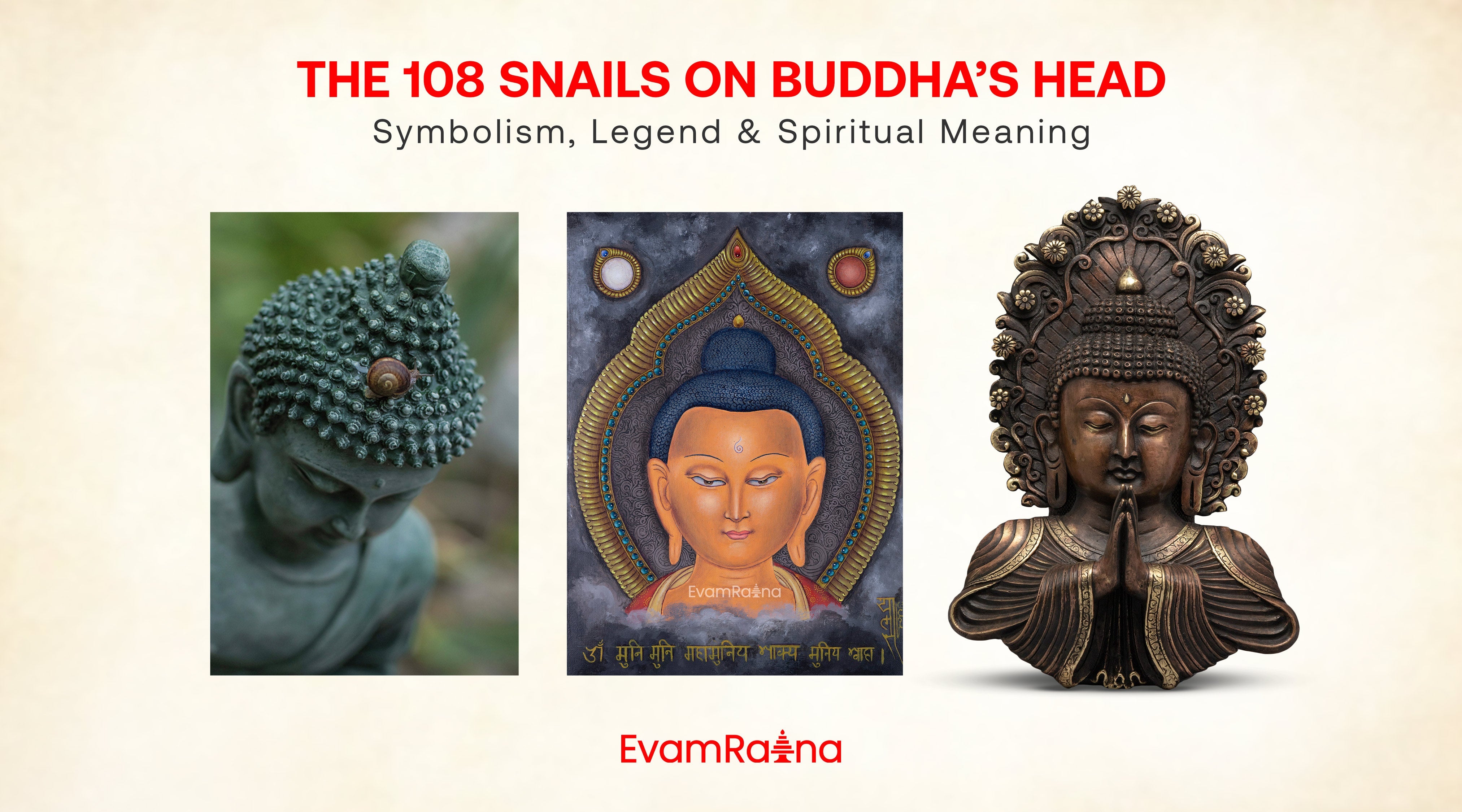
When you have looked at a Buddha statue, you might have noticed something unusual: tight, spiral curls covering the top of his head. Most people assume these are simply a stylistic representation of hair. But according to Buddhist tradition, those curls are not hair at all. They are 108 snails on Buddha's Head. This is one of the most captivating and lesser-known stories in all of Buddhist tradition. For centuries, artists, monks, and devotees across Asia have depicted the Buddha with these distinctive ringlets, each one quietly honoring a remarkable act of selfless sacrifice.
The Sacred Legend of the 108 Snail Martyrs

The story begins with Siddhartha Gautama, the prince who would one day become the Buddha. Siddhartha gave up his palace and left for the truth; he walked through forests, sat at the feet of sages, and did extreme austerities to his body. After some time, he sat beneath the Bodhi tree in Bodh Gaya, making the vow to never leave the tree until he attained complete and perfect enlightenment.
He meditated for a long time and very hard. The time passed by, but it seemed like forever. The sun was shining brightly, and there was no shade or protection from the sun. The scorching rays beat down upon his bare, shaved head, leaving Siddhartha vulnerable to heat and distraction. It was during this moment of fierce concentration that a group of snails, wandering nearby, became aware of the meditating prince. One snail, sensing both the danger of the scorching sun and the extraordinary significance of what was taking place, moved by compassion, climbed onto the head of the meditating Siddhartha and took his moist, cool body there to shield him from the heat, and settled there.
One by one, 107 more snails make the same selfless decision, each settling on his head, forming a living cap of protection across his crown. As hours pass, the intense heat dehydrates the snails. Their bodies dry and harden on his head, but none retreat. All 108 give their lives willingly. At dusk, when Siddhartha finally gets up, fully enlightened, he finds that he had a crown of 108 dried snails, all sacrificed for his enlightenment. The Buddha regards the snails as martyrs. Their sacrifice is mentioned in the Buddhist scriptures, and their form is kept on all representations of the Buddha ever produced.
Snail in Buddhist Tradition: What Do the Snails on Buddha's Head Symbolize?
In Buddhist lore, the snails are known as the Snail Martyrs, who gave up their lives for no personal benefit, only for the sake of another. Their act is regarded as one of the most perfect expressions of karuna (compassion). According to tradition, when Siddhartha Gautama finally achieved enlightenment and became the Buddha, the snails remained on his head as a symbol of their sacrifice and the compassion that lies at the heart of his teachings. This is why, in virtually every artistic depiction of the Buddha across Asia, his head is shown covered with these distinctive spiral formations.

The 108 snails on the Buddha's head are not just a charming legend. Each has several layers of spiritual symbolism that are very profound in the teachings of Buddhism, such as:
Compassion (Karuna)
The snails did not do this because they had to or because they owed it to their people, but simply because they were moved to do it. They are the most selfless acts of karuna, the heartfelt wish to ease another's suffering.
Selfless Sacrifice
The snails knew that the heat would kill them; however, they decided to stay. It is similar to the Bodhisattva ideal in Buddhism, the desire to give up one's own comfort and even life to help free others.
All Life is interconnected
The 108 snails became symbols of compassion, respect, and the interconnectedness of all life. Even the humblest creature participates in the unfolding of enlightenment.
The Power of Focused Meditation
The Buddha was so deep in meditation that he was unaware of the snails accumulating on his head. Their existence reflects the absolute stillness and inwardness necessary for spiritual awakening.
Wisdom and Healing
Snails have indeed been used for centuries to help bring wisdom and health into human beings. For this reason, snails embody enlightenment and spiritual wisdom in the Buddha sculpture.
Martyrdom and Sacred Memory
These snails are now honored as martyrs and are shown on many statues of the Buddha to remind us of their sacrifice. Every statue becomes a living memorial to their act of love.
How the 108 Snails Are Depicted in Buddha Statues and Art

Across centuries and continents, from the ancient temple complexes of India and Sri Lanka to the golden shrines of Thailand, the stone monasteries of Tibet, and the carved caves of China and Japan, artists and craftspeople have consistently depicted the Buddha's head covered with these characteristic spiral forms.
There are around 108 ringlet curls on the Buddha's head. One might wonder why artists have been portraying Buddha with short ringlets. There are numerous beliefs, one of which suggests that those ringlets are not short hair. They are 108 dried snails.
In most traditions, the snail-curls are depicted pointing upward or to the right, a direction associated in Buddhist iconography with auspiciousness and spiritual ascent. The curls are uniform in size, tightly packed, and rest just above the ushnisha, the raised protuberance at the crown of the head that represents the Buddha's supreme wisdom.
Artistic Significance
On modern Buddha stone statues, especially the Buddha head, a curly hair-like surface is crowned on the head to commemorate the events with the spiritual role of 108 snails. Whether crafted in jade, bronze, sandstone, or gold, this feature remains one of the most consistent and recognizable elements of Buddhist iconography worldwide.
Different regional traditions interpret the curls slightly differently. In Southeast Asian Theravada art, the curls tend to be tighter and more numerous. In Mahayana traditions from East Asia, they may be more loosely rendered. But the underlying story, and the homage to the snail martyrs, remains constant, a symbol of selfless protection and how peaceful the nature of Buddha is.
Spiritual Lessons We Can Learn from the Snail Martyrs

The tale of the 108 snails is not just a pretty tale. Yet, in their sum, they made the conditions for the greatest spiritual awakening in human history. The teaching here is clear: no act of true compassion is wasted; it is unimportant.
No Act of Compassion Is Too Small
The snails were tiny. Their individual contribution, a few degrees of coolness on a blistering hot day, was minuscule. And yet, together, their collective act of love created the conditions for the greatest spiritual awakening in human history. The teaching here is clear: no act of genuine compassion is wasted or inconsequential. Every being has a role to play.
Selflessness Is the Highest Practice
The snails did not act to gain merit, recognition, or even survival. They felt compassionate, and they did it wholeheartedly, without any hesitation. This is in keeping with the Bodhisattva ideal of Mahayana Buddhism, a commitment to using all of one's efforts, over many lifetimes, to free all beings.
Respect All Life
The story of Buddha's snail-adorned hair teaches us about sacrifice, compassion, and the importance of caring for one another, no matter how small or seemingly insignificant. The snails teach us that wisdom and goodness do not just belong to us; they emerge from places of sensitivity, presence, and love.
Enlightenment Belongs to All Beings
According to Buddhism, every living being has Buddha-nature, the inherent potential to attain enlightenment. Not in this story did the snails become enlightened, but they were directly involved in the enlightenment of the one who was to teach all mankind. Their act demonstrates that they can serve the arrival of liberation, even those who are not close to the throne.
Why Did the Buddha Shave His Head? The Symbolism of Hair in Buddhism
To understand the full significance of the snails, it helps to first understand why the Buddha's hair matters at all in Buddhist teaching. Hair is often metaphorically regarded as a human being's illusion in Buddhist thought. It is also known as "weeds of ignorance," and having a shaved head is a symbol of liberation from ignorance. It is thought that by maintaining cleanliness of our body and mind, proper understanding and enlightenment can be obtained. That is why we often see Buddhist monks with shaved heads.
One of the first things Siddhartha did when he left the palace to find enlightenment was to shave his head, a symbol of renunciation, of giving up the self, of abandoning all sense of self, royal identity, vanity, and attachment. At present, shaving of the head is still a symbol of renunciation, humility, and detachment in Buddhism. It signifies giving up attachments to material attachments and embracing a life of simplicity and spiritual pursuit.
The Sacred Number 108: What Does It Mean in Buddhism?
The number 108 is not arbitrary. Across Buddhism, Hinduism, Jainism, and yogic traditions, 108 is considered among the most sacred and auspicious numbers in existence. Its appearance in the legend of the snails is deeply intentional.
108 and Human Defilement
In Buddhism, there are believed to be defilements, or "earthly desires," that humans experience. There are said to be 108 of these vices that we go through during our time on earth, including experiences like arrogance, obsession, and violence. Each human experiences these earthly desires as a means to enlightenment. To achieve freedom from suffering and to attain nirvana, one must overcome all 108.
The parallel is profound: just as 108 defilements bind human beings to suffering, 108 snails died to help free one human being from that very suffering. The number itself becomes a bridge between ignorance and wisdom, between bondage and liberation.
108 Across Buddhist Practice

According to Buddhism, there are 108 defilements and 108 earthly temptations. Prayer beads have 108 mala beads. The Buddha has 108 names and 108 lamps devoted to him. Most Buddhist temples have 108 steps and 108 columns. The Tibetan Buddhist canon contains 108 sacred books, and there are believed to be 108 sins and 108 delusions of the mind.
In Buddhism, a bell is chimed 108 times to mark the end of an old year, because among Buddhist doctrines, there are 108 types of earthly desires. Every Buddhist must overcome these 108 temptations on the path to seeking nirvana.
108 and the Cosmos
Vedic astrologers determined that the average distance between the sun, moon, and earth is 108 times their respective diameters. So 108 is viewed as several wholeness and existence. The number literally encodes the structure of our solar system, which may explain why it has felt so universally sacred across cultures and millennia.
For thousands of years, 108 has symbolized spiritual completion, cosmic balance, and the unification of body, speech, and mind on the path to enlightenment. In Buddhism, the number 108 connects us to our place in the dharma. Within us, the heart chakra is formed of 108 lines of energy (nadis) and 108 pressure points (marmas). Even at the level of the human body, 108 marks the channels through which life and consciousness flow.
Conclusion:
The tale of 108 snails on the Buddha's head is a reminder of the ultimate compassion, selfless dedication, and the interdependence of all life. Their courageous act protected the Buddha, who was meditating, from the scorching sun, and he was able to realize nirvana. What the snails represent are deep spiritual insights: that no act of true kindness is too small, that selflessness is the greatest virtue, and that all beings have a role to play in the path towards liberation. This legend is still fostered in the art of Buddhism as a reminder to the Buddhist practitioner of karuna, mindfulness and devotion in everyday life.