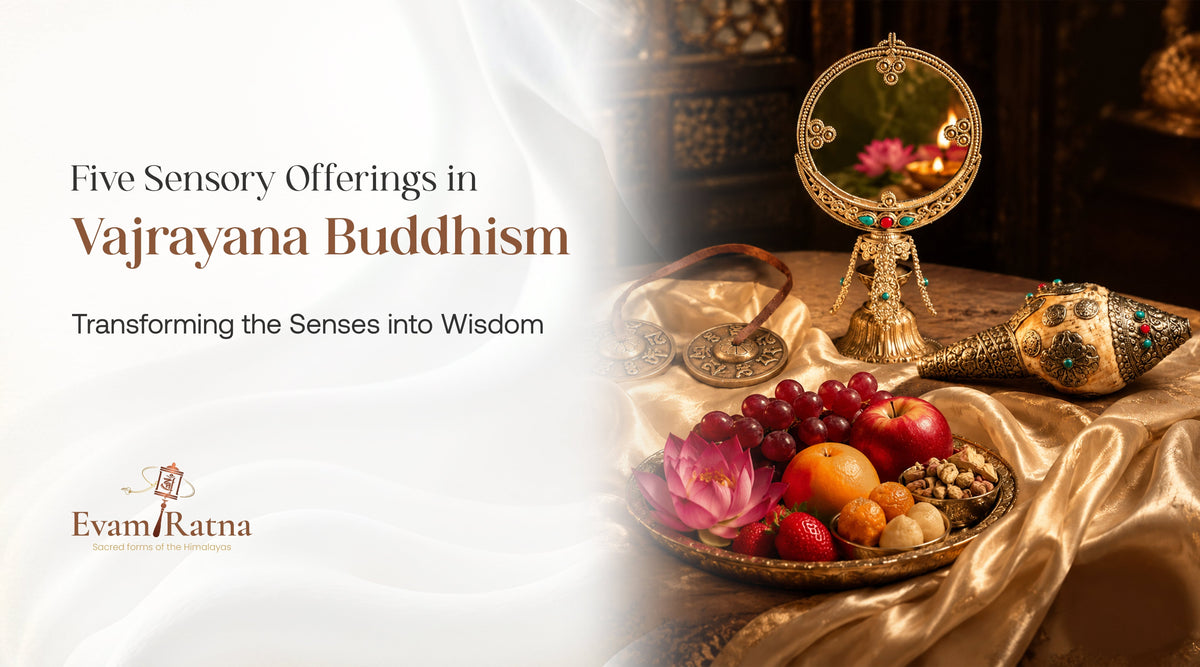
Five Sensory Offerings of Enjoyment in Buddhist Rituals, Altars, and Thangka Art
Most of the offerings that are made on a Tibetan Buddhist altar are Sensory Offerings, which are central to many Vajrayana rituals, pujas, and prayer practices. Making sensory offerings is a symbol of surrendering everything we are naturally inclined to hold on to through our senses: pleasure, desire, and transforming the experiences of pleasure and desire into acts of generosity, devotion, and wisdom. One great expression of this principle is the giving of the Five Senses, which are called the Five Sensory Offerings, Five Objects of the Senses, or Five Sensory Enjoyments.
The senses shape nearly every moment of human experience. We see the forms and colours, hear the voices and music, taste and touch, and smell the world around us through sight, sound, taste, touch, and smell. These experiences exist in the world to make life beautiful and enjoyable, but they can attach, crave, distract, and repel the mind when it is dependent on them. In Vajrayana Buddhism, giving the best of the five senses to Buddhas, deities, and enlightened ones is a way of cultivating non-attachment and recognizing the impermanent nature of all experiences.
What Are the Five Sensory Offerings?

The Five Sensory Offerings are a traditional set of symbolic offerings in Vajrayana Buddhism. In the tradition, they are symbolized by five objects: a mirror for sight, musical instruments or cymbals for sound, incense or a perfumed conch for fragrance, fruit for taste, and a piece of silk cloth for touch. When combined together, they are the most delightful experiences of the five senses.
- Sight: represented by a mirror
- Sound: represented by cymbals, a lute, or another musical instrument
- Smell: represented by incense or a perfumed conch shell
- Taste: represented by fruit or delicious food
- Touch: represented by soft silk cloth
These objects can be offered before Buddha's, bodhisattvas, tantric deities, or spiritual teachers, and they represent generosity, devotion, purification, and giving up of the attachment to pleasurable experience. The practitioner symbolically collects all that the practitioner can see, hear, smell, taste, and touch, which is beautiful, and presents it to the awakening. Thus, sensory experience becomes a spiritual practice. The profound nature of these gifts is the change in attachment.
Humans are by nature attracted to good, wholesome things, sounds, and smells, to good taste and physical feeling. Sensory experiences are a normal aspect of life, but as they can become fixated on them, they can develop into craving and dissatisfaction, or the need to have something that is temporary. With the practice of sensory offerings, practitioners learn to let go of this grasping by mentally giving whatever they see, touch, taste, smell, and hear that is most beautiful and most enjoyable.
In Tibetan Buddhist ritual art, they are sometimes arranged within an offering bowl or depicted as separate offerings placed before peaceful deities. Similar representations can also appear in thangka paintings, miniature ritual paintings, sculptural compositions, and elaborate ceremonial offerings. Their outward forms are simple, but their symbolism is profound.
Why Are the Five Senses Offered?
At first, making offerings of pleasurable sensory objects may appear contradictory to Buddhist teachings on attachment. If desire causes suffering, why present beautiful things to enlightened beings? The purpose lies precisely in the transformation of attachment.
Ordinary experience often follows a familiar pattern. We see something attractive and want to possess it. We hear something pleasant and want it to continue. We encounter enjoyable food, fragrance, or physical comfort and immediately begin thinking in terms of “I want this,” “this is mine,” or “I need more.”
The sensory offering reverses that habit. Instead of holding on to an attractive experience, the practitioner mentally releases it. So rather than saying “This beauty belongs to me," practice by saying:
May every beautiful appearance become an offering. May every harmonious sound become an offering. Similar for every fragrance, flavor, texture, and pleasant sensation you experience.
The practice is therefore connected with generosity and non-attachment. The practice of offering the senses contributes to practitioners becoming aware of this habit of grasping (attachment), of clinging to sensory experiences and desires. Letting go of the thought of “this belongs to me” or “I must hold on to this” by consciously offering them to Buddhas, bodhisattvas, deities, or spiritual teachers is an act of offering that transforms personal enjoyment into an expression of devotion and generosity. When liberated from attachment, the five senses become gateways to the arising of the five wisdoms.
1. Sight: The Mirror

The traditional object associated with sight is a mirror, often represented as a round silver, bronze, or highly polished reflective disc. It stands for everything perceived through the eyes: colors, shapes, landscapes, sacred images, beautiful objects, light, and visual form itself. Among the five sensory offerings, the mirror carries especially rich symbolism.
A mirror receives countless appearances without holding onto any of them. A face appears within it, yet nothing has physically entered the mirror. A mountain may be reflected perfectly, yet the mountain itself does not exist inside the reflective surface. In Buddhist symbolism, this makes the mirror a powerful illustration of the relationship between appearance and emptiness. The mirror becomes an accessible symbol for this contemplation. Reflections arise clearly while remaining insubstantial. Offering the mirror, therefore, represents both the offering of beautiful visual forms and a reminder not to grasp at appearances as permanently existing things.
2. Sound: Cymbals or the Lute

The second sensory offering represents sound. Traditional representations may include cymbals, tingsha, a lute, or another musical instrument. The precise object varies according to artistic and ritual traditions, but the underlying meaning remains the same: the offering of every pleasant and harmonious sound. This may include music, chanting, mantra recitation, bells, ritual instruments, birdsong, flowing water, or any sound considered beautiful.
Sound and Impermanence
Sound provides an immediate lesson in impermanence. A cymbal is struck. The sound arises. It resonates through space. Gradually, it fades and disappears. No matter how beautiful the note may be, it cannot be frozen or permanently possessed. For this reason, sound naturally illustrates the Buddhist teaching that conditioned phenomena arise through causes and conditions and eventually pass away. We often try to hold pleasant experiences long after their conditions have changed. Sound demonstrates the futility of this instinct with unusual clarity. Listen carefully to a bell, and impermanence can almost be heard directly.
Sound as Dharma
Sound also represents sacred teaching. In Buddhist literature, there are many vivid expressions that portray the Dharma through sound. Awakening can be likened metaphorically to a powerful voice that pierces the fog and speaks to the beings according to their capacity. Within ritual, music and sacred sound also have important functions. Bells, cymbals, drums, chanting, and mantra may help create a sacred environment in which ordinary perception is redirected toward contemplation.
3. Smell: Incense or the Perfumed Conch

The third offering corresponds to smell and is commonly symbolized by incense or a conch shell containing scented substances or perfumed water. Fragrance has long played an important role in Buddhist ritual traditions. Incense may be offered at shrines, temples, monasteries, meditation spaces, and household altars. Its fragrance helps establish an atmosphere associated with reverence and practice, while its rising smoke has generated many layers of symbolic interpretation.
Fragrance as an Offering
The sensory offering of smell includes every pleasing aroma. One may imagine sandalwood, medicinal herbs, flowers, incense, fresh forests, sacred substances, and countless fragrances filling the whole of space. Instead of seeking pleasant smells purely for personal enjoyment, the practitioner offers them. The act transforms fragrance from an object of sensory possession into an expression of generosity.
The Fragrance of Ethical Conduct
Traditional Buddhist imagery sometimes compares virtuous conduct to fragrance. Ordinary perfume travels only according to physical conditions, but the effects of wholesome conduct can extend far beyond one's immediate surroundings. A person whose behavior is guided by generosity, restraint, honesty, patience, and compassion influences others without needing to announce those qualities. In this sense, fragrance becomes a useful metaphor for ethical conduct that quietly spreads benefit. The offering of scent can therefore serve as a reminder that Buddhist practice is not only about inner experiences. It is also expressed through how practitioners behave toward other beings.
4. Taste: Fruit

The sensory object representing taste is traditionally fruit, although bowls of delicious food or other nourishing substances may also serve as representations. Fruit represents all enjoyable flavors: sweet, sour, salty, rich, delicate, refreshing, and countless combinations of taste. Food occupies an especially interesting position in spiritual life because it is both necessary and potentially a source of powerful attachment. We need nourishment to survive. At the same time, taste can easily become another area of grasping, excess, dissatisfaction, and constant preference. The offering transforms that relationship.
Offering the Finest Flavors
Rather than keeping the most desirable food for oneself, the practitioner imagines offering the very best. Fresh fruits, exquisite meals, medicinal nectars, grains, sweets, and all pleasant tastes may be visualized as infinitely multiplied. The point is not that awakened beings need food in the ordinary biological sense. Offerings are methods for training the mind of the practitioner. Giving what we value reveals attachment.n Giving what we enjoy develops generosity. Offering something desirable teaches the mind that pleasure does not always need to end in possession.
The Taste of Dharma
Taste also lends itself naturally to spiritual metaphor. Just as nourishing food relieves physical hunger, Dharma practice addresses deeper forms of dissatisfaction rooted in ignorance and attachment. Different foods may satisfy hunger temporarily. Buddhist teachings point toward understanding the causes of suffering itself. The offering of taste can therefore remind practitioners to distinguish between temporary satisfaction and liberating wisdom. Enjoyable food has its place, but no flavor remains forever. The Dharma points beyond the endless search for sensory completion.
5. Touch: The Silk Cloth

The fifth sensory offering represents touch and is commonly symbolized by soft silk cloth, sometimes understood in Tibetan contexts through luxurious textiles or scarves. Silk is chosen because of its lightness, softness, beauty, and pleasant tactile quality. It represents the entire range of enjoyable physical sensations. Warmth on a cold day, comfortable clothing, soft fabrics, gentle breezes, physical ease, and every pleasing sensation associated with the body can be mentally gathered into this offering.
Touch and Attachment to Comfort
Of all the senses, touch is closely tied to bodily identity. We instinctively seek comfort and avoid discomfort. Even small changes in temperature, texture, pressure, or physical position can strongly influence our state of mind. The silk offering invites practitioners to notice this relationship.
A pleasant sensation arises. The mind immediately wants to keep it. An unpleasant sensation arises. The mind immediately wants to escape it. Through practice, one learns to observe both reactions with greater awareness. Offering a pleasant touch does not require rejecting comfort. Rather, it trains the practitioner not to make comfort the foundation of happiness. The soft cloth becomes a symbol of enjoyment freely offered rather than desperately possessed.
The Five Sensory Offerings and the Five Buddhas
Within Vajrayana systems of symbolic correspondence, groups of five frequently relate to one another. The Five Buddhas, five wisdoms, five colors, five directions, five aggregates, emotional patterns, and other categories can be organized into interconnected mandalic systems.
The Five Sensory Offerings are also related to the Five Buddha families. In one traditional arrangement associated with the sensory offerings:
- Vairochana is connected with the visual form and the mirror.
- Ratnasambhava is associated with the sensory field represented through sound.
- Amitabha is associated with perception and fragrance.
- Amoghasiddhi is associated with the motivating dimension represented through taste.
- Akshobhya is associated with consciousness and touch.
Such correspondences should be understood within the wider symbolic language of Vajrayana rather than as simple statements about the ordinary biological senses. Tantric systems frequently layer multiple categories together so practitioners can contemplate experience as an integrated mandala rather than as disconnected parts.
The deeper message is transformation. Ordinary perception, feeling, recognition, motivation, and consciousness need not remain bound by ignorance. When their nature is understood, the same field of experience becomes inseparable from wisdom.
The Five Offering Goddesses

Vajrayana Buddhism takes the symbolism one step further by personifying the sensory offerings as goddesses. They are represented as divine female offering figures carrying the corresponding attributes.
- Goddess of Sight (Melongma): Offers visual beauty, often represented by a mirror.
- Goddess of Sound (Luma): Offers melodious sound and music.
- Goddess of Fragrance (Drichapma): Offers delightful scents and incense.
- Goddess of Taste (Roma): Offers exquisite tastes and nourishing foods.
- Goddess of Touch (Rekchama): Offers soft, luxurious tactile sensations.
The Five Sensory Offerings in Tibetan Buddhist Art
The Five Sensory Offerings appear throughout Tibetan Buddhist visual culture. In thangka painting, sensory offerings are frequently shown before peaceful Buddhas, bodhisattvas, lineage masters, and other sacred figures. Artists may depict them individually or combine the five objects into a single arrangement.
A viewer familiar with their symbolism immediately understands that these small objects represent something far greater. Together, they create a symbolic offering of the complete sensory universe.
- The mirror represents the entire visual world.
- The instrument represents all sound.
- The incense or perfumed conch represents fragrance.
- The fruit represents flavor.
- The cloth represents tactile pleasure.
Sensory Offerings in Ritual Practice

In certain Tibetan Buddhist ceremonies, representations of the sense offerings may be formally presented during the ritual. A mirror, musical instrument, fragrant substance, conch, fruit, and silk may be brought forward as symbolic objects. Depending on the particular liturgy and lineage, the presiding lama may interact with or briefly touch the objects as part of the ritual sequence.
Such practices remind us that Tibetan Buddhist ritual physical objects support visualization, meaning, and intention. A practitioner sees a mirror, but through ritual imagination it becomes the offering of every visual form. One sees a piece of fruit, but it becomes every desirable taste. This ability to move from a limited physical object to an unlimited mental offering is central to understanding the symbolism.
Placing the Five Sensory Offerings on a Buddhist Altar
When represented physically, the Five Sensory Offerings may be placed on a Buddhist altar as part of a larger arrangement of ritual offerings. Their exact placement can vary according to tradition, lineage, ritual instructions, and available shrine space. They should therefore not be treated as objects governed by one universal altar arrangement.
Instead of looking at beautiful objects with a desire to possess them, practitioners practice generosity by mentally offering them. The act reminds us that everything we experience through the senses is temporary, dependent on conditions, and cannot be permanently held.
In Tibetan Buddhist rituals, the Five Sensory Offerings are often presented before peaceful deities as expressions of devotion and as offerings of delight to enlightened beings. They can also be included in visualization practices where practitioners imagine the offerings expanding infinitely throughout space. Through this practice, the limited physical objects on the altar become symbols of limitless generosity.
Turning Daily Sensory Experience Into Practice
The most powerful meaning of the Five Sensory Offerings may appear when we leave the altar. Every day presents countless sensory experiences. You see a beautiful sunset. Instead of immediately wanting to photograph, preserve, possess, or compare it, pause for a moment and mentally offer its beauty. You hear music that deeply moves you. Rather than holding tightly to the experience, imagine offering the sound to all awakened beings. You encounter the fragrance of flowers or incense. Offer it. You taste delicious food. Offer the pleasure before eating. You feel the warmth of sunlight or the softness of fabric. Offer that sensation as well. Nothing external needs to change. The transformation takes place in the relationship between perception and mind. Through this simple shift, daily life begins to resemble an offering practice.
From the Five Senses to Wisdom
The Five Sensory Offerings ultimately point toward one of Vajrayana Buddhism's most important themes: transformation rather than mere suppression.
Seeing, hearing, or taste is not the problem. Attachment, ignorance, and the mistaken ways in which experience is appropriated around a fixed sense of self are what create suffering. When the practitioner develops wisdom, the same world that once produced endless craving can become a field of practice.
- The mirror teaches us about appearance and emptiness.
- Sound teaches impermanence.
- Fragrance recalls ethical conduct.
- Taste reminds us of the difference between temporary pleasure and deeper nourishment.
- Silk reveals our attachment to physical comfort.
Five simple objects therefore become five contemplations. Five pleasures become five offerings. And five ordinary senses become doorways through which awareness can deepen.
Conclusion:
In Vajrayana, simply having these five senses is the basis for Five Sensory Offerings, which are the basis for awakening spiritual practices. The offerings, which include a mirror, cymbals, incense, fruit, and silk cloth, are symbolic gestures of giving and awareness, intended to help the practitioner to value the beauty of life and to remember that it is impermanent. The attachment is transformed into wisdom, compassion, and detachment. Whether it's a ritual or a meditation, everything is an opportunity to reach enlightenment, and every sensory detail is a deeper contemplation, each one linked to wisdom and liberation.