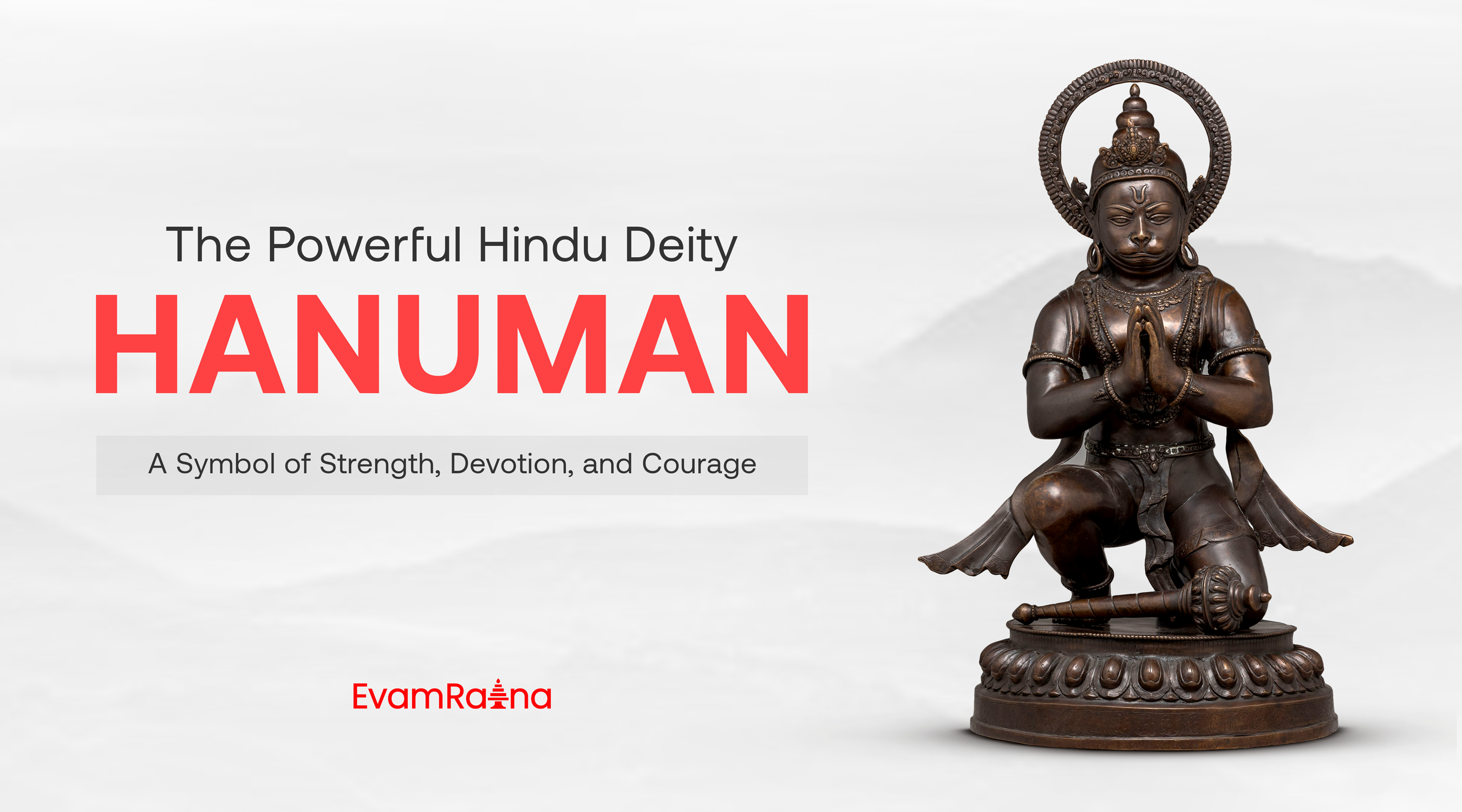
Symbolism and Iconography of Hanuman: Exploring His Divine Qualities
Lord Hanuman, the "Monkey God" of the Hindu pantheon, is the deity of pure, primal force and celestial force, as well as a pure symbol of selfless devotion. He is the bridge between the animalistic and the divine, proving that through discipline and faith, they can go beyond their nature to do the impossible. Hanuman is a spiritual guide for anyone who wants to learn how to be strong and brave in a world that is often full of challenges. He is a powerful deity who once mistook the sun for a glowing and ripe fruit and flew into the sky to eat it; he can also grow to the size of a mountain, and yet remains the ultimate symbol of humble and selfless service.
Introduction to Lord Hanuman:

In Hindu mythology, Lord Hanuman is one of the most admired and revered deities. He is seen as a symbol of strength, protection, and unwavering loyalty. He is a Hindu god and a divine vanara who was Lord Ram's devoted follower and dearest friend in the epic Ramayana. People know him as Bajrangbali because of his great strength, wisdom, and loyalty. He is a Chiranjivi (immortal) and is sometimes thought to be the reincarnation of Lord Shiva, the spiritual son of Vayu. While he possesses the might to move mountains and the speed to outpace the wind, his true power lies in his "Bhakti" (devotion). For millions of devotees worldwide, a Hanuman statue is a piece of art and a focal point for spiritual energy and a source of solace during life's most difficult trials. Hanuman's presence still inspires faith and gives people a sense of divine protection, from ancient temples in India to tall monuments in the Western Hemisphere.
Historical Origin & Significance
The birth of Hanuman is a tale of celestial intervention and divine destiny. Hanuman was born to Anjana, a celestial nymph who had been cursed to live on Earth as a monkey, and Kesari, a powerful Vanara monkey chief. Anjana was a devout worshiper of Lord Shiva, so he was impressed by her dedication and intense penance (tapasya) to have a child. Shiva ordered Vayu (considered the wind god and spiritual father of Hanuman) to deliver a portion of the sacred pudding from King Dasharatha’s yagna to her. After eating pudding, she gave birth to monkey faced child, Kesari and Anjana named their son Bajrang.
His childhood was marked by a legendary display of power and mischief. Famously, the young Hanuman once saw the Sun rising and, mistaking it for a giant, glowing, ripe fruit, leaped into the sky to snatch it. Indra, the king of the gods, heard this news and struck Hanuman with a thunderbolt to stop his chase, injuring the child's jaw. This incident led to Vayu, the wind god, withdrawing all air from the world in retaliation, causing immense discomfort to the gods. The gods healed Hanuman and gave him immortality and other divine powers to make Vayu happy.
But Hanuman was a mischievous child who often troubled forest-dwelling sages. To save the world from his childish disturbances, the deities enlisted the services of Brahma, who cursed Hanuman: until the moment of great necessity, he would forget his immense powers. It was not until the epic Ramayana, when the bear king Jambavant reminded him of his true potential, that Hanuman’s dormant abilities, such as the power to grow larger than an elephant, were rekindled to serve Lord Rama.
Sacred Iconography and Symbolism

Hanuman’s physical appearance is rich with spiritual symbolism:
- Monkey Face: He has a monkey face because he is the monkey god and represents a mischievous yet noble nature, signifying intelligence, courage, and the ability to overcome any obstacle through loyalty and devotion.
- Sindoor (Vermilion): Hanuman is often shown covered in orange sindoor. According to tradition (though not detailed in the sources), this symbolizes his total devotion to Rama, as he once covered his entire body in sindoor, believing it would ensure Rama’s longevity.
- The Tail: The tail of Hanuman is a representation of strategic genius and great strength. In the Ramayana, when the demon king Ravana ordered Hanuman’s tail to be set on fire, Hanuman used his divine powers to grow his tail so long that the demons ran out of cloth and oil to cover it. He then used his burning tail to set fire to the city of Lanka before escaping.
- The Sanjeevani Mountain: He is frequently depicted carrying an entire mountain. This commemorates his greatest feat during the battle of Lanka: when tasked with finding a life-saving herb for the wounded Lakshman, Hanuman flew to the Himalayas. Unable to identify the specific herb, he chose to carry the entire mountain back to ensure the healing was successful.
- The Blessing posture: Many statues depict Hanuman in a posture of blessing, signifying his role as a protector and a bestower of spiritual well-being.
- Gada (Mace): The gada in his left hand is a symbol of his strength and combat prowess, highlighting his role.
Role of Hanuman in Ramayana
 In the Ramayana, Lord Hanuman plays the pivotal role of the supreme devotee (Rama-bhakta), scout, and general, serving as the primary catalyst for Lord Rama's victory over the demon king Ravana. His contributions range from diplomatic missions to extraordinary feats of strength on the battlefield.
The Scout and Messenger
Hanuman’s most critical initial role was as a scout to Lanka. His journey was marked by divine challenges:
Overcoming Sursa: To reach Lanka, he had to bypass the demoness Sursa. He cleverly outwitted her by expanding his size as she tried to swallow him, then quickly shrinking to escape through her ear, technically fulfilling her divine boon while continuing his mission.
Locating Sita: In the Ashokvatika grove of Lanka, Hanuman found Sita held captive. He acted as a divine messenger, reassuring her of her impending rescue and presenting Rama’s signet ring as proof of his identity and mission.
The Destroyer of Lanka
After locating Sita, Hanuman's role shifted to one of tactical disruption and psychological warfare:
Confronting Ravana: After defeating Ravana's son Meghnaath, Hanuman was captured and brought before the demon king.
Burning of Lanka: When Ravana ordered Hanuman’s tail to be set on fire, Hanuman used his powers to grow his tail to an immense length. He then shrank to escape his bonds and used his burning tail to set fire to the entire city of Lanka before flying back to the mainland with vital intelligence on Ravana’s forces.
The Hero of the Battlefield
During the Great War, Hanuman was the ultimate warrior and healer:
Defeating Guardians: He defeated Lankini, the principal guardian of Lanka, and was a constant presence in the front lines of the battle.
Lifting the Sanjeevani Mountain: Hanuman’s most famous feat occurred when Lakshmana was fatally wounded. Hanuman flew to the Himalayas to find the Sanjeevani herb. When he could not identify the specific plant, he chose to carry the entire Dronagiri mountain back to the battlefield to ensure Lakshmana’s survival. This act is celebrated as a symbol of his boundless strength and benevolence.
The Eternal Devotee
Hanuman’s role did not end with the war. Following the victory and Rama's coronation in Ayodhya, he remained Rama’s favorite general:
The Ultimate Proof of Faith: In the court of Ayodhya, to prove his absolute devotion, Hanuman tore open his chest to reveal the presence of Rama and Sita residing within his heart.
Immortality through Service: When offered any boon by Rama, Hanuman requested only to live for as long as people spoke of Rama’s deeds. This established him as a Chiranjeevi (immortal) who continues to provide protection and solace to devotees today.
Significance of Hanuman Forms and Statues
The presence of a Hanuman statue in a home or any space is believed to foster harmony and spiritual well-being. There are many forms of Hanuman with their own spiritual significance. These sacred icons serve as focal points for worship, inspiring faith and resilience while acting as a source of solace during difficult times.
Aashirvaad Anjaneya

In this popular form, Hanuman is depicted standing or seated with his hand raised in the Aashirvaad mudra (gesture of blessing), while the other hand often rests on his thigh or holds a Gada (mace). This posture represents:
- Benevolence: It shows Hanuman’s kindness and assurance toward his devotees.
- Divine Presence: These statues are considered perfect for daily rituals aimed at attaining Hanuman’s virtues in one's life.
Hanuman in Namaskar Mudra

Depicted with his head gently bowed and hands joined in salutation (Namaskar), Hanuman is often shown in the Veerasana or heroic pose. This form signifies:
- Supreme Devotion (Bhakti): It is the ultimate symbol of self-surrender and the virtue of devotion to Lord Rama.
- Calmness: This statue helps devotees embody the gentler qualities of Hanuman, bringing peace and tranquility to the heart.
Hanuman in Dhyana Mudra

As the Rudra avatar of Lord Shiva (the primordial Yogi), Hanuman is frequently shown as a practitioner of Yoga. In this meditative form, he is seen with his hands placed in his lap and a tranquil expression. This form represents:
- Restraint and Calmness: It reflects Hanuman’s status as a Brahmachari (ascetic) and his total dedication to the supreme being.
- Spiritual Awakening: It is a sacred icon for those seeking to embody the inner stillness and discipline of the "son of the wind".
Sanjeevani Hanuman
This form depicts the legendary episode where Hanuman flew to the Himalayas to retrieve the Sanjeevani herb to save Lakshman. He is usually shown in a valiant pose, carrying the entire Dronagiri mountain on one shoulder. Its significance includes:
- Benevolence and Strength: It serves as a powerful reminder that Hanuman will move literal mountains to help those who call upon him.
- Healing: It commemorates his role as a healer who rejuvenated the wounded.
Panchamukhi (Five-Faced) Hanuman

The Panchamukhi (five-faced) form is a powerful manifestation assumed to remove obstacles and protect against negative influences. According to the sources, this form is used for:
- Warding off Negativity: It is believed to safeguard the home from evil energies, especially when placed in a south-facing position.
- Purification: The associated mantras are used to purify the surroundings and remove sinful influences.
While the sources confirm the general power of the Panchamukhi form to remove obstacles and provide protection, the specific breakdown of the five faces and their cardinal directions is as follows:
- Hanuman (East): Focuses on purity of mind and success.
- Narasimha (South): Removes fear and sinful influences.
- Garuda (West): Offers protection from negative energies and black magic.
- Varaha (North): Bestows prosperity and wealth.
- Hayagriva (Upward): Bestows knowledge and wisdom.
The Power of Practice, Mantras, and Rituals
Worshipping Lord Hanuman involves rituals designed to instill the deity's qualities of strength and resilience within the practitioner. Common practices include:
- Offerings: Devotees offer flowers, prasad (sanctified food), and sindoor as marks of reverence and gratitude.
- Removal of Negativity: Worshippers believe that dedicated practice helps ward off negative energies and provides divine protection against spiritual and physical threats.
- Selfless Service: Following Hanuman’s example, many practitioners view their service to others as a form of worship, embodying the "selfless service" for which Hanuman is celebrated.
Why millions recite Tulsidas's 40 verses?
The Hanuman Chalisa is a set of 40 verses traditionally attributed to the poet-saint Tulsidas. Reciting these verses in front of a Hanuman Murti is a central practice for millions. Devotees believe that these verses carry a vibrational frequency that can bring divine blessings and protect the household from negative influences.
The psychological benefits of chanting for focus and courage:
From a psychological perspective, the rhythmic chanting of the Chalisa acts as a form of meditation and mindfulness. The repetitive nature of the verses helps the mind find a "flow state," reducing anxiety and increasing mental clarity.
- Focus: The discipline required to memorize and recite the 40 verses sharpens the cognitive faculties and improves concentration.
- Courage: By focusing on the attributes of his strength, his lack of fear, and his ability to overcome demons like Lankini and Sursa, the chanter internalizes these qualities. This serves as a form of positive affirmation, building the psychological resilience needed to face modern life's challenges.
Conclusion
The legacy of Lord Hanuman shows how strong faith can be. He remains an honored figure in Hindu culture and a growing symbol of spirituality around the world. He is known as a remover of obstacles and a source of divine strength. The statue and the strong vibration of the Hanuman Chalisa convey a sense of security and comfort. This is because of the skillful work that went into making them from different materials, such as brass, copper, gold-plated, oxidized, etc. By looking toward Hanuman, we are reminded that no mountain is too heavy to move and no ocean too wide to cross when one is selfless by a heart full of devotion and a mind fixed on a higher purpose.