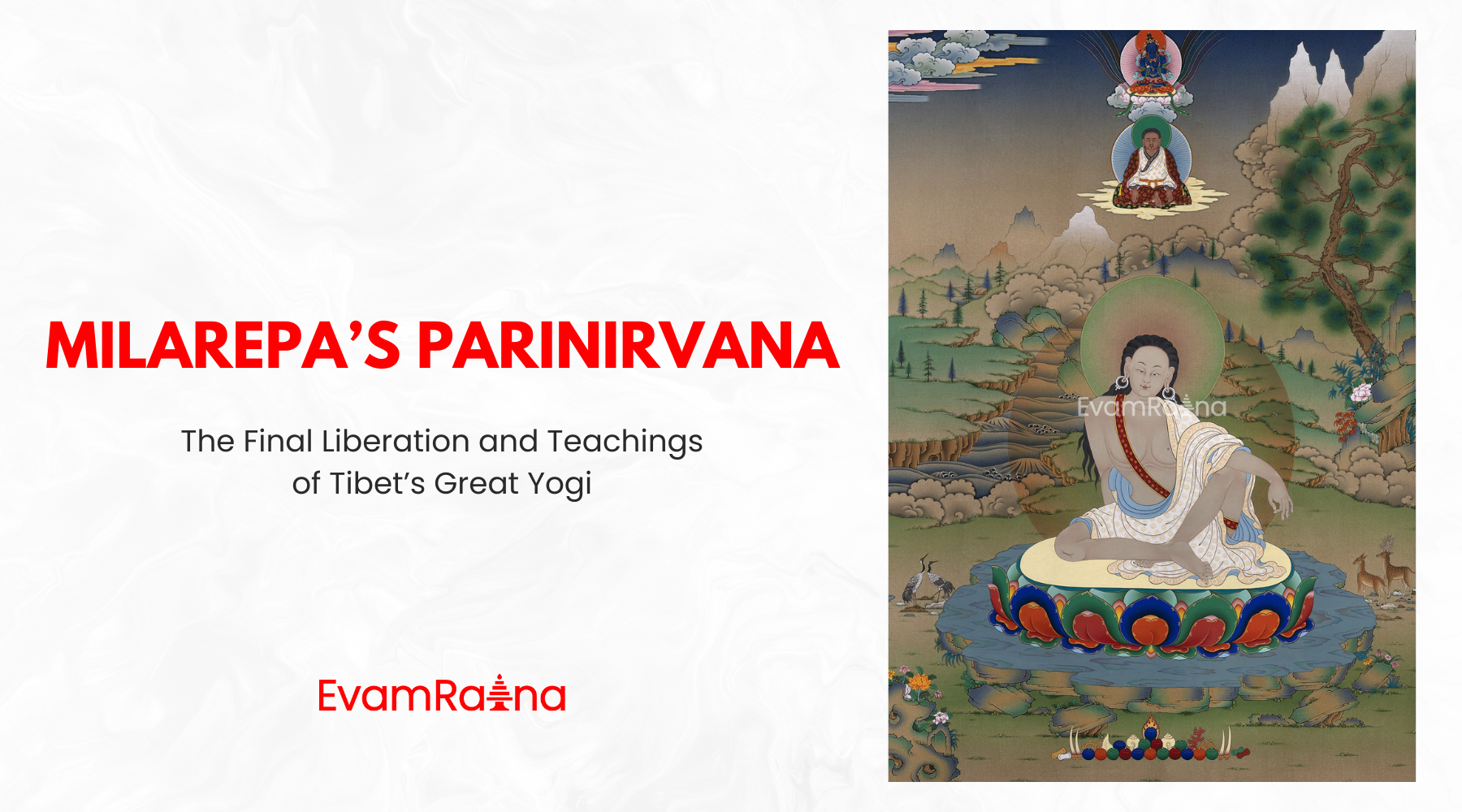
Milarepa Wisdom and Miracles: The Life and Legacy of Tibet’s Great Mystic
Milarepa (c. 1028-1111), a renowned Tibetan Buddhist who is one of the most venerated yogis and spiritual personalities, is the one whose life turned into a miracle of shifting towards the darkness of transgressions to extreme enlightenment. More than a tale of a mighty mystic, his story is an assertion of the power that Dharma can have to change people, and of the vast potential of the human spirit to overcome its limitations. The Parinirvana of Milarepa was no ordinary physical death, but a dying teaching of ultimate mastery on the fundamental identity between nirvana and samsara. He taught that nirvana is not merely a subjective state but an ontological reality in which the stains of delusion and distortion are wiped away.
Introduction: The Final Chapter of Milarepa’s Life

Milarepa had a life of severe change; his life was riddled with regrets and spiritual sins, and as his life came to an end, he was enlightened in the same life as he lived it. And after full liberation, he passed away in the state of Parinirvana when he was 84 years old, a last dying that was full of miraculous signs and deep teachings. The Parinirvana of Milarepa was not only the conclusion of his bodily life, but it was a complete lesson where he showed the truth of nirvana and samsara to be non-different. His final words of teaching are a guiding light into spiritual understanding that gives us the lessons on the impermanence of life, what is there in the mind, and the ultimate truth of emptiness. Milarepa created an unforgettable legacy of wisdom, compassion, and enlightenment through his miracles, celestial signs, and final song.
Milarepa's Early Life and Transformation

The first years of Milarepa were full of misery and avenging efforts, as he resorted to black magic after having suffered as a person. Being deprived of his father and oppressed by his aunt and uncle, he wanted to have the power to take revenge on the miseries of his family. Milarepa did mighty sorcery during this dark period, and many people were killed. But when Milarepa realized the devastating effects of his deeds, he was so remorseful. This conversion was the turning point in his life, and he approached Marpa the Translator, a great teacher of Tibetan Buddhism, who exposed him to hard training and spiritual challenges.
It is his realization of emptiness and what the mind is that was attributed to the fact that Milarepa cleared himself of past karma through the grueling path that he went through, and the repentance he had done. His commitment to spiritual practice and the strictness of his meditation on the Six Yogas of Naropa actually brought him into full liberation, and he reached a state of enlightenment during his lifetime. His life represents the opportunity to be spiritually redeemed and the way to escape suffering, regardless of the severity of the past sins.
Read More About Legacy and Life of Milarepa: The Great Tibetan Yogi
Parinirvana of Milarepa: The Final Moments
The Parinirvana of Milarepa started with envy by a scholar called Geshe Tsakpuhwa, who wanted to get rid of the great yogi by trickery. Through a concubine, the Geshe delivered poisoned curdled milk to Milarepa so that he would die. Although Milarepa was able to foretell that this was poison and he was able to know this at once, he still willingly drank it. The wisdom of this moment is great; when Milarepa regarded the poison as a logical conclusion of his mission on earth, and when he accepted this poison as an illustration of non-attachment and equanimity, which are the primary features of spiritual realization.
Instead of showing anger or fear, Milarepa made the illness that ensued an ultimate lesson on the non-difference of nirvana and samsara. His body got hurt, yet Milarepa continued to be calm, proving the fact that there is no separation between suffering and liberation, just as there is no separation between nirvana and samsara. One of the last things that Milarepa did was to shift the suffering of his disease to a wooden door, which shattered under the force of the energy, a symbol of the burden of bad deeds and the power of change. This was sending a very bright message to the Geshe on the repercussions of his own behavior and that he needed to truly repent.
The Miracles of Milarepa’s Parinirvana

The days leading up to Milarepa’s passing were filled with miraculous signs, marking his transition as a profound cosmic event. As Milarepa’s physical body began to weaken, the sky above his residence in Chuwar was filled with rainbow canopies, five-colored clouds, and a rain of multicolored blossoms. These miraculous phenomena were visible to all who were present, signifying the presence of divine energy and the merit of the outstanding yogi’s life. Additionally, the fragrance of exotic perfumes filled the air, further amplifying the sacredness of the moment.
The days that preceded the death of Milarepa were ones of miraculous signs, and Milarepa's transition was a great cosmic event. When the physical body of Milarepa started to give way, the sky over his house in Chuwar was covered with the rainbow canopies, five-colored clouds, and rain of multicolored blossoms. All people present could see these miraculous phenomena, which meant that divine energy existed, and the merit of the life of the revered yogi was achieved. Moreover, the smell of exotic perfumes was in the air, which also intensified the sacredness of the moment.
There were too many of his followers, so Milarepa had to multiply in order that he could fulfill the needs of his followers at the same time, who had been dispersed in various parts of the world. In this wondrous work, Milarepa made sure that all of his followers, regardless of where they were, could be a witness to his last transition and still feel one with him even though his physical body was dead. This scene showed the great compassion of Milarepa and how he managed to cross the physical limits even at the end of his life.
Milarepa’s Final Song: The Song of the Six Essential Principles
Milarepa’s final teaching was his "Song of the Six Essential Principles," which he gave when he was incinerated and was situated in one of the celestial mansions. This song is also one of the most touching lessons in his life, and it is full of wisdom that can be heard by the Buddhist practitioners. The song encouraged the heart-disciple of Milarepa, Retchung, and his disciples to defeat the great illusions that were inhibiting spiritual development.
These illusions include:
- The Illusory Body: Milarepa warned against clinging to the material body, which can deceive the mind into prioritizing worldly pursuits over spiritual realization.
- The Illusory Mind: The mind, which is a slave of the senses and the ego, prevents the realization of Ultimate Reality.
- Inner Consciousness: Milarepa cautioned against becoming lost in conditioned perceptions of the self and the world.
- Bardo Consciousness: He advised not to seek a new body in the bardo state but to recognize the true nature of the mind.
- Desire and Hatred: The roots of evil karma, which keep beings trapped in samsara, are driven by desire and hatred.
- Conceptual Falsehoods: Milarepa urged his followers to abandon conceptual falsehoods and embrace the path of direct realization.
The teaching insisted on seeking to seize the fortress of unborn emptiness by all beings, which made the spiritual practice of life, death, and the intermediate state (the bardo) unified. Such wisdom is the final arrival at the conclusion that emptiness is the key to liberation, and it goes beyond the polarities of life and death.
The Miraculous Relics and the Final Gift of Liberation

After the cremation of Milarepa, his heart-disciple Retchung came late, Milarepa miraculously talked through the funeral pyre, and gave his last word to the guru-disciple Retchung. That was the time Retchung was told to carry on with the work of propagating the teachings of Milarepa so that his legacy would be remembered.
Following the cremation, a group of female spiritual beings known as dakinis removed all bodily remains, and no ashes were left. Yet Milarepa has left behind him one last, wondrous gift, before his hearth: a fragment of raw sugar, and a cloth, which, however much taken or cut, would never grow less. This present was representative of the unconditional mercy of Milarepa and was thought to have the ability to emancipate any person who either drank the sugar or held the cloth belonging to the lower spheres of life. This last show of kindness meant that the presence of Milarepa would still remain to guide and shield his followers even when he was no longer physically with them.
Milarepa’s Legacy: The Ultimate Teachings of a Great Yogi
The Parinirvana of Milarepa and the wonders that happened in his final moments remain the inspiration of millions of Buddhists practicing across the globe. His lessons about emptiness, compassion, and non-difference between samsara and enlightenment are used by those who are willing to guide themselves in the path of enlightenment.
The biography of his life stands as a prime illustration of the ultimate liberation, which proves that the heart of the blackest kind can be changed with the help of persistence, dedication to the guru, and application of the Dharma. In his last teachings, Milarepa encouraged his disciples to accept the realities of emptiness and to comprehend that liberation does not involve leaving life but revealing the real nature of what all existence is all about. Being the best yogi, the teachings of Milarepa still remain in the Kagyu school and are upheld by the numerous followers who still uphold his traditional teachings today.
Milarepa’s Parinirvana: A Day of Blessings and Enlightenment

The 14th day of the first month is celebrated as the anniversary of the Parinirvana of Jetsun Milarepa, the 15th day as the anniversary of the Parinirvana of Marpa Lotsawa. These anniversaries are of great spiritual importance, especially to Vajrayana followers. The physical bodies of these great enlightened masters have passed, but their blessings will always be there. The blessings granted by the guru are said to be most powerful when they pass into nirvana, as well as during their anniversaries of Parinirvana. Such days are believed to be full of immense potential to practitioners, and particularly blessed days to serious meditators in need of deeper realization.
During the day of the Parinirvana of Milarepa, followers perform Guru Yoga with utmost devotion, offering prayers to the guru and meditating without thought. It is a deep mode of uniting our common minds with the masterful mind. In these times, the time of collecting blessings and merit is unmatched, giving an amazing chance to advance consciousness and even to enlighten. It is a period when spiritual association with these great masters is most complete, promising limitless possibilities of development on the spiritual path.
Conclusion: A Living Legacy of Wisdom and Compassion
The Parinirvana of Milarepa was not only the termination of his life in this world, but it was the last liberation, the instruction of one of the greatest Tibetan mystics. His biography, which is full of miracles and great teachings, serves as an icon of the power of the Dharma and the great kindness that can be developed by means of adequate spiritual practice. The stories of how Milarepa, the cotton-clad yogi, traversed the path of black magic to full enlightenment demonstrate that every person, no matter what he has done previously, can liberate himself or herself. This wisdom is probably most touchingly expressed through his last Song of the Six Essential Principles, addressed to his heart-son Retchung, in a mansion in heaven. He encouraged his followers in his song to see through the real meaning of the mind, to drop the great robber of the illusion of the body, and to seize the citadel of empty existence born. His Parinirvana is an excellent reminder that real spiritual freedom can always be attained by anyone who chooses to walk the path of wisdom and kindness.
On this auspicious day of Parinirvana, may we embody the wisdom and compassion of Milarepa, and may our practice lead us to the ultimate freedom of enlightenment.