Tibetan Buddhist Ritual Vases: Meanings, Uses, and Differences
In Tibetan Buddhism, both the Long Life Vase (Tsebum) and the Bhumba (Ritual Vase) are sacred vessels used on altars and in rituals, but they have distinct purposes, shapes, and symbolic meanings. At first glance, both look like ornate metalwork vessels. Both sit on Buddhist altars. Both are used in rituals, ceremonies, and pujas. Yet they serve fundamentally different purposes, hold different substances, carry different symbolism, and have different roles within Vajrayana Buddhist practice.
Introduction: Two Vases, Two Sacred Purposes

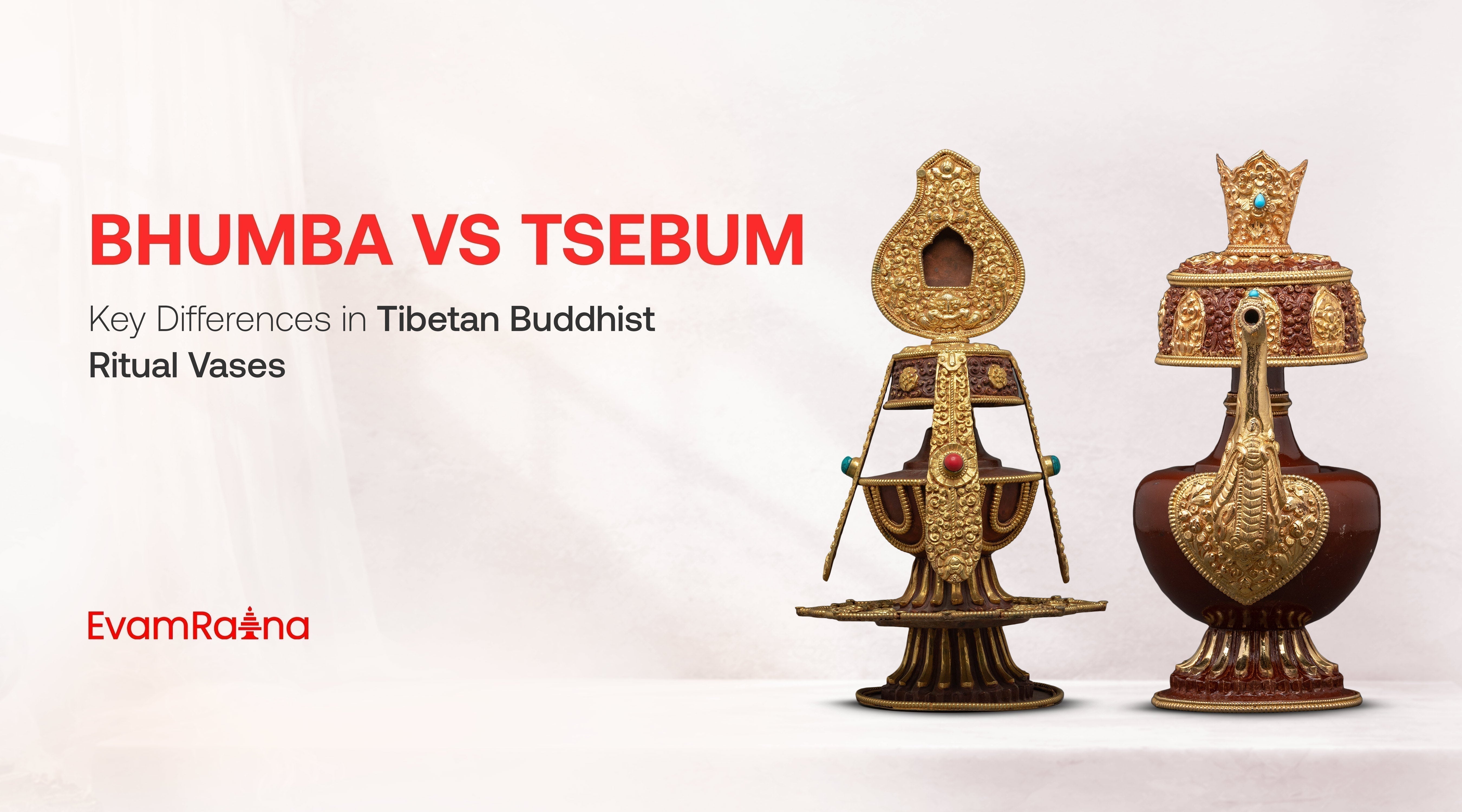
When it comes to Tibetan Buddhism, we can encounter numerous ritual objects, including their role, importance, and symbolism. Among them, the two most commonly seen and most commonly confused are the Bhumba and the Tsebum. They are vital ritual vessels in Vajrayana Buddhism that symbolize the harmony of purification and sustenance. They share the altar, but their roles provide an in-depth symbolic contrast. The Bhamba is a vessel with a holy water vase with a peacock feather or kusha grass cover. It is an active ritual instrument with which Lamas cleanse and activate the circulation of holy water. A sacred vessel called the Tsebum or Chegumba, which is mainly a ceremonial vessel and the consecrated water (amrita) is considered a potent long-life tool and symbolic of the enlightened activity of Amitayus, the Buddha of Longevity.
Bhumba: Tibetan Ritual Vessel for Purification Rituals

The Bhumba, also spelled as Bhumpa or bumpa, is a ritual vessel filled with Guru-blessed holy water for purification and empowerment rituals. The holy water of Bhumba is a blessing for clearing negative karma and consecrating people, objects, and sacred spaces.
The Bhumba is an essential element in Vajrayana practice, typically filled with blessed water and used for consecrations, empowerment ceremonies, and purification rituals. Its presence on an altar signifies abundance, purity, and the direct blessings of the Buddhas.
Read More About Tibetan Buddhist Ritual Vessel Bhumba: Handcrafted Sacred Water Offering Vessel
Tsebum (Chegumba): Tibetan Ritual Vessel for Long Life

The Tsebum, Tse means life or essence, and Bum means vase, is also known as Chegumba. It contains long-life holy water, also known as the nectar of immortality. The liquid nectar traditionally consisted of clean water and saffron to turn it yellow, as well as a mix of auspicious substances.
The vase represents the enlightened activity of Amitayus, the Buddha of Longevity. The top of the vase will often feature a Ghau (amulet) that can be opened to place a small image of Buddha Amitayus inside. It is the focus of the long-life rituals and spiritual empowerments, whereby they aim at eliminating impediments to their life force.
Read More About Understanding the Vase of Immortal Nectar (Tsegum Vase) in Buddhism
Key physical differences between Bhumba and Tsebum
|
Feature |
Bhumba |
Tsebum |
|
Name & Meaning |
Derived from Tibetan (bum-pa), meaning "vase" or "pot". |
Derived from Tibetan (tshe bum), meaning "life vase". |
|
Shape & Design |
Bulbous body, narrow neck, flared mouth with a spout. |
Typically taller with a wider body, often topped with a Ghau (amulet compartment). |
|
Function |
Used for pouring consecrated water in rituals. |
Dedicated to invoking the blessings of longevity and removing obstacles to long life. |
|
Material |
Copper, brass, silver, gold, and occasionally clay. |
Copper, brass, gold, or silver plating. |
|
Decoration |
Often decorated with Buddhist iconography, gemstones, and mantras. |
Typically adorned with sacred motifs, often a Ghau compartment for a miniature image of Amitayus. |
|
What It Holds |
Holds consecrated water for purification. |
Holds consecrated amrita (spiritual nectar), sacred herbs, grains, and mantras. |
|
Association |
Represents the expanse of the universe, used in purification ceremonies. |
Represents Amitayus (Buddha of Longevity), used in long-life empowerment rituals. |
|
Symbolism |
Purification, abundance, wisdom through the spout. |
Longevity, vitality, and blessings of Amitayus for extending life. |
|
Special Feature |
The spout controls the flow of water during rituals. |
The Ghau compartment can hold a small image of Amitayus for blessings. |
|
Primary Use |
Used in purification rituals, consecrations, and empowerment. |
Used in long-life rituals and empowerment (tse wang), for conferring blessings of longevity. |
|
Ritual Context |
Used for general-purpose rituals and empowerment. |
Used specifically in Vajrayana long-life rituals to invoke health and longevity blessings. |
How the Tsebum Emerged from the Amitayus Longevity Tradition?

In Vajrayana Buddhism, the Tsebum is a ritual vessel used in sacred rites, which physically embodies the blessings of Amitayus, the Buddha of Infinite Life. Its origin can be traced to the Mahayana sutras of India, including the Sukhavativyuha, which reveres Amitayus as a god of long life. While Amitayus is an aspect of Amitabha Buddha, Tibetan Buddhism uniquely distinguishes the two, developing a dedicated ritual tradition focused specifically on the "Boundless Life" aspect of the deity.
Amitayus practices are the key to spiritual development in the Vajrayana tradition. Through the meditations on him, the practitioners are seeking to eliminate the bad karma that leads to early death and rejuvenate the energy required to engage in serious spiritual practice. These teachings were introduced to Tibet by masters such as Padmasambhava and became a foundation of longevity rites, known as tsewang.
The iconographic link between the deity and the vessel is profound. Amitayus is traditionally depicted seated in meditation, holding a vase of amrita (nectar of immortality) in his hands. This imagery signifies a life free from the suffering of disease and the decay of time. The Tsebum is considered the living embodiment of Amitayus’s enlightened activity brought into tangible, ritual reality.
When placed upon an altar, the Tsebum serves as the focus of empowerment ceremonies. It is frequently filled with precious substances and consecrated through mantra and meditation to become a conduit for healing, prosperity, and the restoration of life force. By utilizing the Tsebum, practitioners engage directly with the qualities of Amitayus, transforming the physical vessel into a powerful instrument that protects and sustains their journey toward enlightenment.
The Lotus-Born Master and the Tantric Foundation of Both Vessels
The Vajrayana, which Padmasambhava introduced to Tibet, was not an abstract philosophy. It was a living system of ritual practice, a system in which the objects of consecration, the ceremonies of empowerment, the physical tools such as the Bhumba and the Tsebum had vital functions to perform. The Tibetan Buddhist sect Rnying-ma-pa, the Old Order, claims to follow most closely Padmasambhava's teachings, emphasizing Tantric ritual, worship, and Yoga.
For the Bhumba, Padmasambhava's transmission of Vajrayana ritual codified the role of the ritual water vase in empowerment ceremonies, specifically the bum wang or vase empowerment, which became the foundational first empowerment in the Vajrayana system. During the vase empowerment, the vajra master and practitioners visualize a vase as a heavenly palace that is filled with enlightened deities. The enlightened deities melt into the liquid in the vase, turning it into a sacred substance. This is the direct lineage that gives the Bhumba its power, a living transmission originating with masters like Padmasambhava himself.
For the Tsebum, Padmasambhava's role was equally defining. Amitayus is revered by Tibetan masters such as Guru Padmasambhava and Je Tsongkhapa, who transmitted long-life empowerments and Amitayus initiations through unbroken lineages. The long-life empowerment practice, which Padmasambhava introduced to Tibet and which has been maintained and passed on by his successors, such as Tsongkhapa, is the current of life in which the Tsebum functions today.
Ritual Use Guide: Bhumba and Tsebum

-
Prepare the Space and Vessels: Begin by cleaning the altar and both vessels, the Bhumba (for daily offerings) and Tsebum (for ceremonial use). Use a clean, dry cloth, ensuring that this act of cleaning is done with mindfulness and respect.
-
Fill with Pure Water or Sacred Nectar: Fill the activity Bhumba with the cleanest available water (spring or filtered water is ideal). For the Tsebum, fill it with symbolic amrita (spiritual nectar), traditionally a mixture of clean water, saffron, and auspicious substances like herbs, grains, and mantras.
-
Bless and Consecrate the Water or Nectar: For the Bhumba, recite the mantra "Om Ah Hum" to bless the water, transforming it into a tool for purification and blessings. For the Tsebum, the Lama’s guidance leads the empowerment, visualizing divine energy entering the vessel, making it a sacred reservoir of longevity blessings.
-
Sprinkle or Pour Blessings (Yonchap): In both cases, blessings are conferred through the water or nectar. The Bhumba is used to sprinkle blessed water over the recipient, altar, or objects to purify and consecrate them. The Tsebum, during its empowerment, can also be used similarly, with the recipient receiving blessings either directly from the vessel or through the Lama’s touch, typically on the crown of the head.
-
Daily Renewal and Ritual Completion: In the Bhumba practice, the water should be refreshed daily. Respectfully pour used water onto plants or bodies of water, carrying blessings into the natural world. The Tsebum, however, is sealed and placed on the altar after the empowerment ceremony, holding within it its consecrated amrita and sacred substances. It is not opened or refreshed between ceremonies.
Both vessels, the Bhumba and Tsebum, play vital roles in maintaining spiritual purity and facilitating blessings, with the Bhumba serving daily purification and the Tsebum being part of more formal, ceremonial blessings like longevity empowerments.
A Note for Home Practitioners
The Tsebum should ideally not be used in formal longevity ceremonies without guidance from a qualified lama. However, a consecrated Tsebum placed respectfully on a home altar with an image of Amitayus, with daily mantra recitation of Om Amarani Jiwantiye Soha, is entirely appropriate and spiritually beneficial. As longevity is something sought by almost everyone, it is very common to find high lamas giving longevity empowerments to huge crowds as part of their public religious services. Seeking such empowerment from a qualified Lama is always encouraged.
Conclusion
The Bhumba and Tsebum are essential tools of a Tibetan Buddhist altar, each carrying deep spiritual meaning. The Bhumba represents purification, a vessel filled with fresh water every day, transformed through mantra and intention to cleanse the mind and start fresh. Each morning, when a practitioner fills the Bhumba and recites "Om Ah Hum," they renew their practice, letting go of the past and embracing the present moment with clarity and freshness.
The Tsebum, on the other hand, symbolizes aspiration and the desire for a long, meaningful life to practice and benefit others. Filled with sacred substances and consecrated by a Lama, it holds the blessings of Amitayus, a symbol of boundless life. This vessel embodies the wish for longevity, allowing time to accumulate wisdom and compassion. Together, the Bhumba and Tsebum represent the two essential aspects of Vajrayana practice, purification and the cultivation of time for spiritual growth. They remind practitioners that both purification and aspiration are needed for a complete path toward enlightenment.