The Spiritual Significance of the Bhumba: Vessel for Purification & Empowerment
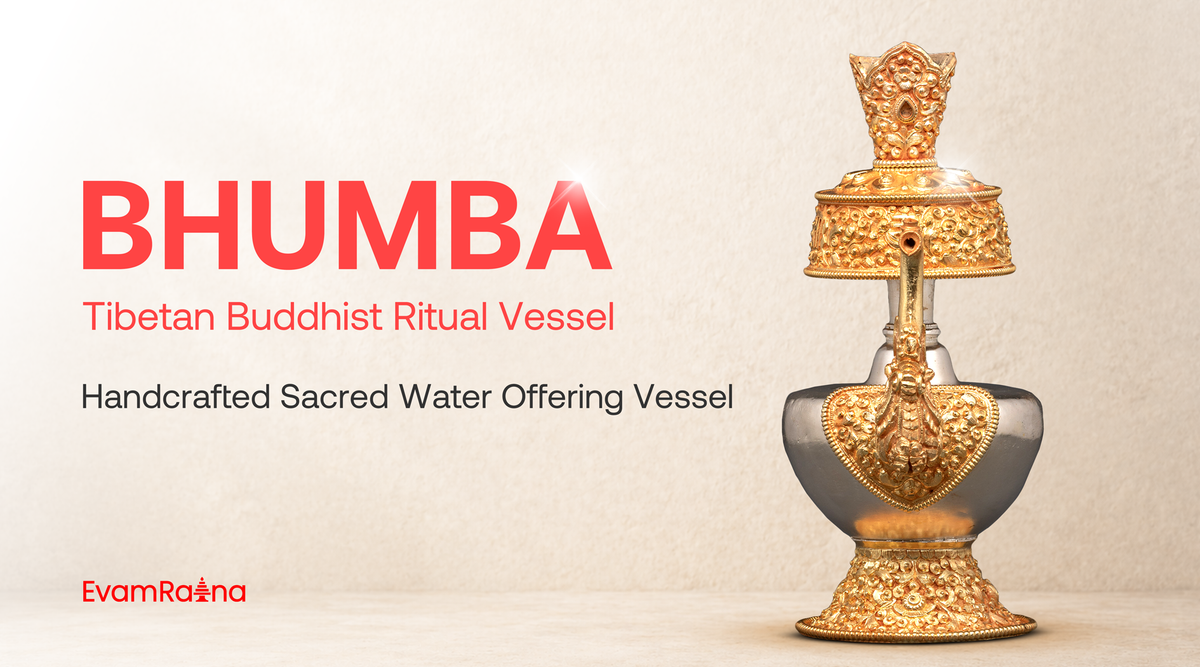
Among many Buddhist ritual items, the Bhumba, the sacred water offering vessel of Tibetan Buddhism, holds a place of profound importance. If you have encountered a Tibetan Buddhist altar or attended an empowerment ceremony, you have almost certainly seen this vessel: a graceful, bulbous vase with an elegant spout, crowned with a peacock feather and kusha grass, its copper body etched with lotus flowers and sacred symbols. It is known as Bhumba, a living instrument of purification, blessing, and spiritual transformation.
Introduction to Tibetan Ritual Bhumba:

Click Here To View Our Collection of Tibetan Buddhist Ritual Vessel Bhumba
The Bhumba, also known as Bhumpa or Bumpa is the same ritual vessel known by several transliterations of the Tibetan. It refers to a ritual vessel with a spout, used in Tibetan Buddhist ceremonies for blessing, empowerment, purification, and water offerings. It is a significant ceremonial essential for holding Guru-blessed holy water. Comprising the "chief" or "principal" vase and the "action" or "working" vase, the former is stationed on the altar, brimming with holy water in monasteries or temples. The water is actively involved in pouring water during different phases of the ritual purification. The holy water is believed to remove negativity and to chase away evil spirits.
Ancient Origins: The Bhumba in Vajrayana Buddhist Tradition
The origins of the Bhumba are in the depths of the Vajrayana, the Diamond Vehicle, the esoteric Buddhism of the high Himalayan kingdoms of Tibet, Bhutan, and Nepal. The practice of Vajrayana is full of ritual objects which are physical supports of subtle inner change, and the Bhumba takes a central role among these holy objects.
Water has always been fundamental to both Hindu and Buddhist rites. Before elaborate metalwork vases were crafted, ritual specialists used simple clay or stone vessels to hold consecrated water on the altar. Over centuries, as Himalayan metalworking traditions reached extraordinary sophistication in cities like Patan and Kathmandu in Nepal, the Bhumba evolved into a masterwork of devotional art, the copper and brass vessels we know today, inlaid with turquoise and coral, engraved with mantras and deities, and crowned with the iconic peacock feather.
The Bhumba is particularly central to Kriyayoga Tantra, one of the four classes of Tantra in Tibetan Buddhism, where the Bhumba empowerment is described as the primary ritual empowerment. It also appears in Dzogchen and Kalachakra practices, as well as virtually every major Vajrayana ceremony from house blessings to elaborate monastery rituals. There is also a cultural lore that, according to oral history from eastern Tibet, a revered lama once used a Bhumba vase filled with holy water and medicinal herbs to heal an entire village during a plague, reinforcing its symbolic power of healing and protection.
Sacred Symbolism: What does the Bhumba represent?

Every element of its form, its shape, its materials, the substances it holds, carries layers of symbolic meaning that practitioners engage with consciously in ritual.
The Vessel as the Expanse of the Universe
In Tibetan Buddhist cosmology, the Bhumba is commonly regarded as the vessel of the expanse of the universe, a vessel of water representing the totality of existence. In some ritual contexts, it is understood to represent the celestial palace of the Buddha itself: the sacred space in which enlightened beings reside and from which blessings flow outward. To pour water from the Bhumba during the ceremony is, in this symbolic register, to release blessings from the heart of reality into the world.
Water as Pure Nectar and Offering
The water that is contained in the Bhumba is not normal water. It turns into amrita, the nectar of immortality, once blessed by a lama by means of reciting mantras and meditation, and is said to possess the purifying power of the wisdom mind of the Buddha. This water is used in ritual to clean the objects, purify the spaces, and bless practitioners. The contents of the Bhumba, when offered as a water offering, are considered to be the purest offering that one can give to the enlightened beings on the altar.
The Treasure Vase: Abundance and Boundless Compassion
The unique bulbous form of the Bhumba makes it symbolically related to the Treasure Vase (Tib: Bumpa Rinchen), among the Eight Auspicious Symbols of Tibetan Buddhism. The bulge of the vase represents the limitless quality of spiritual riches, the unsurpassed generosity and wisdom of the Buddhas that can never be exhausted, however freely it is distributed. It is believed to bring prosperity, good luck, and the blessings of the three jewels in any altar where it is found.
How is the Bhumba used in Tibetan Buddhist Rituals?

The Bhumba's in rituals are varied and rich, spanning the full range of Vajrayana ceremony from daily altar practice to elaborate multi-day empowerments.
Purification and Cleansing Ceremonies
The most frequent use of the Bhumba is purification. A lama or experienced practitioner fills the vessel with clean water, recites mantras, and performs visualizations that infuse the water with the blessing power of enlightened beings. This water is then used to purify people, sacred objects, altar items, homes, temples, and holy sites by sprinkling or gentle pouring. The holy water is believed to remove negative karma, dispel harmful energies, and create the conditions for spiritual clarity and well-being.
Empowerment Ceremonies (Wang)
The Bhumba is essential to Vajrayana empowerments, the ritual transmissions through which a qualified Guru introduces students to a specific deity practice and permits them to practice advanced meditation. The water empowerment, in which blessed water from the Bhumba is touched to the crown of the initiate's head, is among the most fundamental of these transmissions. In Kriyayoga Tantra, this Bumpa empowerment is specifically identified as the main empowerment activity of the tradition.
Yonchap: The Sacred Practice of Sprinkling Blessed Water
Yonchap is the ritual of sprinkling blessed water of the Bhumba with ritual gestures or tools, normally the peacock feather sprinkler, which is attached to the spout. By means of Yonchap the Guru, or ritual expert, scatters the blessings everywhere: to those who are present, to the ritual site, to the objects which are on the altar, and, through visualization, to all sentient beings everywhere. Yonchap is performed to remove obstacles, invite harmony, bestow protection, and reinforce the positive energy of the ceremony.
Protection, Healing, and Prosperity Rituals
In addition to formal empowerment, Gurus invoke Bhumbas in all forms of enormous ceremonies: blessings to newly built houses, purification of monuments and stupas, protection ceremonies of people with problems or diseases, and longevity ceremonies during which the Bhumba water is linked to the vitality of both the practitioners and the gods.
The Anatomy of the Bhumba: Form and Spiritual Function

Every element of the Bhumba's physical form is intentional, connecting outer aesthetics to inner meaning.
The Body, Neck, and Spout
The bulbous shape of the Bhamba is its most noticeable characteristic, broad, generous, and steady as it reminds one of the unending abundance of the dharma. The body can be simple or engraved with detailed designs of lotus flowers, Buddhist symbols, deity forms, or auspicious patterns. The narrow neck symbolizes the concentrated, measured dispensation of blessings, and the graceful, curvy spout is the utilitarian conduit of the blessed water. The wide, flattened base holds the vessel steady when holding the ceremony and the altar, symbolically supporting the Buddhist teachings in the world of form.
The Peacock Feather (Bumdro): Transforming Poison into Wisdom
The most familiar ornament of the Bhumba is the peacock feather, or the Bumdro, when woven with kusha grass and brocade. The Asian Buddhist cultures regard peacocks as sacred. Their feathers are naturally shed and are picked up by the birds roaming freely across the grounds of Nepalese and Indian temples and monasteries and used as ritual ornaments. The feather with the terminal, circular mark is especially sought after, the one-eyed feather with the typical marking on the tip.
In Buddhist symbolism, the peacock's extraordinary ability to consume toxic plants without harm is understood as a metaphor for the Bodhisattva's capacity to transform the poisons of the mind, such as ignorance, attachment, and aggression, into the nectar of wisdom. The peacock feather atop the Bhumba thus represents the alchemical transformation at the heart of Vajrayana practice: poison becoming wisdom, confusion becoming clarity, ordinary water becoming amrita.
Kusha Grass and Brocade: Sacred Adornments
Kusha grass (Desmostachya bipinnata) is considered sacred across both Hindu and Buddhist traditions, and is known for its purifying properties and its association with the earth's steadiness. In the Bumdro ornament, kusha grass is bundled with the peacock feather and wrapped in brocade, a rich woven fabric, often gold and silk, that adds both beauty and symbolic richness to the assembly. Together, these three elements form a complete ritual ornament that crowns the Bhumba with layers of purification, transformation, and auspiciousness.
The Bhumba on Your Altar: Placement, Care, and Respect
Bringing a Bhumba into your home is a meaningful commitment. Being a ritual object, it holds the force to safeguard and keep the practitioners on the path of liberation, and the power comes with responsibility for respectful care.
Placement: The Bhumba should be placed on a clean, elevated surface, never on the floor or in areas where people walk or sit. On a home altar, it is traditionally positioned near statues, thangkas, or sacred images, either to the side or in front, according to the specific tradition of your practice lineage. The Tso Bum (principal vase) is typically placed centrally; the Le Bum (activity vase) can be set to one side when not in active ceremonial use.
Refilling and Refreshing: In active practice the Bhumba can be filled with clean, fresh water each day, ideally offered with the recitation of mantras and visualization, or reserved for specific ceremonies. Water should be refreshed regularly and never allowed to stagnate.
Care: Clean your Bhumba with a soft, dry cloth. Avoid harsh chemicals that may damage plating or stones. When not in use for extended periods, the vessel can be wrapped in clean cloth or silk and stored in a respectful location. Ritual objects are not decorative objects in the ordinary sense; they should be treated with the same mindfulness you would bring to any sacred practice.
Conclusion: The Bhumba as a Living Vessel of Devotion
The Bhumba, however, is, ultimately, what all great sacred objects are: an intersection point of the visible and the invisible, the manmade and the sacred, the human and the divine. In the hands of a skilled artisan in Patan, copper and brass are shaped into a vessel of extraordinary beauty. In the hands of a qualified Lama, that vessel becomes something more, a container for the blessings of the Buddha, a channel for purification, a physical anchor for the boundless compassion of an enlightened mind.
The Bhumba is a gateway to one of the most ancient spiritual traditions of the world, a tool to be held in the hand of a practitioner, a treasure to be gathered by a collector, a thing of beauty to be touched by anyone who encounters it, be it in a monastery, a shrine room, an altar where the voice of water and mantra meet.