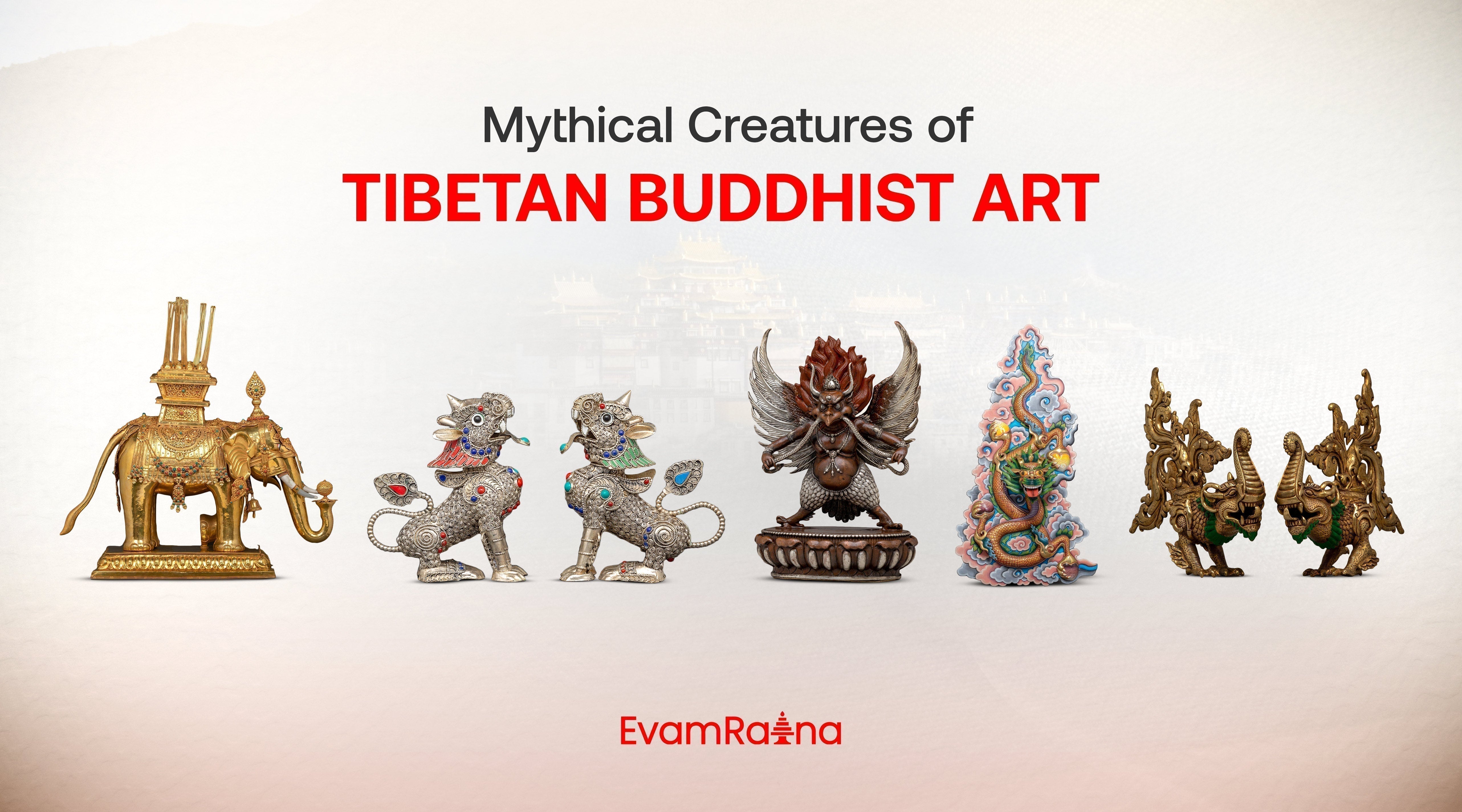
The Tibetan Buddhist art is not merely a picture of beauty, but a breathing language of symbols, tales, and cosmic power. One of its most effective manifestations is mythological animals, beings, which are situated on the border of mythology, philosophy, and spirituality. These are not just ornamental creatures but virtues, warnings, protection, and the connection that is deep between humans, nature, and the sacred.
This blog discusses some of the greatest mythical creatures in Tibetan Buddhism art, their origin, meaning, and spiritual application.
Kirtimukha (Chepu) – The Face of Majesty

Kirtimukha, meaning “Face of Glory,” is one of the most dramatic and symbolic figures in Himalayan art. Known as Chepu in Newar craftsmanship, this fierce face guards sacred thresholds.
Popular Legends of Kritimukha
There are three major legends of Kritimukha:
The Legend of Manjushri and Kiritmukha

In a Newar mythology, Manjushri convinces Chepu to strip himself and display his real form. When Manjushri reveals his great power, Chepu is overwhelmed by it and turns into formlessness; only the hands and the head can be in the clouds.
As a reward for his transformation, Manjushri orders Chepu to act as a protector at the entryways to shrines where his presence would cause fear of both evil spirits and Nagas, and ensure that the sacred areas are not damaged.
The Legend of Lord Shiva and Kritimukha

This Image is AI-generated
The Skanda Purana states that Shiva created a demon named Jalandhara, who was born from his third eye. Having a passion for Shiva's consort, Jalandhara approached Rahu, and they devised a plan to entrap her. Shiva was enraged on finding out this plan and sent out another demon through his third eye to devour Rahu. But Rahu repented, and Shiva took his repentance.
The monster ate itself up because it was hungry, and until only its face was left. Shiva was pleased with this, and so he called the creature Kirtimukha and placed him as the eternal guardian of his door.
The Legend of Garuda and Kritimukha

In one story, Chepu is the elder brother of Garuda. He was destined to be the greatest and the strongest, but hatched prematurely because of his mother, Vinata’s, impatience; he was born with only his hands and head.
Iconography & Significance of Kritimukha

In the iconography of Kiritimukha, he holds the serpent in his mouth with his two hands, and he is often shown vomiting a net of jewels from his mouth when not holding a naga
Kritimukha is placed above temple doors as a protector of Vajrayana Buddhism and the Kathmandu Valley. In some toronas, he replaces Garuda occasionally at the apex of the throne.
Nagas – Lords of Water and Hidden Wisdom

The Nagas are mystical creatures that have a history stretching to the Indus Valley civilization in Buddhist mythology. They are entrenched in the ancient cults of the serpent that greatly influenced the Indian spiritual practices and beliefs.
Origins and Lineage
Nagas and Garuda are brothers in the mythology, both of them being the sons of Kradu, who gave birth to numerous Nagas on Patala, a region located at the bottom of the world. Such mighty creatures as Shesha, Vasuki, and Takshaka rule the land of Nagas.
Role in Buddhist Cosmology
Nagas are said to live in the water bodies that are found on land, in seas, and in underground waters. They live in the lower region of Mount Meru in the Buddhist cosmology and may appear in the form of snakes or human beings, which demonstrates their flexibility and mysticism.
Protectors of Sacred Knowledge

Nagarjuna, an Indian Buddhist philosopher of the 2nd century, is reputed to have received the Prajnaparamita Sutras, transmitted directly to him by the Nagas, as terma, or hidden teachings, transferred to enlightened beings.
Powers and Consequences
Nagas have the power to field the weather and cause droughts or ill fortune on those who do not respect them. Such activities as polluting water, urinating around Naga settlements, disrespecting them, etc., are said to lead to dire consequences, such as diseases, including leprosy, cancer, and kidney diseases.
Iconography

The Eight Great Nagarajas of Buddhist art are depicted in different forms. They are frequently destroyed by wrathful gods, which symbolizes the domination of the ego. Instead, they are decorations of gods, symbolizing their controlled power over the elements and their significance in iconography.
The Dragon – Bearer of Auspicious Power
Unlike their destructive European counterparts, dragons in Tibetan Buddhist art are seen as auspicious, life-giving forces, symbolizing strength and prosperity.

Origins of the Dragon
The earliest existing examples of dragons are considerations of the Neolithic carvings dated to the 5th millennium BCE in China. These dragons were originally outlined in the I Ching, where they represent the brilliant Yang principle, which has a spirit of vitality and power.
Symbolism and Powers

Just like Nagas, the dragons are said to have the power to control the weather. They are frequently shown with four jewels, which can release dew or rain. Clenching these jewels results in strong downpours, which is a reflection of the power of the dragon over the natural elements.
Cultural Legacy
The sound of thunder, which is exemplified in the Tibetan word "Druk," indicates the strength and power of the dragon. Druk Yul, or the Kingdom of the Thunder Dragon, is the name of Bhutan, which is named after the potent image. The Bhutanese are referred to as Drukpa because they belong to the Drukpa Kagyu school of Tibetan Buddhism, one of the major schools.
Another typical symbol of dragons is the Flaming Pearl or the "Night-Shining Pearl. This pearl, according to Chinese myths, is said to be made up of the mouth of the ocean dragon, and this symbolizes wisdom, enlightenment, and the endless pursuit of the truth.
Deities Associated with Dragons in Buddhism
Here are the deities that are associated with Dragons in Buddhism:
White Dzambhala

Buddhist Monks
In buddhism, it is possible to witness Buddha or Chinese Buddhist monks with a dragon, as depicted here:

The Snow Lion – Emblem of Enlightened Majesty

The Snow Lion has an ultimate significance in Tibet and Buddhism. The lion is a symbol used by early Buddhists to identify Shakyamuni Buddha, whom they usually referred to as the Lion of the Shakyas. This lion was changed in the mind of the Himalayan high beings into the Snow lion, white and powerful and fearless.
Yogi Milarepa and Snow Lion
Milarepa once had a prophetic dream of the snow lion. His teacher, Marpha, interpreted that "The Lion pressing on the top of the pillar represents the yogi's lion-like nature, and his luxurious mane shows how he is adorned with the esoteric teachings.
Source: "The Handbooks of Tibetan Buddhist Symbols" by Robert Beer
Symbolism of Snow Lions
- The four legs of the Snow Lion symbolize the Four Immeasurables: loving-kindness, compassion, joy, and equanimity.
- Its eyes looking up at the heavens signify the rejection of worldly attachments and the desire for enlightenment.
Associated Deities
The Snow Lion is closely linked with several important deities and protectors, including:
Tseringma

Pehar Gyalpo

Namtoshe

Simhanda Manjushri

Lokeshvara

Vairocana

Infact, the Vehicle of Central Dhyani Buddha Vairocana is lions or Dragons.
The Snow Lion was so respected in the past that it was featured on the national flag of Tibet, which is an indicator of its sovereignty, purity, and spiritual power.
Garuda – The Sky Sovereign and Slayer of Serpents

One of the strongest mythical creatures in Buddhist cosmology is Garuda. Garuda came into the world originally as a myth of the Hindus, but it was through Vajrayana Buddhism that Garuda was fully absorbed, and he is now worshiped because of his immense power and his ability to protect.
Garuda is a divine creature of fire and wind, which is said to move with unsurpassable power and clear his way through all impediments as well as ignorance.
A Famous Legend of the Garuda
Garuda is a famous character in Hindusim which origin story is really inspiring. If you wish to learn more about his story, please visit this blog, Garuda Mythology.
In Buddhist Mythology, a famous Tibetan myth about Garuda holds that he devoured the jewel of the Nagas at the peak of Mount Meru and subsequently regurgitated it into the world. This tale can be used to describe one of the traditional Tibetan myths that eagle vomit is a remedy for snake poisons and toxins.
Spiritual Role of the Garuda

Amogasiddhi Buddha on Garuda Statue
Garuda is highly venerated in Bon and Vajrayana Traditions, as the practices in Buddhism are thought to dispel evil, disease, and ignorance. He serves as the vehicle of Amogasiddhi Buddha, and in Hinduism, he is the primary vehicle of Lord Vishnu. In the Terma Tradition of Buddhism, the garuda is the guardian of hidden treasures, and in the Nyingma Tradition, he personifies some wrathful forms of Guru Padmasambhava.
Makara – The Composite Guardian of Thresholds
Makara is a mythological dragon of the sea, one of the most graphically complicated beings of both Buddhist and Hindu art. It is worshiped because of its complex construction and symbolic significance in the religious sense.

Origins of Makara:
Makara is the carriage of the Vedic God of water Varuna, and is closely related to the river goddess Ganga. It is also aligned with the 10th zodiac sign in Indian astrology, which also ties it to both heavenly and earthly forces.
Anatomy of the Makara
Makara is a mythical beast, a hybrid of other animals:
- The crocodile’s lower jaw
- The elephant’s trunk
- The wild boar’s ears
- The monkey’s darting eyes
- The scaly, elastic figure of the fish.
- The peacock’s feathers
When it passed on to the Tibetan art, it developed further in form and included:
- A lion’s forepaw
- A horse’s mane
- A dragon horn
Artistic Role of the Makara

The Makara is often seen in toranas (decorative gateways), with ritual blades emerging from its mouth. It is also commonly used as a water spout in temples. It is heavily incorporated into Buddhist iconography, such as Toranas and Carvings, symbolizing it as the guardian of protection.
Here in this torona, Makara is placed below the garuda on both sides to represent the protection and stability.
Mythical White Elephant - Symbol of Stability

Symbolism of the Elephant in Hinduism and Buddhism
Elephants are also widely used in Hinduism, particularly in the seven items of a Chakravartin (the ruler of all), the elephant being a valuable symbol. The animal that carries Indra, the king of gods, is Airavata, the six-tusked bull elephant. The Lord Ganesha, the god of wisdom, also has strong relations with themes of elephants because he has an elephant head as a sign of cleverness and clarity.
According to Buddhism, the white elephant is frequently associated with Queen Maya's dream, the mother of the Buddha. She even had a dream of a six-tusked white elephant falling in her womb during conception, which was regarded as a sign that her child would become the Buddha. The white elephant here symbolizes the purity and goodness that heralded the spiritual path taken by the Buddha.
Iconography of the Mythical Elephant in Buddhism:

AI-Generated Content
The elephant in Buddhist iconography has a greatly strong and dignified shape, which represents the enormous strength that is controlled by peaceful consciousness and controlled wisdom. Well above its head is the Dharma Wheel, that symbol of the Buddha and the unstirred path of righteousness, which even great power is kept within.
The elephant is frequently covered with jewels and fine ornaments, both as an expression of the spiritual prosperity and the richness of the awakened qualities, instead of the luxurious worldly life. On the back, it carries a wish-fulfilling jewel, which indicates the fruit of good intentions and prosperity out of merit. The elephant might have a radiant jewel at the end of its trunk or, in other iconographic traditions, a bowl of vermilion, which symbolizes blessings, good fortune, and divine gifts. Collectively, these elements focus the elephant as a kind and mighty protector of the Dharma- steady, generous, and most symbolic of enlightened power.
Deities Associated with the Elephant in Buddhist Art:
Samanthabhadra

Aksobhya Buddha

Aksobhya Buddha Statue on Elephant
Conclusion: The Timeless Symbols of Wisdom
Tibetan Buddhist art is a strong combination of mythology, spirituality, and cosmic energy. Not only are the depictions of the mythical creatures, the Snow Lion, Garuda, Nagas, Makara, and the White Elephant, but they also hold significance in the form of virtues and teachings. They symbolize protection, wisdom, strength, and purity, and each is an important facet of the enlightenment road. These creatures remind their devotees of the innermost relationship between man and nature, as well as of the sacred, and help them achieve spiritual development and the Dharma itself. The Tibetan Buddhist art remains very inspirational and educational through its symbolism.