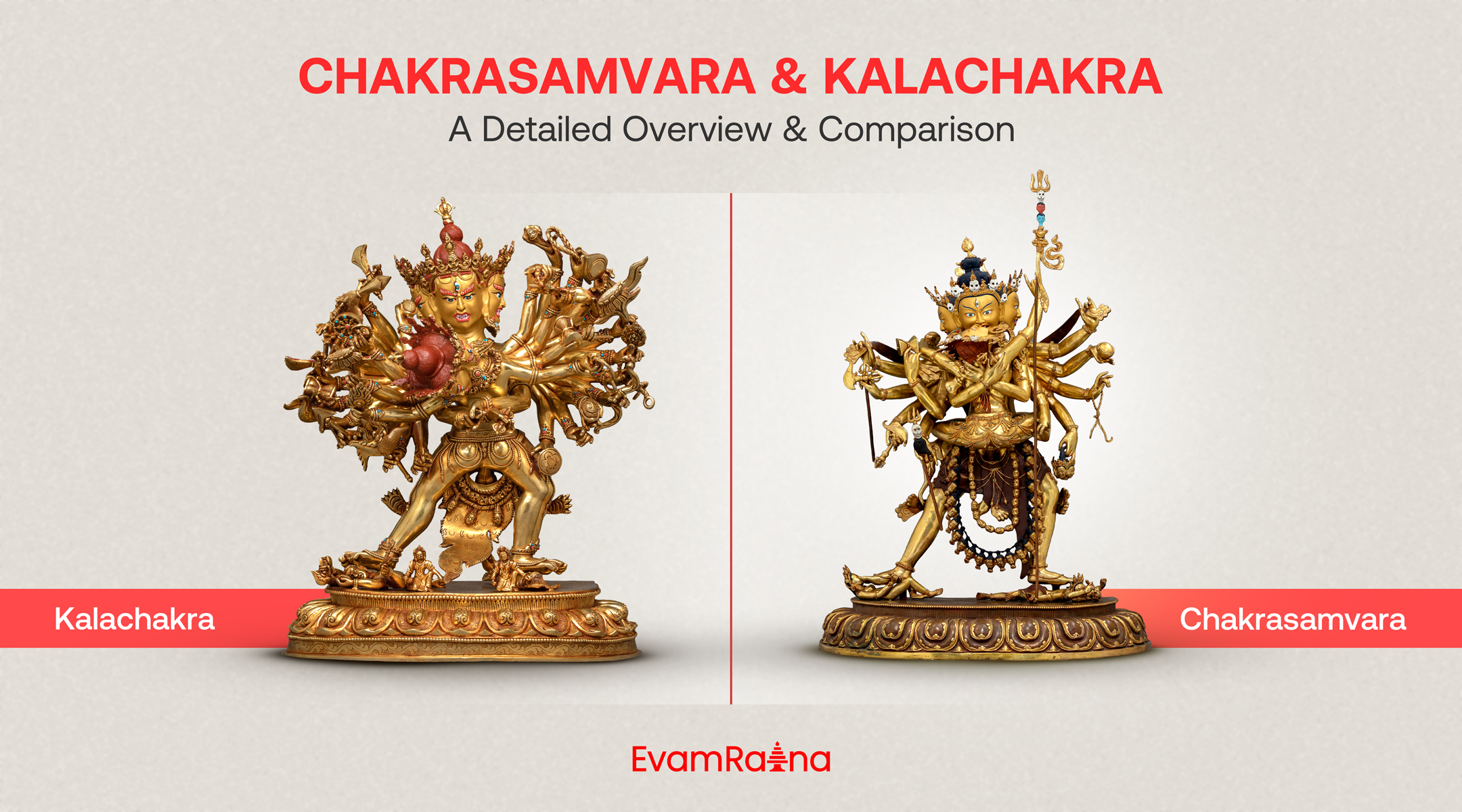
Chakrasamvara and Kalachakra: A Detailed Overview and Comparison
Two of the significant tantric deities in Vajrayana Buddhism are chakrasamvara and Kalachakra, and both have significant spiritual implications. Nevertheless, they are very visible, and most individuals find it hard to differentiate them because they are similar in terms of iconography and teachings. The purpose of this blog is to explain the main distinctions between Chakrasamvara and Kalachakra and to investigate their peculiarities, functions, and practices. These differences will make the blog useful to practitioners as they become aware and familiarize themselves with each deity, and this information will enable them to enhance their Tantric practices as Buddhists.
Chakrasamvara: The Tantric Deity of Union and Transformation

The Wheel of Bliss (Chakrasamvara) is one of the key figures of the Vajrayana school of Buddhism, especially the Anuttarayoga Wisdom (Mother) classifications. Chakrasamvara is one of the most respected Tantric Buddhism deities and is very important in the Himalayas and Tibet, especially after the 11th century.
Shown in many different ways, peaceful and wrathful, simple and complex, Chakrasamvara is the incarnation of wisdom and compassion. His consort, Vajrayogini, is an extension of his vigour, enhancing the transformative effect of their union. The complex and varied representations of the deity owe their premise to Tantric Buddhism, with more than fifty different lineages, all of which provide their own meditation techniques depending on the emotional and psychological requirements of the practitioners.
Following its origins to early India, the concept of Chakrasamvara easily found its way to Tibet, where it was adjusted to local traditions and strengthened its spiritual importance in all cultures and eras.
Kalachakra: The Wheel of Time and Cosmic Order

The Kalachakra, or the Wheel of Time, has its origins in ancient India, where it was initially passed down by the Buddha Shakyamuni as esoteric teachings. Such teachings were subsequently contained in the Kalachakra Tantra books, which became part of the wider Buddhist canon. An important aspect of the Kalachakra story is that it is linked to the mystical kingdom of Shambhala, which represents the optimal balance, knowledge, and the ultimate aim of spiritual realization. This utopian world is also the idealized world that depicts the ideal society as taught in the teachings.
There is a profound spiritual meaning of Kalachakra that was introduced to Tibet by great masters such as Atisha and later expanded by Tibetan scholars and practitioners.
The doctrine was popularized by the activities of the Dalai Lamas, who have been instrumental in the propagation of the Kalachakra Tantra. His Holiness the 14th Dalai Lama has turned the Kalachakra initiation into a worldwide affair where he has conducted public initiations that have spread the teachings to the global world, not limited to cultural and geographical borders.
Kalachakra is normally portrayed alongside his mistress, Vishvamata, whose presence enhances the transformative energy of the wisdom of the deity. They are combined and represent wisdom and compassion integration, and they provide such depth that spiritual practitioners may go through.
Differences Between Chakrasamvara and Kalachakra
Now that we have discussed the origins and the deities, let's delve into their differences:
Key Iconographic Differences
1. Consort's Leg Position

Chakrasamvara:
In the most common depiction, Vajrayogini, the consort of Chakrasamvara, has her left leg standing with her foot on the ground.
Right leg bent and wrapped around Chakrasamvara. This is typical in the Krishnacharya tradition.
In the Luipa and Ghanta traditions, both legs of Vajrayogini are wrapped around Chakrasamvara.
Kalachakra:

Vishvamata, the consort of Kalachakra, is depicted with both feet on the ground, unlike Vajrayogini.
Vishvamata often has multiple faces, which can be another identifying feature.
2. Face of the Consort

Chakrasamvara:
Vajrayogini is depicted as a single face, often with a fierce or serene expression, depending on the tradition.
Kalachakra:
Vishvamata is depicted with multiple faces, symbolizing the multifaceted nature of the deity and the teachings.
3. Two-Armed Versions

Even in the two-armed version, Vajrayogini's feet do not touch the corpses, and her legs are wrapped around Chakrasamvara.
Kalachakra:
In the two-armed version, Vishvamata’s feet are firmly placed on the corpses, emphasizing her grounded nature.
Thangka Art Comparison of Chakrasamvara and Kalachakra

Kalachakra Thangka Symbolism:
Front Face (Blue): Fierce yet compassionate, symbolizing the transformative power of wrathful compassion—turning anger into enlightened energy.
Right Face (Red): Radiates vitality and warmth, representing passion and attachment transformed into awakened consciousness.
Left Face (White): Embodies calm, serenity, and clarity of mind.
Body Color: Dark blue, symbolizing wisdom, complemented by the consort in orange, representing energy.
Consort's Color: Orange, symbolizing vitality and Energy
Chakrasamvara Thangka Symbolism:
Central Face (Blue): Serene and stable, symbolizing compassion.
Left Face (Red): Represents passion transformed into wisdom.
Right Face (White): Denotes purity and clarity of mind.
Consort's Color: Red, symbolizing energy and vitality.
Color Palette & Style:
Chakrasamvara:
Earthy tones with blues, reds, and muted hues, creating a serene, meditative atmosphere. The deity's blue skin symbolizes wisdom, while the soft background tones enhance its peaceful presence.
Kalachakra:
Vibrant, contrasting colors like red, green, gold, and turquoise. The bright yellow skin symbolizes energy and transformation, while the dynamic background of blues and purples reflects cosmic energy and the cycles of time.
Kalachakra thangka is dynamic and expansive, highlighting cosmic movement and balance, while Chakrasamvara emphasizes calm, wisdom, and spiritual balance.
Kalchakra and Chakrasamvara Mandala
The Kalachakra and Chakrasamvara mandalas both represent complex systems within Tibetan Buddhism, but they differ in their symbolism, structure, and focus.
Kalachakra Mandala:

The Kalachakra Mandala, which is a sacred design because of its detailed design, represents the Cycle of Time and also carries the themes of Time, cycles, and cleansing. It depicts a multi-dimensional universe, and the theme of the primary one is Kalachakra as the Wheel of Time. The geometric form of the Mandala symbolizes the relation of the outer and the inner world, the passage of the normal life into Enlightenment.
It is a visual map, and it is highly rooted in the tantric tradition. The colorful image and extensive use of symbols direct adherents to the experience of Buddhahood. It is most striking in its complex layers, a symbolism of the body, speech and mind of the practitioner, and the gods, notably of Kalachakra and Vishvamata, the cyclic quality of time.
Chakrasamvara Mandala:

Chakrasamvara mandala is, on the other hand, more organized in visualization and is aimed at cleansing the mind and heart. It is a construction of the picture of a square with cardinal directions with vajras, flames, and lotus petals around it and is taken to symbolize the purification of all the negative emotions such as anger, pride and jealousy into wisdom.
The main deity, Heruka Chakrasamvara, is shown surrounded by other deities, all of whom portray various images of Enlightenment. The Chakrasamvara Mandala lays great emphasis on the transformative process in the mind, where it takes the practitioner through a process of cleansing the psycho-physical elements. The square form of the Mandala with its cardinal direction colors compares the cyclic nature of the Kalachakra as a time frame to the more focused meditation of the Chakrasamvara on the process of internal purification with the five Buddhas.
Although the Kalachakra Mandala is the detailed visual and ritual map of the cycles of time and the passage to Buddhahood, the design of the Chakrasamvara Mandala is aimed at the result of the purification of the mind and the heart due to the visualization of the gods and Goddesses. The two mandalas are effective instruments for practitioners, but they focus on different aspects of Buddhism practice, where one is a device used to comprehend the universe and the other a device used to cleanse the internals and spiritual purity.
Difference in Practices and Rituals
The Chakrasamvara practice is centered mostly on the marriage of wisdom and method. This is symbolized in the core deity, Chakrasamvara, and his partner Vajrayogini, which symbolizes the unification of compassionate action and wisdom. The focus of the ritual practice is the empowerments and visualizations that enable the practitioners to be able to relate to these energies. The rituals usually entail elaborate visualizations, the recitation of mantras and offerings, which are supposed to cleanse the mind and body and to change the mundane consciousness of a practitioner to enlightened consciousness. Chakrasamvara Tantra also focuses on wrathful practices, with deities portrayed in wrathful forms, which represent the demolition of all the hindrances and ignorance on the path to enlightenment.
On the contrary, the Kalachakra meditation emphasizes the cyclical wholeness of time and the oneness of all phenomena. The main deity, Kalachakra, is the symbol of the cyclicness of the world, and all the practices aim to unite the energy of the practitioner with these cosmic time cycles. Kalachakra practices commonly include extremely involved initiation, in which the Kachakra practitioner is empowered by a qualified teacher, and meditative practices oriented towards cleansing the practitioner, aligning his or her body, speech, and mind with the enormous energy of the cosmos. The Kalachakra Tantra also puts great stress on Shambhala, and the meditators will focus on this sacred kingdom as the culmination of their spiritual path. As well, the kalachakra practices are closely connected with the time cycles, and the meditators tend to meditate about time, space, and the reality that exists, in order to comprehend the actual essence of existence.
Conclusion
To sum up, Chakrasamvara and Kalachakra are considered to be the foundations of Vajrayana Buddhism, and both of them provide an individual way to spiritual enlightenment. Although these two possess common features in terms of their symbolic functions of wisdom, compassion, and transformation, their iconography, rituals, and teachings offer different practices to the various facets of the process of the practitioner. Chakrasamvara focuses on the marriage between wisdom and means; he is interested in the transformational energies of compassion and wisdom, and he emphasizes wrathful practices that dismantle barriers on the way to enlightenment. Kalachakra, on the other hand, revolves around the cyclicality of time and the inter-relationship of all things and practices that help practitioners synchronize themselves with cosmic time and have a harmonious relationship with the sacred world of Shambhala.
Knowing the distinctions of the two gods, their related Mandala, and their rituals, practitioners in Tantra can enhance their Tantric practices and have a clear picture of which is the right path and what is in accordance with their spiritual requirements. Both Chakrasamvara and Kalachakra have potent means of change, and each of them is relevant to the overall aims of liberation, wisdom, and enlightenment in their own significant and remarkable ways. Through becoming acquainted with these differences, practitioners are able to deepen their knowledge, enrich their practice of meditation, and become better participants in the transformative process that Tantric Buddhism provides.