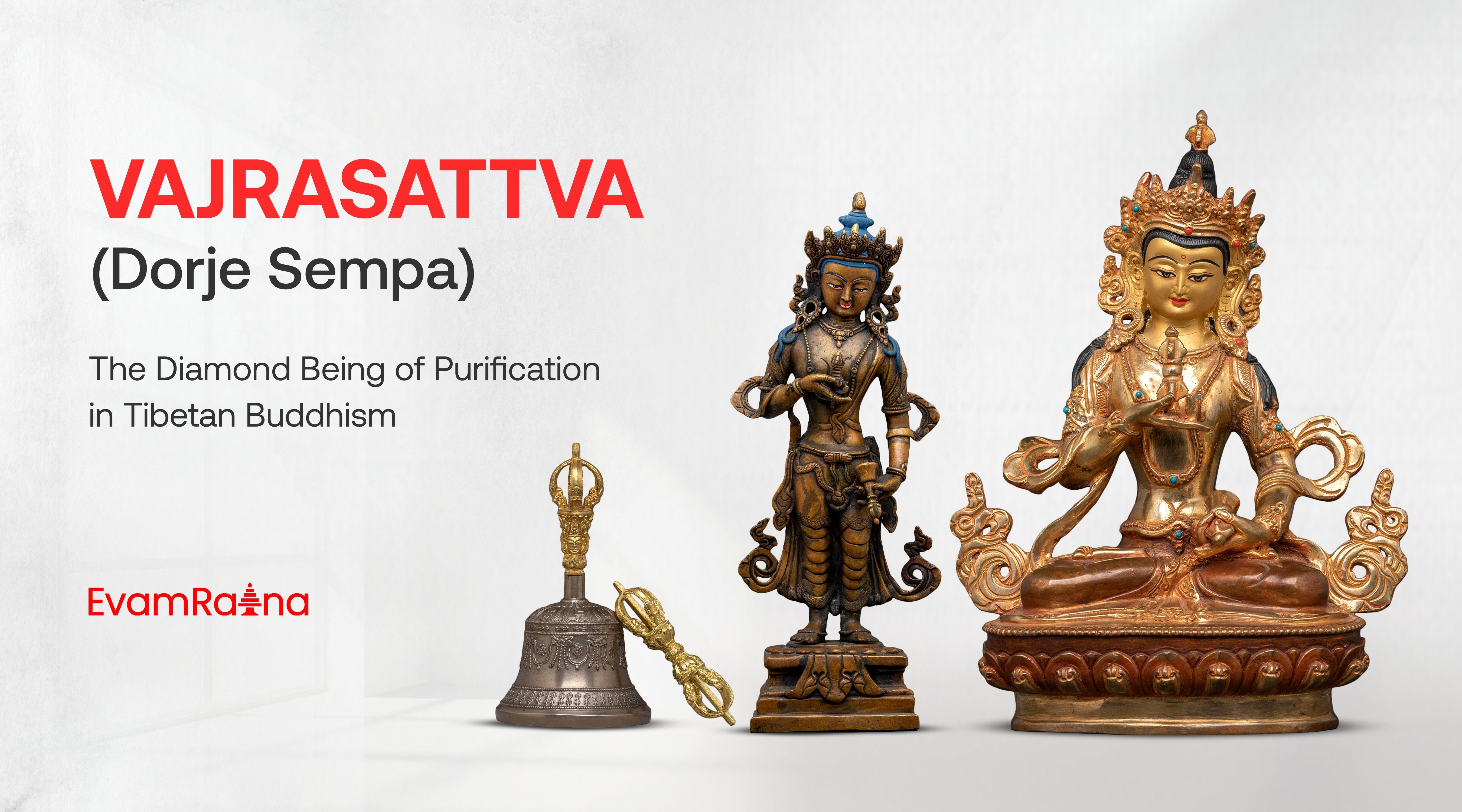
Understanding Vajrasattva's Role in Karma Purification in Tibetan Buddhism
Vajrasattva, known as Dorje Sempa in Tibetan, is the Buddha of primordial purity, the great purifier, and the deity whose very name is said to carry the power to dissolve lifetimes of accumulated negative karma. He serves as the primary deity of purification in Tibetan Buddhism. He is a Sambhogakaya Buddha and the personification of the vajra, representing the indestructible and luminous nature of the awakened mind. Central to his practice is the Hundred-Syllable Mantra, a potent spiritual tool for cleansing negative karma, emotional burdens, and broken spiritual commitments.
Introduction of Vajrasattva

The Vajrasattva is a Sanskrit word composed of two words: Vajra, which means diamond or Thunderbolt, symbolizing both indestructible and supremely clear, and sattva, meaning being or one of noble essence. Together, the name is most commonly translated as "Diamond Being" or "Thunderbolt Being."
The diamond metaphor is central to understanding Vajrasattva. Just as a diamond cannot be scratched or diminished, the pure awareness at the heart of all beings cannot be corrupted by negativity. Vajrasattva embodies and reflects that indestructible purity back to practitioners, reminding them that no matter how heavy the accumulation of karma, the underlying nature of the mind remains perfectly untouched.
The Iconography of Vajrasattva:

Traditional depictions of Vajrasattva follow precise symbolic conventions, each detail carrying meaning for the practitioner who meditates upon him.
- Color: Vajrasattva's body is brilliantly white, luminous, and radiant, often described as a snow mountain illuminated by a thousand suns. White in Tibetan Buddhist iconography signifies purity, clarity, and the complete absence of defilement. His whiteness is not blank emptiness but active luminosity, the quality of awareness that perceives without distortion.
- The Vajra (Dorje): In his right hand, raised to the level of his heart, Vajrasattva holds a golden vajra. The vajra represents skillful means (upaya), the active, compassionate engagement with beings to liberate them. It also represents the indestructible nature of enlightened awareness, the clarity that cuts through illusion without itself being affected.
- The Bell (Ghanta): In his left hand, resting upon his left thigh, he holds a silver bell. The bell represents wisdom (prajna), specifically, the wisdom of emptiness, the direct insight into the nature of reality. Together, the vajra and bell in Vajrasattva's hands represent the inseparable union of compassion and wisdom, the two wings of enlightenment.
- Posture and Seat: Vajrasattva sits in the full vajra posture upon an eight-petalled lotus of purest white, symbolizing his abiding in the state of primordial purity. In some iconographic traditions, he is depicted with his right leg slightly extended, a gesture indicating his readiness to step forward and help beings who call upon him.
- Dress and Adornments: He is adorned with the jewels and silks of a bodhisattva, not the simple robes of a monk, but the garments of spiritual royalty. This reflects his sambhogakaya nature: a being who manifests in the richest possible form to benefit those who are capable of perceiving that form.
Vajrasattva and His Two Sacred Implements

Look at any traditional image of Vajrasattva, painted on a thangka, or a statue, or described in a sadhana text, and what defines him visually is what he carries.
In his right hand, raised to the level of his heart: a golden vajra. In his left hand, resting at his hip: a silver bell. He does not hold them casually. The vajra is pressed to his heart as if it were the most important thing he owns. The bell rests against his body with quiet confidence, its weight balanced, its shape complete.
Vajra and Bell are core emblems of the Vajrayana symbolic domain. Vajrasattva displays Vajra and Ghanta as the attainment of the adamant state, Shunyata.
These two objects are so central to his identity that his very name carries the first of them. Vajra-sattva. The Diamond Being. A being defined by the indestructible, thunderbolt quality of enlightened awareness and who holds that quality in his hand, at the heart level, as an offering to anyone who approaches his practice.
Understanding Karma and Why Purification Matters in Tibetan Buddhism
To understand Vajrasattva's role, it is essential first to understand what karma means in the Tibetan Buddhist framework and why purifying it is considered so urgent.
Karma (Tibetan: las) refers to the imprints left in consciousness by every action, word, and thought. Karma isn’t just about moral scores; it refers to the subtle effects in our mind that shape our future experiences, how we see the world, and even our rebirth. Negative karma creates the conditions for suffering: not as punishment, but as a natural consequence. It’s like when a stone is dropped in water, it naturally creates ripples, just as our actions create consequences in our lives.
In Tibetan Buddhism, practitioners acknowledge that the weight of accumulated negative karma, from this life and countless previous lives, creates what are called obscurations. These obscurations veil the mind's luminous nature and prevent genuine spiritual progress. They manifest as emotional reactivity, distorted perception, mental fog, and an inability to access the deeper clarity that practice is meant to reveal.
The Vajrayana tradition teaches that purification is not supplementary to the spiritual path; it is the path, at least in its foundational phase. Without actively working to dissolve these karmic imprints, even the most diligent meditation practice will struggle to penetrate the layers of obscuration that cloud the mind's natural brilliance.
Vajrasattva practice directly addresses this challenge. It offers what the teachings describe as the most powerful, most swift, and most complete method of purification available within Vajrayana Buddhism.
Vajrasattva's Role as the Supreme Purifier

Vajrasattva is described in the teachings as the sambhogakaya Buddha, one of the three bodies (kayas) of enlightenment, associated with the realm of pure form, bliss, and communication. In this capacity, he is the sovereign of all Buddha families, the one who embodies and transmits the purifying qualities of every enlightened being.
His vow, recorded in the tradition, is extraordinary in scope. Upon attaining enlightenment, Vajrasattva made the following aspiration:
"May all beings be purified of their obscurations, their negative deeds, and their dense darkness of ignorance, simply by hearing my name, seeing my form, thinking of me, or reciting the mantra that contains my name."
This vow is inspirational and is the doctrinal basis for Vajrasattva's efficacy as a purification practice. Because he made this aspiration and fulfilled it through the attainment of Buddhahood, practitioners who call upon him with sincerity enter into the field of his enlightened activity.
Importantly, the teachings do not present Vajrasattva as an external savior. Rather, he is understood as a mirror of one's own pure awareness, a reflection of the Buddha nature that already exists within every sentient being. His practice dissolves the layers of obscuration not by importing something foreign, but by removing what has accumulated and revealing what was always already present.
Benefits of Vajrasattva Practice: What the Teachings Say
The scriptural and oral teachings of Tibetan Buddhism describe the benefits of Vajrasattva practice in expansive terms. These are the potential fruits of sincere, sustained engagement with the practice.
-
Purification of negative karma: The primary purpose of the practice. The teachings outline the mantra of Vajrasattva to have the power of cleansing even the heaviest of karmic deposits, those actions that would otherwise be subject to suffering over a multitude of rebirths.
- Repair of broken vows and samayas: For Vajrayana practitioners, samaya vows, the sacred commitments made at empowerment, are very vital. Breaking these vows creates serious obstacles to practice. Vajrasattva is specifically described as the remedy for samaya violations, capable of restoring the purity of one's commitments when practiced with the four powers and genuine resolve.
- Removal of obstacles: Practitioners report that consistent Vajrasattva practice clears the way for other practices to deepen, for circumstances in life to become more workable, and for the mind to become clearer and more available for meditation.
- Healing: The purifying nectar visualization is associated with healing on physical, emotional, and mental levels. While the tradition is careful not to present this as medical treatment, many practitioners report significant shifts in well-being following periods of intensive Vajrasattva practice.
- Progress toward enlightenment: By dissolving the obscurations that veil Buddha nature, Vajrasattva practice directly supports the ultimate aim of all Vajrayana practice, the recognition and stabilization of one's own enlightened nature.
How the Vajra and Bell Function in Vajrasattva Ritual

During Mantra Recitation
The vajra is held in the right hand (which is facing down), and the bell in the left hand (which is facing up), and they are moved in elegant movements during chanting.
The hand positions are specific during Vajrasattva mantra recitation. The right-hand falling approach goes down into the world, working with experience. The facing-up left hand wisdom open, receptive, receiving emptiness. The gestures throughout the recitation are not decoration; they are a language of the body that mirrors and reinforces what is happening in the mind and the visualization.
During the Vajrasattva Visualization
The ritual application of the instruments is still more personal in the Vajrasattva practice in particular. The vajra can be used for visualization or evocation of deities; ringing the bell can be used to request protection or other actions from a deity, or it can represent the teaching of dharma, and can also be a sound offering.
When the practitioner visualizes the Vajrasattva above the crown, white, luminous, grasping his own vajra and bell, then he sees the purifying nectar flowing down, the physical vajra and bell in the hands of the practitioner are anchors. They relate the visualization to the body. They make abstract purification into something felt, held, heard.
Opening and Closing Sacred Space
Practitioners practice meditation to develop a calm, focused mind that is the perfect setting for beginning the ritual. The environment is surrounded by sacred symbols and offerings in order to help generate a spiritual experience. Before any sacred event begins, purification rituals are performed to purify the mind, body, and environment with the use of water, incense, and the chanting of sacred mantras.
Practice starts with the ringing of the bell, which consecrates the space to invite wisdom and marks the transition between normal activity and sacred activity. It is struck once more at the end of practice, closing what has been achieved and bringing back to everyday life what has been perceived during practice.
Read More About Unlocking the Secrets of the Vajra and Bell: A Guide to Ritual Practice
Conclusion: Let the Vajra and Bell Begin Your Practice
Vajrasattva (Dorje Sempa), the Diamond Being, is invoked for the purification of negative karma, the repair of broken commitments, and the dissolution of the obscurations that prevent us from recognizing our own luminous nature. These are the most human of concerns.
And the instruments through which that purification flows, the vajra and the bell, are among the most beautiful, most symbolically rich, and most practically powerful ritual objects in the entire Vajrayana tradition. The vajra in the right hand: indestructible compassion, skillful means, the force that cuts through obscuration without being cut. The bell on the left: the voice of wisdom, the sound of emptiness, the resonance that reminds awareness of its own boundless nature.
When you hold a vajra and bell in your own hands, the two things that Vajrasattva holds at his heart and at his hip. You are placing yourself in the iconographic position of the deity himself, who has vowed to purify all negativity, for all beings, for all time.
Begin there. With sincerity. With the mantra. With the vajra in your right hand and the bell in your left.