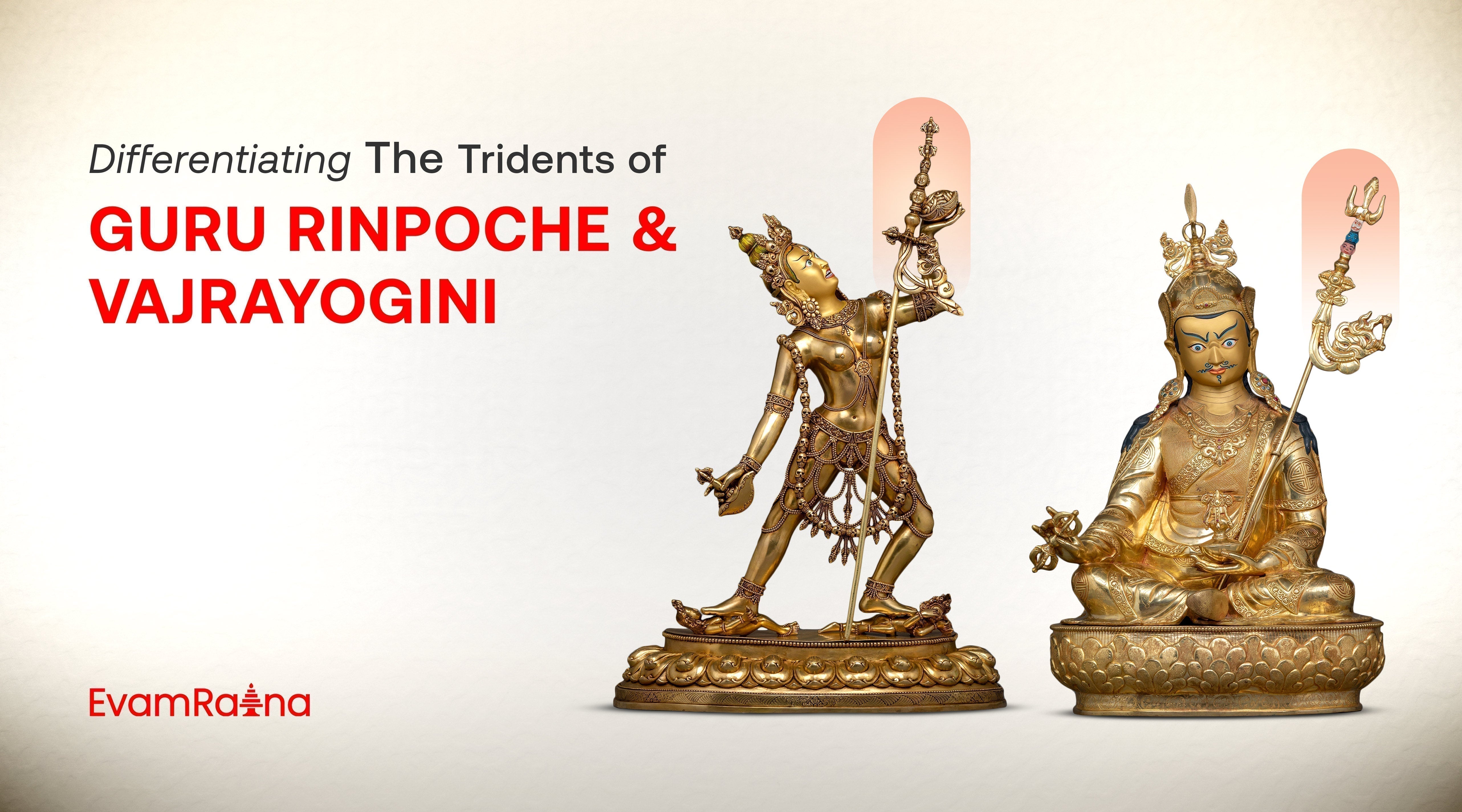
The Khatvanga Trident of Guru Rinpoche and Vajrayogini
Tridents hold a special place in the rich tapestry of Buddhist iconography, which is not merely an ornament or weapon. A lot of meanings are attached to them and usually bring out the deep spiritual truths of the teachings. The Khatvanga trident is one of the most noticeable signs in Vajrayana Buddhism as a potent and versatile sign that the divine beings used to reveal their peculiarities and the symbolism of the universe. This blog discusses the special meanings and purposes of the tridents of two of the most esteemed personalities of Tibetan Buddhism: Guru Rinpoche (Padmasambhava) and Vajrayogini.
The Trident of Guru Rinpoche (Padmasambhava)

Padmasambhava, or Guru Rinpoche, is the legendary figure who introduced Tantric Buddhism in Tibet. The trident of his has a unique design and is related to spirituality. The trident of Guru Rinpoche is a combination of the traditional trident (with three prongs) and the Tantric Buddhism Khatvanga staff, as it is trident-topped. In his Iconography, the khatvanga trident is held by his left shoulder, in an elbow-joint position.
In numerous iconographic representations of Guru Rinpoche, the trident will have a puff of fire above the middle, the power of wisdom to transform. Under the trident is commonly found three separate heads piled on top of each other, representing the three kayas or three bodies of the Buddha (Dharmakaya, Sambhogakaya, and Nirmanakaya).
Some of the variations depict a trident with three groups of three heads, further highlighting the cycle of life according to buddhist philosophy (Birth, Death, and Rebirth). A vase and a half of Vishva-vajra, which symbolizes the unity of wisdom and compassion, is placed at the middle of the trident.
The importance of the flaming trident of Guru Rinpoche is connected to his teachings about the Three Jewels (Buddha, Dharma, and Sangha) and the Three Kayas. It also symbolizes his consorts:
-
Yeshe Tsogyal
-
Mandarava
-
Shakyadevi
-
Kalasiddhi
-
Tashi Khyidren
The Trident of Vajrayogini

The trident of Vajrayogini is unlike that of Guru Rinpoche, especially in that it does not possess the flaming prongs attribute. Rather, the trident of Vajrayogini has been frequently represented as a Khatvanga staff topped by a vajra, used to represent the marriage between wisdom and compassion.
The trident has a deep symbolic meaning in the practice of Vajrayogini, as it is the embodiment of the harmonious union of method and wisdom. At the very center of this symbolism is the vajra at the top of her staff that symbolizes her male consort, chakrasamvara , the ability to have skillful means and method.
The trident on the bottom, on the other hand, is representative of the feminine element of wisdom and reflects the developmental feature of wisdom in the practice of Vajrayogini. This is a combination of the male and female energies, which is an enlightened union of wisdom and method. It is a direct experience of the practice, and the trident can be used as a cutting tool to slice through the illusions in the mind and lead the practitioner to the process of realizing emptiness and non-duality.
Contrast Between Vajrayogini & Padmasambhava's Trident:

The khatvanga of both deities could appear similar, but there is a slight iconographical and symbolic difference between them:
Vajra vs. Flaming Topped Trident:
The trident of Guru Rinpoche is covered with flames of the power of transformation by wisdom, and the trident of Vajrayogini is topped with a vajra, the female consort and the vehicle of approach. The trident of Vajrayogini does not require flame, as she is the fire of knowledge.
Symbolical Difference:
There is a stark symbolic contradiction between Vajrayogini and Guru Rinpoche's trident, as Vajrayogini's vajra-topped trident highlights the male consort, Chakrasamvara, and the essence of method.
In contrast, Guru Rinpoche's trident highlights his female consorts and the nature of wisdom.
Protection vs Transformation
Guru Rinpoche khatvanga trident conveys the meaning of protection, such as eliminating the spiritual hindrances, ignorance, and ego, as well as protection from the negative worldly influences. So, the visualization of Padmasambhava's Khatvanga for protection is best suited.
The Vajrayogini Khatvanga Trident represents the transformation of negative emotions and energies to positive ones.
Similarity in Trident's Iconography
While some of the trident's attributes are different due to what both legendary figures represent, here are some of the similarities we can witness in both tridents:

Three Skulls:
The two deities have three skulls in their trident, which signify how the three poisons (ignorance, attachment, and aversion) became wisdom. This is the overcoming of delusion and the understanding of the three bodies of Buddha, a fundamental teaching of the Vajrayana Buddhism.
Kalasha (Sacred Water Vase):
Kalasha, a sacred water vase, is portrayed in the tridents of both Vajrayogini and Guru Rinpoche. It is the motherly wisdom, power, and the cleansing of ill karma. It also represents the abundance of spiritual blessings and wisdom that the two legendary figures provide to the people who perform them.
Half Viswa Vajra:
The half Viswa Vajra is a representation of the wisdom that is indestructible. In the trident of Vajrayogini, this symbolizes the male consort (method), and in the trident of Guru Rinpoche, this is the way he has turned the obstacles into wisdom. It is an embodiment of the marriage between wisdom (feminine) and method (masculine), the basis of Vajrayana practice.
Bell and Damaru on Silk Ribbon:
Bell and damaru (drum), suspended on a silk ribbon, are ritual items of Vajrayana Buddhism. The bell is a symbol of wisdom, and the damaru is the symbol of method. Their attachment through the silk ribbon means the oneness of wisdom and compassion, which is reflected in their doctrines and actions.
Sandalwood Shaft:
The trident purifies and brings spiritual clarity, and this is symbolized by the sandalwood shaft. Sandalwood is attributed to its relaxing and cleansing properties, and the fact they are used in the tridents of Vajrayogini and Guru Rinpoche indicates the purpose of the trinities to help the practitioners cut off ignorance and to bring about a purified, enlightened state of mind.
These similar iconographical elements, combined, help to strengthen the functions of Vajrayogini and Guru Rinpoche as the powerful deities who help the practitioners in their transformation of delusion into wisdom, the integration of compassion and wisdom, and in their spiritual enlightenment.
Ritual and Iconographic Distinctions

By: institutvajrayogini.fr
Another difference between the two tridents is their ritual and iconography. The flaming trident of Guru Rinpoche is frequently employed in rituals that are centered around protection and throwing off impediments. Most tantric practices include Guru Rinpoche as their teacher and protector.
Vajrayogini, on the other hand, uses the trident in rituals that aim at metamorphosis and knowledge attainment, usually by means of activities such as sadhana and visualization.
Conclusion
In conclusion, both tridents serve as potent reminders of the union of wisdom and compassion in Vajrayana Buddhism, guiding practitioners on the path of enlightenment through their transformative and protective power. The differences in their symbolism reflect the unique roles of Guru Rinpoche and Vajrayogini in the spiritual journey, yet both play vital roles in aiding practitioners' progress toward awakening.