Exploring the Meaning Behind Mandala Offerings: A Sacred Practice for Inner Peace and Enlightenment
What if I say that you could hold the entire universe in the palm of your hand, every star, every mountain, and every success you’ve ever dreamed of, only to discover that the greatest power lies in giving it all away? In Tibetan Buddhism, the mandala offering is known as the highest ritual expression of devotion, a practice that helps us to build spiritual merit and counteract negative traits like ego and attachment.
If you are seeking a path to inner peace or you are curious about how an ancient ritual can help you navigate modern stresses like greed, anxiety, and ego, this practice holds a transformative secret. Let’s dive into how visualizing a perfect, purified cosmos can help you liberate your mind and connect with a purpose that is much bigger than you.
Introduction: What is a Mandala Offering?

A mandala offering is a ritualized act of devotion where a practitioner offers a symbolic representation of the purified cosmos to a lama, teacher, or meditational deity. In Sanskrit, the word mandala signifies a "circle" or "sacred center". However, its Tibetan translation (dkyil ’khor) carries a deeper meaning: "that which circles a center" or, more importantly, "absorbing the essence". Through this practice, the practitioner mentally gathers everything valuable in the universe and offers it as a gesture of total surrender and commitment to the path of enlightenment.
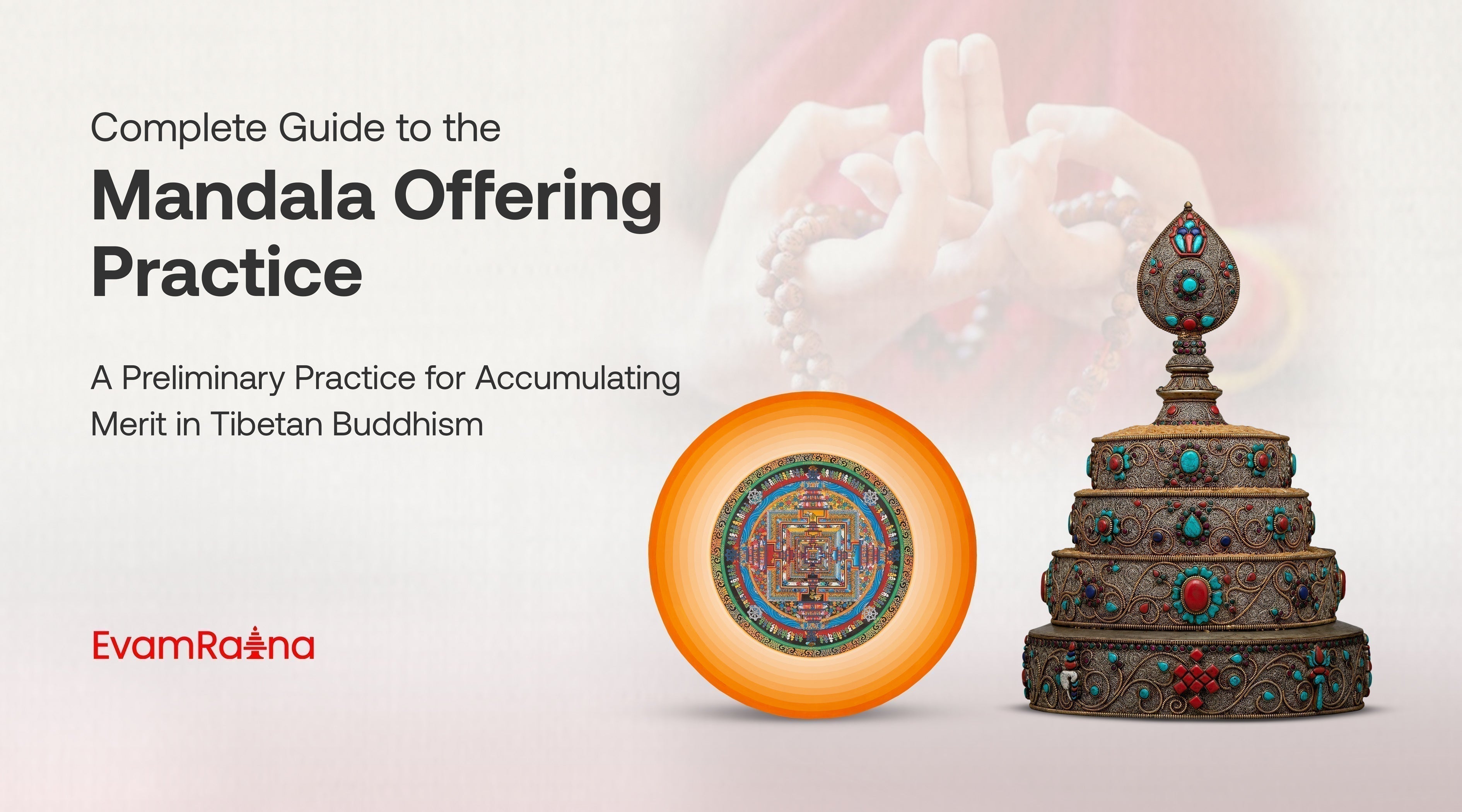
This practice is used as a figurative representation of a perfect universe with four continents and four sub-continents with Mount Meru at the center, and is considered a pure land. The ritual usually applies a physical mandala collection comprising a circular base of precious metals, stone, and wood, and concentric rings stacked in an upward direction. They contain materials such as rice and barley, and polished precious stones as well as gold and silver, as symbols of plenty in the world. Although commonly used together with this particular offering plate, mandalas may also be found in other art forms such as cloth paintings, three-dimensional sculptures, and complex patterns created with sand.
Accumulation of large amounts of merit and purification of negative karma, especially greed, ego, and attachment, are the main reasons behind this practice. It is usually divided into three stages: the Outer Mandala that provides the external material universe; the Inner Mandala that entails the visualization of the personal body as the cosmos; and the Secret Mandala that entails the provision of the nature of the mind itself. When one starts to train the mind to part with everything that it holds onto, the practitioner develops the perfection of generosity and generates the spiritual causes that he or she needs to achieve complete enlightenment.
History of Mandala offering

The history of mandala offering practice extends back to the ancient Indian philosophical tradition, to the ritualization of the practice in Tibetan Buddhism as practiced in the different schools. It has its roots in the Indian Buddhist cosmology and the early Mahayana sutras, which later became the complicated preliminary practice (Ngondro) that is currently in use.
Origins and Canonical Roots
The conceptual framework for the mandala offering is derived from ancient Indian Buddhist cosmology, specifically detailed in the Abhidharmakosa. This text provides the detailed physical descriptions of the universe, Mount Meru, the four continents, and the surrounding oceans that practitioners visualize during the ritual.
In the Mahayana tradition, exoteric sources like the Diamond Sutra (Vajracchedika Prajnaparamita) provided an early scriptural basis for the practice. In this text, the Buddha and his disciple Subhuti discuss the "great heap of merits" generated by filling the universe with the seven precious things and offering them as a gift. Although this dialogue has been considered a literary device, it founded the spiritual reasoning that the giving of the whole universe is the highest way of gaining merit.
Introduction to Tibet
The mandala offerings were unique to the Indian schools of Buddhism, and they were offered to the Buddhas and Bodhisattvas as a sign of faith and as a way of collecting positive energies. The traditions were also transmitted to the Vedanta (Tantric) school and brought to Tibet in the 7th century CE. These offerings over time, become part of the Ngondro, whereby the Tibetan masters transformed the ritual into a disciplined method of non-attachment and ego-purification.
Historical Development of Ritual Variations
As the practice matured in Tibet, various masters developed specific ritual formulas to define exactly what should be visualized and offered:
Chögyal Phakpa (13th Century): The head of the Sakya school and preceptor to Kublai Khan, he composed the widely renowned 37-point mandala offering. This version includes the "seven riches of a universal sovereign," which some historians suggest also served a social role in justifying the union of religion and politics in Tibet.
Buddhaguhya: Taught a 13-point mandala according to the tradition of yoga tantra, focusing on Mount Meru and the continents.
Jetari: Described a 17-point offering that added the sun, moon, victory banner, and parasol.
Mañjuśrīkīrti: Described a 23-point offering including the seven emblems of royalty and the treasure vase.
The Kālacakra Tantra: Established 25 point mandala incorporating the planets Rahu and Ketu.
Significance of Lama Tsongkhapa
The efficacy of this practice was famously demonstrated in the 14th century by the founder of the Gelug school, Lama Tsongkhapa. He offered one million mandalas on a stone base on which he was doing his retreat. He rubbed the bottom with his arm so often that his flesh was scarred and calloused. They say that with this severe cleansing and merit-building, he received direct visions of Manjushri and became completely enlightened.
Artistic and Geographical Evolution
Beyond Tibet, the Newar Buddhists of Nepal maintain a parallel tradition known as guru-mandaralcana, where the mandala is offered to the deity Vajrasattva. By the early 15th century, during the reign of the Yongle Emperor in China, highly elaborate gold-gilt mandalas became popular for shrine displays. These more ornate versions were often not used for daily physical ritual but were placed permanently on altars to represent the presence of a purified universe.
Types of Mandala Offering
The various types of mandala offerings in Tibetan Buddhism are categorized by their spiritual depth, their alignment with the "Three Bodies" of a Buddha, the number of symbolic ritual points used, and their physical material form.
The Three Levels of Mandala Offering

The most common way to categorize mandala offerings is through three levels of increasing spiritual profundity:
Outer Mandala: This is the symbolic offering of the external material universe and all its riches, including "samsara's delights" like possessions, wealth, and friends. It typically uses a physical base and concentric rings.
Inner Mandala: This practice is entirely mental and involves conceiving of one’s own body as a complete mandala of the world. For example, the skin is visualized as the golden ground, the trunk as Mount Meru, the limbs as the four continents, and the eyes as the sun and moon,
Secret Mandala: This level involves offering the Bodhi Mind (the aspiration for enlightenment) and the Wisdom that perceives emptiness (Shunyata). It is a "wisdom offering" where one offers the very nature of their mind to the Object of Refuge.
Mandalas of the Three Kāyas (Buddha Bodies)

Mandala offerings are also classified according to the three levels of a Buddha's existence:
Nirmāṇakāya Mandala: Represents one billion universes, a "hundred times ten million worlds" filled with the wealth of gods and human beings.
Saṃbhogakāya Mandala: Visualized in the space above, representing the five buddha families and goddesses in the paradise of Akaniṣṭha-Ghanavyūha.
Dharmakāya Mandala: Represents the naturally arising wisdom of the mind, often referred to as the "youthful vase body," purified of all clinging.
Read More About Types of Tibetan Mandalas: Sacred Art and Spiritual Depth
Ritual Point Variations
The ritual point variations in a mandala offering refer to the number of symbolic "heaps" of grain or precious materials arranged on the mandala base, representing different components of the idealized universe. Although the essence of the visualization is still based on the Abhidharmakosa, various lineages and historical masters have come up with certain formulas between 7 and 37 points.

(Photo From Vajrasecrets)
7-Point (Short) Mandala: This is the shortest of the mandalas, which is generally used in daily practice or when time is restricted. It consists of Mount Meru (Sumeru), the four continents (East, South, West, North), the sun, and the moon. Despite its brevity, it is often considered a "three kāya mandala" because the nirmāṇakāya (represented by these physical elements) is inseparable from the nature of the three kāyas.
13-Point Mandala: Taught by the Indian master Buddhaguhya within the yoga tantra tradition. It includes Mount Meru, the four continents, and the eight subcontinents.
Notably, in this specific variation, the heaps for the sun and moon are omitted.
17-Point Mandala: This version incorporates the sun, moon, a parasol (in the south), and a victory banner (in the north) to the 13 points attributed to the master Jetari.
23-Point Mandala: As Manjusrikirti describes, this formation adds to the base of Mount Meru and the continents or subcontinents the seven symbols of royalty (the precious wheel, queen, and elephant), the treasure vase, the sun, and the moon. The sun and the moon are placed on the east and west, and the emblems and treasure vase are made on the cardinal and intermediate directions.
25-Point Mandala: This is a tradition that emerged based on the Tantra of Kalachakra and incorporates heaps of the two planets Rahu and Ketu (located in the south and north).
The 37-Point Mandala of Chögyal Phakpa
The most popular and the largest was written in the 13th century by the head of the Sakya school, Chogyal Phakpa. In this ritual formula, there is a list of all the auspicious objects to be recited and put forth, which includes:
Mount Meru is the center of the World Axis.
The Continents: There are four major continents and eight sub-continents.
Unique Assets: Specific treasures for each continent, such as the jewel-mountain, wish-granting tree, the cow that supplies all wants, and crops that require no cultivation.
Royal Riches: The seven precious emblems of a universal sovereign (Wheel, Gem, Queen, Minister, Elephant, Horse, and General) plus the treasure-filled vessel.
Eight Offering Goddesses: Celestial beings representing the transformation of desire and sensory experience into enlightened wisdom, beauty, and joy.
Celestial Symbols: The sun, the moon, a bejeweled umbrella (parasol), and a victory banner.
By arranging these specific points, the practitioner mentally constructs a complete, purified universe filled with "the abundant riches of gods and men" to be offered for the accumulation of merit.
Read More About The 37 Heaps of Mandala Offering: Understanding Their Symbolism and Significance
Components & Materials of Mandala Offering
The components and materials used in a mandala offering are deeply symbolic, representing the physical and spiritual dimensions of the universe. According to the sources, these are categorized into the physical set, the offering materials, and the ritual hand gestures.
The Mandala Set

- The Base: The foundation, called the Vajra Bhumi or "Indestructible Ground of Gold," is typically a round plate. It can be made from precious metals like gold, silver, or copper, but simple materials such as flat stone, wood, or even china are acceptable if precious metals are unavailable.
- Concentric Rings: A standard ritual set includes three or four metal rings of decreasing size that are stacked on top of the base. These rings symbolize the lower levels of Mount Meru and the boundaries of the various mandalas (Outer, Inner, and Secret).
- The Top Ornament: At the very peak of the mound, a small ornate center is placed. This crown ornament represents the palace of Shakra (Indra), the Lord of Deities, located at the summit of the world system. In some traditions, this may also be represented by a Dharma wheel.
- Grains: The most common materials are rice or barley. These are occasionally perfumed with fragrant water or combined with "bajung" (purification pills used during rituals).
- Precious Items: In a more significant or detailed offering, the practitioners use polished precious stones, gold, or silver. According to the source, the best quality the practitioner can provide should be what is offered to make the act more significant.
- Symbolism of Seeds: The grains are also pictured as the fertile seeds to achieve the perfect enlightenment.

- Representing Mount Meru: The performer joins the fingers of both hands, the two ring fingers upwards in the middle. Such straight fingers represent Mount Meru (Sumeru), the universe axis.
- The Four Continents: The four angles of the other interlocked fingers are symbolic of the four continents.
- Acceptance and Blessings: The way the hands are opened is important: when they are opened towards them, this represents that the Buddhas have accepted the offering, and when they are opened towards yourself represents the acceptance of their blessings.
The Purpose of the Practice: Accumulating Vast Merit
To achieve full enlightenment, a practitioner requires a vast collection of merit, the positive energy generated by virtuous actions. Mandala offerings are considered one of the most effective methods for this because they utilize mental activity, which is the strongest form of karma. Mandala offerings are uniquely effective because they primarily utilize mental activity, which is recognized in Buddhist teachings as the strongest and most potent form of karma.
Mental Karma: By sincerely generating the desire to offer the entire world and its wealth to the Buddhas, a practitioner accumulates inconceivable merit even without performing physical or verbal actions.
Seed for Enlightenment: Every grain offered is visualized as a "fertile seed" for attaining Buddhahood. This practice transforms a mind that typically seeks to accumulate for itself into one that finds joy in giving.
Total Reversal: The practitioner is conditioned to think that he/she is giving, rather than seeing desirable objects with a sense that I want it, which is a complete psychological reversal. Thinking that you are offering it to the Triple Gem.
Purification of Negative Karma and Obscurations: The practice serves as a powerful antidote to the internal obstacles that prevent spiritual awakening.
Antidote to Greed and Stinginess: It directly purifies the karmic imprints of greed, attachment, pride, and miserliness.
Clearing the Eight Worldly Concerns: It aids in removing the eight worldly concerns, that is, the attachment to gain, fame, praise, and pleasure and aversion to the opposite, otherwise attracting the mind to samsara.
Offering the Ego: In the "Secret" level of the practice, one offers one's own ego and negative qualities (like laziness or irresponsibility) to the Buddhas. This creates the causes for future egolessness, as offering a negative quality results in obtaining its opposite positive quality.
Buddhist Cosmology: The Foundation of Visualization

(Photo from Donnybacon)
The ritual relies on ancient description on the universe as described in such texts as the Abhidharmakosa.
- Mount Meru (Sumeru): This is the king of mountains located at the centre point of the world. It is said to be of four levels, which extend to an altitude of 80,000 Yojanas with the palace of the Lord of the Deities, Shakra, being at the top.
-
The Four Continents: Arranged in the cardinal directions around Mount Meru, each with a unique treasure:
- Purva Videha (East): Accompanied by a mountain of jewels.
- Jambudvipa (South): Our world, featuring the wish-fulfilling tree.
- Godaniya (West): Noted for a cow providing an endless supply of gold.
- Uttarakuru (North): A land of naturally growing crops.
-
The Eight Subcontinents
The four major continents of the world include the Purvavideha (East), Jambudvipa (South - our world), Aparagodaniya (West), and Uttarakuru (North), which are bounded by two subcontinents of the same shape and color but half of the size of the main continent.
- Eastern Subcontinents (flanking Purvavideha): Deha and Videha.
- Southern Subcontinents (flanking Jambudvipa): Camara and Aparacamara.
- Western Subcontinents (flanking Aparagodaniya): Shatha and Uttaramantrina.
- Northern Subcontinents (flanking Uttarakuru): Kurava and Kaurava.
- Abundant Riches: The visualization includes the sun and moon, a jewel-studded parasol, and a victory banner. It also incorporates the Seven Precious Emblems of a universal monarch, such as the precious wheel, elephant, horse, and queen, representing the highest earthly sovereignty.
Ritual Materials and Setup
While the practice can be done through visualization alone, practitioners often use a physical mandala set.
Choosing a Base: The base, which symbolizes the Indestructible Ground of Gold, is preferably composed of precious metals such as gold, silver, or copper. Nevertheless, moral purity is the most significant; Lama Tsongkhapa made a million offerings on a bare stone surface, making it clear that it is the quality of the sincerity one has that counts more than material possessions. In case there is no underpinning, the practitioner may make use of a china plate or even wood; the practitioner may also do the ritual with a mere hand gesture.
Offering Substances: The common types of grains, such as rice or barley, are used but are sometimes combined with scented water or bamboo pills known as bajung. The rich people offer precious stones, gold, or silver to make their offering meaningful, since one has to give the best quality of the offering that he/she is able to reasonably afford.
Structure: Concentric rings made of metal go on top of the base, and an ornamental crown or Dharma wheel is put on top of the structure to indicate the higher levels of the world system, Mount Meru.
Step-by-Step Instructions for the Practice of Mandala Offering: Guide for Beginners
To begin the mandala offering practice, you should first prepare your materials, which usually include a precious metal or stone foundation, concentric rings and offering materials such as rice, barley, or even precious stones. Although a physical set is preferable, the ritual can be done by hand only (mudras) with interlaced fingers (the continents) and two straight ring fingers (the Mount Meru), as the beginner is learning this ritual.
Purification of the Mandala Base

(Photo From Bureau of His Holiness the Dalai Lama)
Preparation: The mandala base should be in your left hand. You need not leave your hand empty; you may hold a little grain.
The Rubbing Gesture: Sprinkle the grain on the bottom and rub the surface with the right forearm. This is a very symbolic physical gesture; the dirt on the bottom symbolizes your bad karma and mental clouds, the forearm symbolizes the wisdom of emptiness (Shunyata) as the remedy.
Clockwise Rubbing: Then, rub the bottom in a clockwise direction and recite the formulas of taking refuge and creating the Bodhi Mind. The rubbing of the forearm also activates a certain vital channel of the air that assists the Bodhi Mind to come up more easily.
Counterclockwise Rubbing: Wipe the bottom 3 times counterclockwise, contemplate accepting the blessings of the body, speech, and mind of the Buddhas.
Step-by-Step Offering (Outer Mandala)
After purification, you arrange heaps of grain to represent the idealized universe:
The Foundation: On the outer edge, make a thin circular line of grain to show the iron mountain wall that surrounds the world.
Mount Meru: There is a mountain, Mount Meru, the king of mountains, whose place is considered absolutely at the center to be represented by a heap.
The Four Continents: Arrange four heaps in the cardinal directions:
Purva Videha (East/facing you), Jambudvipa (South/clockwise), Godaniya (West), and Uttarakuru (North).
The Subcontinents: Place a heap on either side of each continent to represent the eight subcontinents.
The Assets and Riches: Here place heaps of the particular treasures of each continent (the jewel-mountain or wish-fulfilling tree), then the Seven Ratnas (Precious Jewels) of kings and the eight offering goddesses at concentric circles.
Celestial Bodies: Place heaps of the Sun (on the right) and the Moon (on the left), and a parasol and a victory banner.
Completing the Structure: As the mound of grain grows, add the concentric metal rings to represent the levels of Mount Meru and top the structure with a crown ornament or Dharma wheel depicting the palace of Shakra to be placed on it.
The Act of Offering and Dedication
After getting the mandala in place, you have to convert the mundane visualization into the utmost pure Buddha-Field by drawing upon your mental conviction. Hold the completed mandala up and recite the offering mantra: Idam Guru Ratna Mandalakam Niryatayami.
So, if the Mandala is away from you, it signifies that the Buddhas have accepted your offering, and if it is toward yourself, it signfies request for the blessings, realizations, and dedication of the merit to all sentient beings.
In case the long 37-point ritual is too complicated, you can begin with the Short Mandala of Seven heaps, consisting only of Mount Meru, the four continents, the sun, and the moon. Your mind is the best part because the karma of the mind is the most powerful; with the genuine intent of offering the whole universe and its wealth, a great deal of merit is formed, no matter what the quality of your set is.
If you have a question such as, "Can I offer negative qualities like my ego or laziness?"
- Transformative Generosity: It is possible to give away the ego, laziness, or irresponsibility to the gods of meditation, such as Tara.
- Egolessness: The practitioner presents the ego; this is to provide the reasons that will bring about the state of egolessness.
- No Contamination: Buddhas are free from contamination; therefore, offering them "contaminated" items like your ego does not affect them but serves to purify the practitioner.
Conclusion: Embrace the Transformative Power of Mandala Offerings
Mandalas offering is a ritual and a deep practice that enables you to get into the heart of the universe and cleanses the mind in Tibetan Buddhism. Seeing the ideal, pure universe and presenting it with pure devotion, you not only amass a significant amount of merit but also overcome the bonds, self-interest, and adverse karma. This practice is very transformative and can assist you in coming closer to enlightenment as it teaches generosity and selflessness in your daily living.
If you are seeking spiritual peace, healing, or a deeper connection to your inner self, the Mandala Offering practice gives you a strong instrument for meeting the challenges of life. By giving the universe and even your own adverse aspects to the Buddhas, you create the door to mind clarity, compassion, and free existence of the ego. So, take a step towards inner peace, start your Mandala Offering practice today, and watch as your mind and heart become more aligned with the wisdom of the universe.