The Most Influential Founder in History: Shakyamuni's Journey to Enlightenment
Imagine, for a moment, that you have everything the world says should make you happy: unimaginable wealth, a loving family, a high-status career, and every physical comfort. Now, picture that even in the middle of this "perfect" life, you feel a constant, empty ache and a sense that something is very wrong and that all your things are just distractions from a deep truth about suffering. Have you ever felt "inner emptiness" even though you were doing well on the outside? Over 2,500 years ago, Prince Siddhartha Gautama faced the same problem. We aren't just looking at a historical figure in this guide; we're also looking at a spiritual map made by a man who gave up his throne to find a way to heal the human condition. The story of Shakyamuni Buddha is a timeless guide for finding peace in a world that is always changing, whether you are a dedicated practitioner or just someone who wants to purify themselves from the chaos of modern life.
Shakyamuni Buddha: The Historical Founder of Buddhism

The historical Buddha Shakyamuni or Siddhartha Gautama was the founder of Buddhism, who provided a path to liberation more than 2500 years ago. He was born in the 6th century BCE as a prince of the Shakya Clan, and his life and teachings have transformed the lives of millions of people and have become the universal icon of peace and mindfulness in the contemporary world. His presence is experienced even nowadays in the forms of sacred art, meditations, and a philosophy of stressing the inner peace regardless of the outside conditions.
Birth in Lumbini
Siddhartha Gautama was born in the sacred gardens of Lumbini, which is now in Nepal. His mother, Queen Maya Devi, was traveling from the kingdom of Kapilvastu to her home city of Devadaha when she stopped at Lumbini Park to rest under the shade of the Sala trees. According to tradition, she gave birth while standing and holding a tree branch during the full moon day. Miraculous signs are said to have accompanied the birth, including the infant taking seven steps immediately after entering the world, with lotus flowers blooming beneath his feet to symbolize his purity and predestined enlightenment.
The third in the list of the Twelve Deeds is the birth at Lumbini, which is a crucial milestone that depicts the spiritual journey that Buddha followed. This is where his human path starts, and the Buddhist tradition sees it as the point that links the worldly world to what he is going to do, which is liberation. Soon after his birth, the sage Asita came to the royal palace, and he prophesied that the prince would be a “Saviour of the world". Lumbini is recognized as a UNESCO World Heritage site and remains a major pilgrimage center, often depicted in sacred thangka art with serene landscapes and celestial witnesses.
The Four Encounters

The Four Encounters are a symbolic turning point in the life of Prince Siddhartha, as they shattered his sheltered royal existence and exposed him to the harsh realities of the human condition. The first experience Siddhartha had outside the palace was meeting a white-haired, hunchbacked elderly man who used a cane, a situation that made him understand that old age is an unavoidable fate for all people. He then witnessed a sick person twisting in pain on the roadside, learning that illness can strike anyone at any time. The third encounter was a funeral procession for a corpse, forcing him to confront the fearful truth that every living being must eventually die.
The prince was profoundly moved by these preliminary encounters, and he thought of how transient to nothing are all the joys of the world. But the fourth experience, that of a monk in a yellow robe, gave a glimmer of hope, as he saw a wandering monk, a seeker of religious truth.
Renunciation
Driven by a compassionate vow to find a way for all mankind to transcend old age, sickness, and death, Siddhartha renounced his royal life at the age of 29 to become a wandering seeker of the ultimate truth. In the silence of the night, Siddhartha left the palace of Kapilavatthu without waking his sleeping family to ensure his departure remained unhindered. Accompanied by his attendant Channa and riding his faithful horse Kanthaka, he reached the banks of the Anoma River at dawn. Upon arrival, he removed his precious royal garments and jewelry, handing them to Channa to return to the King as a final message of his departure. By shaving his hair and wearing the plain robes of a sramana (wandering seeker), he formally initiated his serious search towards spiritual liberation and an end to the cycle of birth and death.
Enlightenment at Bodh Gaya
Shakyamuni spent the next six years living in extreme asceticism, which involved long periods of starvation and extreme self-denial with the view that this discipline would open his eyes to a better insight about life. After enduring intense hardships that left him physically exhausted, he realized that neither the luxury of his former palace life nor the starvation of asceticism would lead to enlightenment. This realization led him to pursue the Middle Way, a moderate path that emphasizes balance and mental diligence. After restoring his physical health with rice milk, he traveled to Bodh Gaya and seated himself beneath a large Bodhi tree, vowing not to rise until he attained ultimate liberation.
During his deep meditation under the tree, Shakyamuni triumphed over the temptations of Mara and attained supreme awakening. By this experience, he acquired the ability to recollect his thousands of past lives, the divine vision of viewing the death and rebirth of all the beings based on their karma, and the ultimate discovery that he had gotten rid of all his desires and ignorance. After gaining complete knowledge of the Four Noble Truths, he turned into the Buddha, or the Awakened One. These were his main teachings when he gave his first sermon at Sarnath to his initial five disciples. For the next 45 years, the Buddha traveled on foot across India to spread the Dharma, gaining a global community of followers until his final passing at the age of 80.
Read More About The Path to Enlightenment: Four Noble Truths and Eightfold Path
Iconography of Shakyamuni Buddha

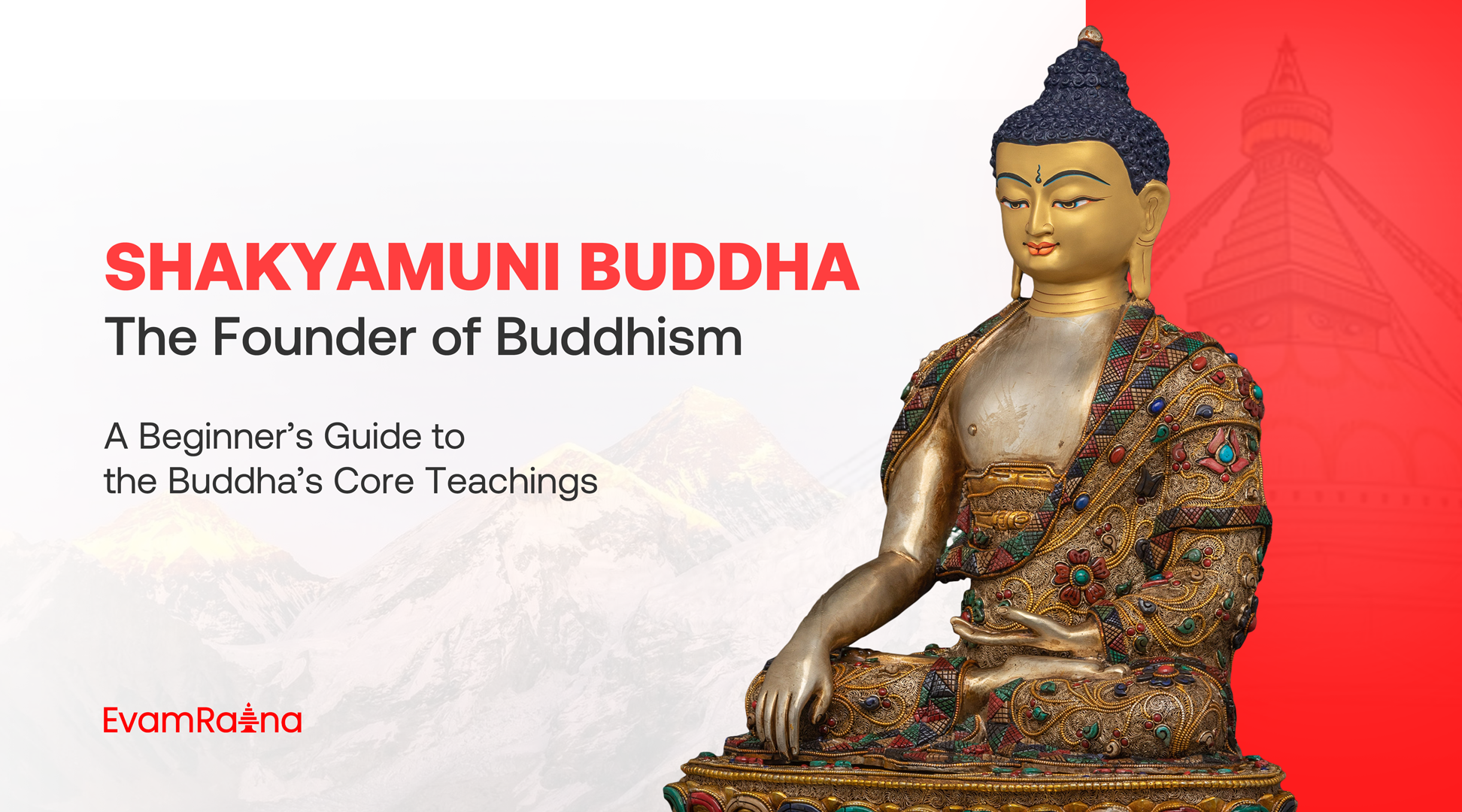
The iconography of Shakyamuni Buddha is a complex system of sacred visual codes used in thangkas and statues to communicate spiritual truths and the ideal state of being. Each detail, including the body color and the gestures of hands, has deep symbolism based on the Buddhist philosophy and history.
Physical Marks of Perfection
Buddhist tradition describes the physical body of the Buddha as the embodiment of spiritual perfection, in which the Buddha cleanses itself through the many lifetimes of merit. This can be depicted by the thirty-two great marks (Mahapurusa Laksanas) which are:
- Ushnisha: This is a bump on the head signifying the highest spiritual knowledge.
- Urna: A tuft of hair or mark between the eyebrows signifying profound insight.
- Golden Skin: A radiant body color that represents spiritual purity and divinity.
- Elongated Buddha earlobes: It symbolizes renunciation of material wealth, as they are a remnant of the heavy gold earrings worn by Prince Siddhartha.
Sacred Gestures (Mudras) and Postures
The Buddha's posture and hand positions (mudras) narrate key milestones of his journey:
- Bhumisparsha Mudra (Earth-Touching): The right hand reaches down to touch the ground while the Buddha is seated in the lotus posture (padmasana). This gesture represents his triumph over Mara and calls the earth to witness his countless lifetimes of merit at the moment of enlightenment.
- Dhyana Mudra (Meditation): Left hands rest in the lap, palms upward, symbolizing deep meditation and concentration. It often holds a begging bowl (or alms bowl),
- Reclining Posture (Parinirvana): Depicts the Buddha lying on his right side between twin sala trees, symbolizing perfect composure and freedom from the cycle of rebirth at the moment of his passing.
- Holding a Bowl: His left hand often holds a bowl, signifying detachment and the simplicity of monastic life.
Surrounding Symbols and Settings

The Buddha is often placed in a certain symbolic setting by iconography:
- The Lotus Throne: He usually sits on a lotus, and this represents the enlightened mind that comes out pure and untainted by the mud of suffering (samsara) in the world.
- The Bodhi Tree: This is commonly referred to as the protective tree that covers the Buddha, and symbolizes wisdom and spiritual grounding.
- Halos and Auras: A golden or green halo around the head signifies the light of wisdom dispelling the darkness of ignorance.
- The Twelve Deeds: Many thangkas feature the central Buddha figure surrounded by small vignettes of the Twelve Deeds, creating a visual biography that serves as a spiritual map for practitioners.
These artistic elements make a thangka or statue more than a mere representation, a scripture to be meditated on and internalized to absorb the teachings of the Buddha.
Shakyamuni Buddha Thangka & Statues: Ultimate Tool for Meditation and Altar Practice
Choosing a Shakyamuni Buddha statue or thangka for your altar transforms it into a vibrant spiritual map and a sacred tool for daily meditation. They also serve as spiritual portals that narrate the Buddha’s journey from a life of royal luxury to ultimate liberation, offering practitioners a visual biography of the Twelve Deeds. By placing such an image on your altar, you invite peace and wisdom into your immediate surroundings, creating a focal point for concentration and reflection that helps cleanse the energy of your home.
There are many profound advantages of practicing with a Shakyamuni thangka or statue to the modern-day practitioner:
- A Visualization Aid: These figures serve as instructions on how to internalize the qualities of the Buddha, including unshakable determination and resilience in the occurrence of the storms of life.
- A Constant Reminder: They act as a physical reminder that enlightenment is a process that is gained through virtue, discipline, and wisdom, not a miracle.
- Symbolic Teaching: Every detail, from the Bhumisparsha Mudra (Earth-Touching gesture) to the Lotus Throne, communicates core spiritual truths like self-mastery and the possibility of emerging pure from worldly suffering.
- Mental Well-being: In a chaotic world, focusing on the Buddha's serene form helps detox digital noise and anxiety, bringing a deep sense of grounding and harmony to your personal life.
- Cultural and Lineage Connection: Selecting these pieces of art is a tribute to ancient wisdom and a tradition of spiritual growth still living.
Conclusion: Embracing the Path of Peace Today
Shakyamuni Buddha's teachings are still relevant today as they were 2,500 years ago; they teach us that awakening begins with us. The essence of his message, finding a way to inner peace despite the external conditions, is a practical approach to becoming less suffering and more mentally healthy in the modern world. When we consider the Four Noble Truths and practice the Middle Way, our perception of reality can be changed, and we can proceed to live a compassionate, balanced life.
Since the Buddha reminded his followers through the final instructions, "All things that are compounded are impermanent. Strive on with heedfulness!" This way of thinking today is an acknowledgment that although the physical bright lamp of the Buddha was extinct long ago, the lamp of the Dharma remains there eternally. This eternal wisdom is like a road map to bring practitioners through the stream of life and death, welcoming a world community to develop harmony and enduring peace.