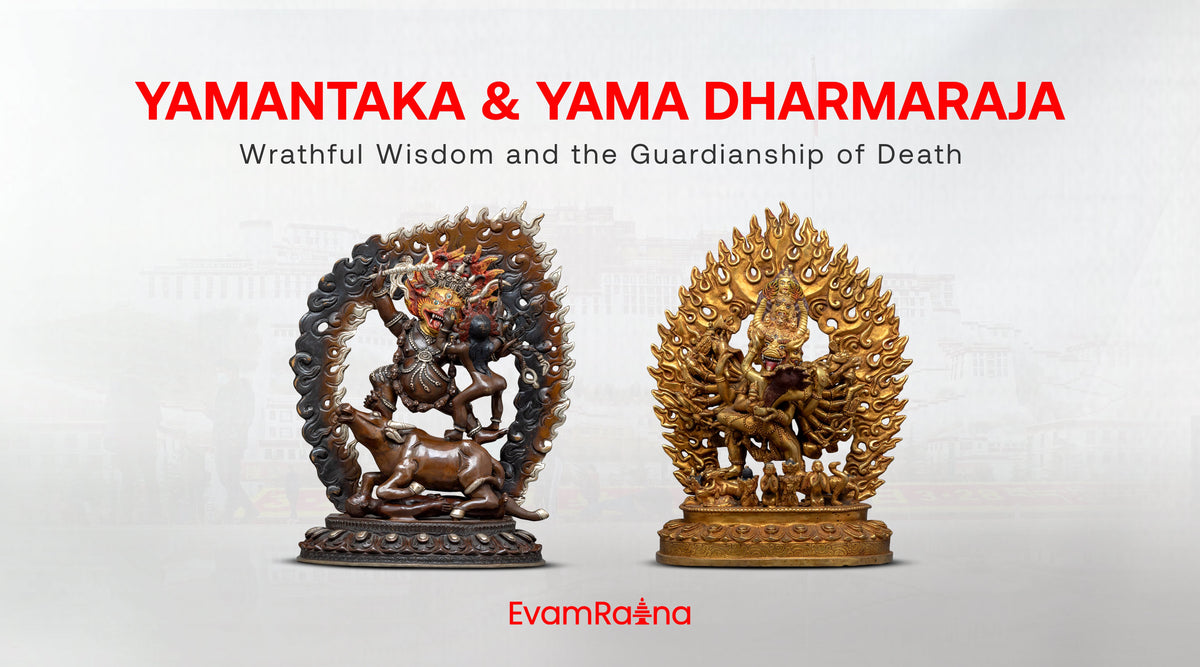
The Union of Inner Transformation and Outer Protection
In Tibetan Buddhism, Yamantaka and Yama Dharmaraja are two powerful wrathful deities representing fierce compassion within the Vajrayana path. Although their appearances, with flaming hair, skull decorations, and violent expressions, may intimidate outsiders, they demonstrate deep compassion towards practitioners. Both have considerable overlap because of their connection to death and related images, but each has a different role to play in Vajrayana Buddhism. The knowledge of these differences not only explains their visual representation, but it also helps to see more about how Tibetan Buddhism believes in transformation, protection, and ultimate reality.
Wrathful Deities: Compassion in Fierce Form

Click Here To View Our Yama Dharmaraja Statue
Before exploring these two figures in detail, it is important to understand the deeper nature of wrathful deities in Vajrayana Buddhism. In this context, wrath does not arise from anger or violence but from enlightened wisdom. It is a direct, courageous, and clear-sighted energy that throws the curtains of ignorance, ego, and clinging away, with clear and definite strokes. Where gentle compassion may guide gradually, wrathful compassion acts decisively, removing the very causes of suffering when subtler methods are no longer sufficient.
Wrathful deities are seemingly vicious, but their aim is liberating. Their fires are symbolic of what can be translated as burning out ignorance, and their heated gestures are symbols of furiousness to wake up instead of fighting. Yamantaka and Yama Dharmaraja, both based on this same principle of enlightened compassion, are manifestations of Manjushri. But their manifestations of this wisdom, although they have a common genesis, are of different effect; the one is the first to regulate the inner change, the other the protection of the conditions upon which the way may be pursued.
Origins of Yamantaka and Yama Dharmaraja
The origins of Yamantaka and Yama Dharmaraja are deeply rooted in the tantric traditions of Vajrayana Buddhism, where enlightened wisdom manifests in wrathful forms to confront ignorance and safeguard the path to awakening. The emergence of both deities is the manifestation of Manjushri, but the two purposes, as manifested in the emergence of these two deities, are related but distinct.
Yamantaka is based on the necessity to directly address the fear of death and the illusion of the self as something fixed. In tantric stories, Manjushri takes on the hideous shape of Yamantaka to defeat Yama, and this serves to say that death is not a final thing but rather a creation perpetuated by lack of wisdom. However, Yama Dharmaraja is a more evolved and contained manifestation of the same force that is no longer death but the ruler of it. Being a Dharma protector, he maintains the karmic law, eliminates obstacles, and maintains the situation that spiritual practice requirements are fulfilled.
Their origins combined are used to express a main Vajrayana teaching that what is feared, death, time, and karmic consequence, is not abandoned, but rather turned into wisdom and protection on the way to enlightenment.
Yamantaka: The Murderer of Death and Inner Transformation

One important meditational deity in Highest Yoga Tantra Tibetan Buddhism is called Yamantaka or Vajrabhairava. His title, which translates as Destroyer of Death, does not refer to overcoming physical death only, but enlightening the fear and ignorance that come with it. Yamantaka is a philosophical attainment of the fact that death, as anything, does not exist. In tantra, he is a wrathful incarnation of Manjushri to overcome Yama, which symbolizes the realization that death is a creation that is carried by ignorance and adherence. His doctrine takes practitioners on the path of destroying the illusion of death based on awakened wisdom.
Iconography of Yamantaka
Yamantaka is one of the most confusing and visually strong deities in Tibetan Buddhism. His highly developed shape is full of symbolic interpretation, every detail depicting elements of enlightened wisdom triumphing over death, ignorance, and ego:
- Color: He is usually painted in a deep blue or black, and this is a symbolism of the immeasurability of ultimate reality and the impossibility of wisdom being destroyed.
- Heads: Yamantaka is often shown with multiple heads, commonly nine, with a central buffalo head. This symbolizes his overcoming Yama, the king of death, and his changing death to wisdom.
- Arms: With thirty-four arms, each holding different ritual implements, he embodies the many methods (upaya) used to overcome ignorance and guide beings toward enlightenment.
- Legs: His sixteen legs trample beings and symbols of ignorance, demonstrating the subjugation of ego, delusion, and obstructive forces.
- Implements: He is holding numerous symbolic tools, skull cups, curved knives (kartika), vajras, and staffs- all symbolizing the cutting, transformation, and purification of negative states.
- Consort (Yab-Yum): Often depicted in union with his consort, this symbolizes the inseparable unity of wisdom (prajna) and method (upaya), a core principle in Vajrayana practice.
- Crown of Skulls: His crown and his bones of skulls are a symbol of the overcoming of death and the turning of the five poisons into the five wisdoms.
Yama Dharmaraja: Guardian of Karma and Protector of the Dharma

Yama Dharmaraja serves a protective role distinct from but complementary to that of Yamantaka and is concerned with inner transformation. He is a Dharmapala who is protecting the Dharma and those practicing and preserving the integrity of the spiritual path. He is not perceived as a meditating god but as an awakened custodian who was involved in earthly affairs. His responsibilities include removing obstacles, regulating karmic consequences, and defending against disturbances that may impede spiritual advancement. As the essence of it, Yama Dharmaraja represents the karmic justice, and he makes sure that the practice is secured, disciplined, and in touch with the truth.
Iconography of Yama Dharmaraja
Yama Dharmaraja has one of the strongest, most symbolically rich portraits in Tibetan Buddhism, and in this regard, every single component of his form has profound spiritual meaning:
- Color: His dark blue-black body symbolizes endless space and supreme wisdom, an all-inclusive consciousness, vast at all times and implacable.
- Head: He is usually represented with one angry buffalo head, and this represents his power over death and ignorance, and his overcoming Yama, who is the king of death.
- Arms and Implements: He has in two or four hands a staff or a mace to smash ego and delusion and a lasso to drag creatures into the spiritual realm- instruments of wisdom, not of devastation.
- Consort (Yab-Yum): He is sometimes shown in union with Chamundi, representing the inseparable union of method (upaya) and wisdom (prajna), essential in Vajrayana practice.
- Mount: His buffalo mount is a symbol of the conquest of death and karma, which depicts his control of samsara fear and illusion.
Key Differences Between Yamantaka and Yama Dharmaraja

|
Aspect |
Yama Dharmaraja |
Yamantaka |
|
Role |
Dharma protector (Dharmapala) |
Meditational deity (Yidam) |
|
Manifestation of |
Manjushri |
Manjushri |
|
Function |
Destroys barriers and protects the Dharma. |
The leads practitioners to enlightenment through overcoming death and ego. |
|
Iconography |
Single buffalo head, rides buffalo, on many occasions in combination with Chamundi. |
Extremely complicated shape having several heads, numerous arms, and legs. |
|
Practice Type |
Invoked through rituals, offerings, and protector practices |
Performed by the complicated stages of Highest Yoga Tantra visualization and generation. |
|
Wrathful Expression |
Protective and authoritative; a controlled, guardian form of wrath |
Complete wrathful wisdom that totally conquers death and ignorance. |
Spiritual Role and Practice of Yamantaka and Yama Dharmaraja
- Inner vs. Outer Function: Yamantaka acts on the inner, where the ignorance, ego, and fear of death are changed to wisdom; Yama Dharmaraja acts on the outer, whereby the Dharma is being safeguarded, and the conditions needed to practice are upheld.
- Spiritual Role: Yamantaka serves as a meditational deity (yidam), guiding practitioners toward enlightenment through direct realization, whereas Yama Dharmaraja acts as a Dharmapala, safeguarding practitioners and upholding karmic order.
- Mode of Practice: Yamantaka is practiced through advanced tantric meditation, visualization, and initiation-based sadhanas, while Yama Dharmaraja is invoked through rituals, offerings, and daily protector practices such as serkyem and fire pujas.
- Purpose in the Path: Yamantaka facilitates deep inner transformation and the realization of emptiness, while Yama Dharmaraja removes obstacles, purifies negativity, and ensures stability and discipline along the spiritual path.
-
Complementary Role: Together, they form a complete system—Yamantaka transforms the practitioner from within, and Yama Dharmaraja protects and supports the path from without, enabling steady progress toward awakening.
Relevance in Modern Buddhist Practice

In modern Buddhism, Yama Dharmaraja is an important enemy of indolence, disorientation, and spiritual stagnancy. He serves as an energetic antidote to the millions of distractions and obstacles that can be in the path of devotion and focus. Although Yamantaka is the image of complete reformation of the consciousness and overcoming death, the role of Dharmaraja, on the contrary, is to clear and get rid of the external barriers, protect the practitioners against the negative factors that may hinder their spiritual direction. He is an essential presence to any person who is interested in enhancing their relationship with Vajrayana Buddhism, as he serves as the guardian of the sacred spaces and teachings. Invoking Yama Dharmaraja encourages a feeling of security, clarity, and power, which is fundamental to progress in the Dharma path, so that those who practice can maneuver their way through the external and inner landscapes they need to make progress to deeper levels of Vajrayana practices.
Conclusion: Appreciating the Wrathful Protector in Your Life
Incorporating Yama Dharmaraja in life, the text underlines that seeing the latter simply as a vengeful character would harm the richness of his presence. Yama Dharmaraja is not only a protector of the sacred wisdom, but he is also the embodiment of the accuracy and reality that Manjushri is. His violent attitude is also supposed to safeguard the Dharma, clear the way, and assist the awakening process. The relationship between them both is highlighted as complementary; Yamantaka facilitates the internal transformation necessary to conquer death and ego, while Yama Dharmaraja provides external protection and eliminates both outer and inner threats. They all depict the practice of wrathful wisdom in full. The experience of being treated as a practicing worshipper who needs his protection, the connoisseur who takes an interest in his symbolism, the initiate who risk the thought of wrathful gods, Yama Dharmaraja is a powerful figure who deserves to be taken on the spiritual road.