The Mystical Khatvanga Trident: A Symbol of Power and Transformation
Khatvanga is one of the most powerful ceremonial ritual tools within the Vajrayana tradition of Buddhism. This trident ceremonial tool is complex in design, incorporating many elements of profound meaning. A Khatvanga is not merely a physical item; rather, it is an object in which extraordinary principles have been imprinted, serving as spiritual tools for meditation and Tantric practices. Because Khatvanga represents death, life, change, and destruction, it embodies the energies of change, destruction, and creation.
In this Blog, we will uncover:
- The Origin of the Khatvanga Trident
- Iconography & Symbolism of Khatvanga Trident
- Khatvanga Trident and the deities who wield it
The Origin of Khatvanga Trident

In Vajrayana Buddhism, the Khatvanga trident is an important and powerful symbol that originates from the ancient Indian Shaivite yogins known as kapalikas ("those who carry skulls").
The Kapalikas began as a group of ritual ascetics who were rejected by society for their status as outcasts after receiving a sentence of twelve years of penance for unintentionally killing a Brahmin priest. As they sought to recover spiritually and physically from their punishment, the kapalikas lived in a state of excessive deprivation and adhered to an extreme ascetic lifestyle and discipline to atone for their crimes. Some kapalikas chose to live in solitude; many were hermits living in the forest or along paths leading to or around charnel grounds, while others were found begging near tree trunks. The Kapalikas wore clothing made from hemp, dog, and donkey hides and carried a wooden staff with the skull of the Brahmin they had killed as part of their ritual practices. As kapalik ascetics, the kapalikas practiced radical left-handed (vama) forms of tantra that recognized the divine feminine energy (Shakti) as the source of all spiritual and material power.
The Iconography & Symbolism of Khatvanga Trident
Khatvanga is an important ritual object used in Vajrayana Buddhism, and is rich with symbolism and complexity. Khatvanga contains philosophical, spiritual, and transformational information. The Khatvanga iconography embodies Buddhist teachings; its symbolism encompasses the aspects of wisdom, method, and the journey toward enlightenment.
Outer Iconography
Representing the "ultimate Bodhisattva," the Khatvanga represents a state of bliss or emptiness; it can also be viewed as an illustration of the Union of feminine and masculine energy (Yab-Yum). Further, the position of holding the Khatvanga by an individual who is a seated Guru, Lineage Holder, or a Siddha, Dakini, Yogin, or Yogini all exhibit uniformity in the position and hold of the Khatvanga, denoting its sacredness in the practice of each of these representatives.
Typically, the length of the Khatvanga correlates to the height of the depicted deity, indicating their "spiritual height" or "spirituality." If a deity is seated or possesses multiple appendages, then the appearance of the Khatvanga may vary in appearance through a reduction in the length to maintain balance in the artwork created depicting that deity.
Inner Symbolism
Eight-Sided White Shaft:
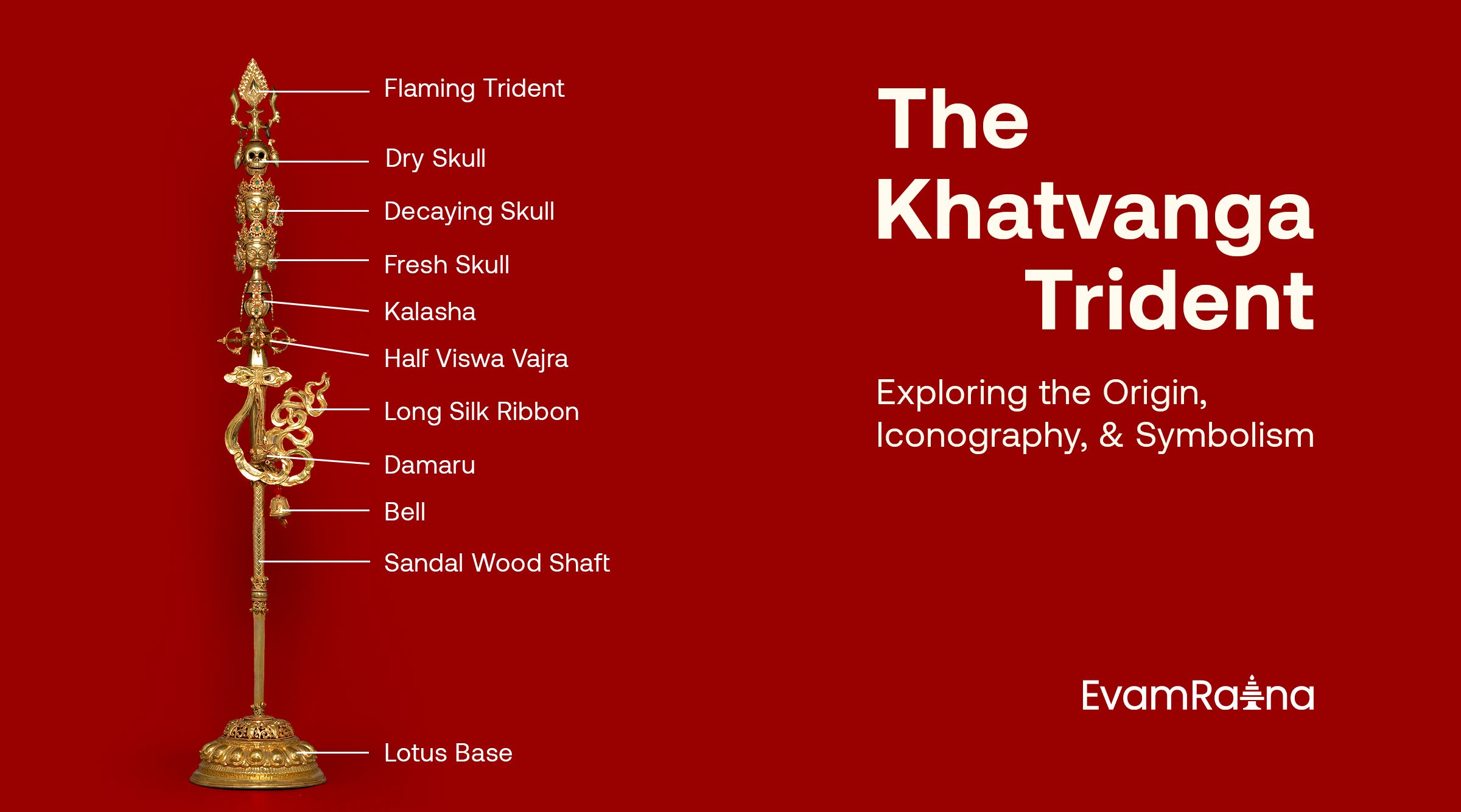
The eight-sided white shaft of the Khatvanga represents the purity of the Noble Eightfold Path of Buddhism. The eight-sided white shaft shows that the practitioner is committed to following the path to enlightenment. It embodies right view, right intention, right speech, right action, right livelihood, right effort, right mindfulness, and right concentration.
Crossed-Vajra:
Traditionally represented by a half-crossed vajra, the crossed vajra represents the four purified elements and actions of the Vajrayana. The four immeasurables (love, compassion, joy, equanimity), the four actions (pacifying, enriching, magnetizing, and destroying), and the four gateways to freedom fall under this category. The crossed vajra symbolizes the unity and balance of these elements surrounding the practitioner on the journey of their spiritual growth.
Golden Vase:
The golden vase that holds amrita (the "nectar" of success) represents the perfection of wisdom, or prajna-paramita. The prajna-paramita represents nonconceptual awareness of the realization of emptiness and the complete attainment of the highest wisdom, representing the ultimate goal of the spiritual practice.
White Silk Ribbon and Triple Banderole:
The white silk ribbon and triple banderole refer to the various teachings of the Buddha as they are appropriate for each disciple. The silk ribbon, as an emblem of the teachings, also reflects how it is displayed for disciples of the Buddha. The triplicate colored banderole (yellow, red, and blue) represents the union of the three major types of Buddhism ( Hinayana, Mahayana, and Vajrayana) and thus signifies also the inclusive and transformative nature of the different paths to the Buddhist goal.
Damaru and Bell:
The small damaru drum and bell hanging from the Khatvanga are important symbols in Tantric practices, with the damaru symbolizing "method" and the bell representing "wisdom." The union of method and wisdom is an essential element of Buddhist practice.
The Three Impaled Heads:
The three heads—a freshly severed red head, a decaying green head, and a dry white skull—carry profound symbolic meaning
The head representing hot desire (red) is attached to the destruction of attachment (nirmanakaya).
The green head representing cold malice or aversion is attached to the transformation of hatred (sambhogakaya).
The skull representing the lifeless state of ignorance represents overcoming ignorance (dharmakaya).
These three heads are tied to the three kayas (bodies) of the Buddha and also symbolize the three doors of liberation: the emptiness of cause, effect, and phenomena.
Five Seed Syllables:

(Photo from Termatree SKU: FBSCX12170)
The three heads, along with the golden vase and crossed vajra, also correspond to the five purified aspects of the Buddha’s body, speech, mind, qualities, and activities. The syllables Om, A, Hum, Sva, and Ha correspond to the Five Buddhas:
-
-
Om (white) – Vairocana (body)
-
A (red) – Amitabha (speech)
-
Hum (blue) – Akshobya (mind)
-
Sva (yellow) – Ratnasambhava (qualities)
-
Ha (green) – Amoghasiddhi (activities)
-
These syllables represent the purification of the practitioner's body, speech, and mind, aligning with the wisdom of the Five Buddhas.
The flaming trident, or bound Khatvanga, at the top of the Khatvanga represents The Three Jewels; i.e., Buddha, Dharma, and Sangha. It also symbolizes victory over the Three Realms of Existence, or overcoming the causes of suffering and confusion; hence, the Khatvanga is a symbol for the fully realized state of Enlightenment, or the highest level of attainment, across all Time and Space.
Divine Guardians: Deities Who Wield the Khatvanga Trident
Padmasambhava (Guru Rinpoche)

Vajrayogini:

Vajravarahi (Dorje Phagmo) :