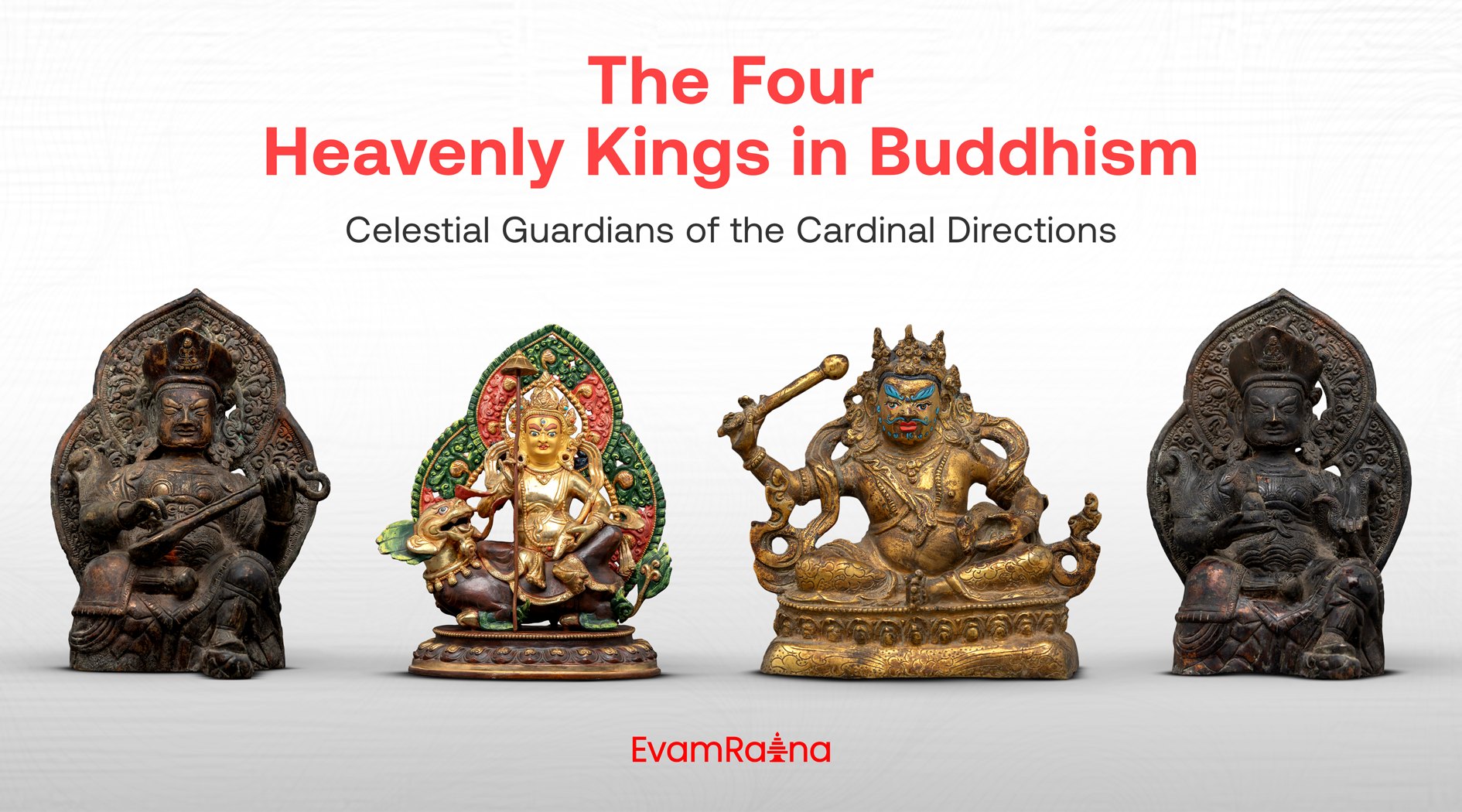
Four Buddhist Heavenly Kings Role Explained: The Guardian Gods of Buddhist Cosmology
The Four Heavenly Kings or Four Guardian Kings are powerful deity figures in the Buddhist tradition who reside on the lower slopes of Mount Sumeru in the Caturmaharajika Heaven. They are also known as Lokapala, "Guardians of the World." When you step through the gate of almost any Buddhist temple in Asia, you might have locked a gaze upon them, four towering warrior-gods, clad in armor, eyes blazing, standing guard at the threshold between the ordinary world and the sacred space within.
They are often depicted as majestic warriors in heavy armor at the entrances of Buddhist temples to signify their protective function. Beyond external protection, they embody and uphold the four Brahma-vihara (sublime virtues) and guard the gateways of the senses to prevent the poisons of the mind from taking hold. They are among the oldest and most universally recognized figures in the Buddhist world. Whether carved in stone at a Nepalese stupa, painted in vibrant pigment on a Tibetan thangka, or cast in gold at a Japanese shrine, these four celestial guardians have stood watch over the Dharma, the Buddha's teachings, for more than two thousand years.
Origins in Buddhist Cosmology: Mount Sumeru and the Caturmaharajika Heaven
In Buddhist cosmology, the universe is centered on Mount Sumeru, a vast, mythical cosmic mountain that serves as the axis of existence for both Buddhist and Hindu worldviews. The mountain rises through multiple realms, each home to different classes of beings, and the Four Heavenly Kings reside on its lower slopes, in a celestial realm called Caturmaharajikayika, the Heaven of the Four Great Kings.
From their palaces on these slopes, each king commands an army of supernatural beings: Gandharvas (celestial musicians), Nagas (serpentine water spirits), Kumbhandas (spirit guardians of life and growth), and Yaksas (powerful spirit-beings associated with nature and wealth). Together, these armies patrol the four cardinal directions of the cosmos, keeping watch over the world below.
The Four Heavenly Kings are not the highest deities in Buddhist cosmology, they serve under Sakra (Indra), the lord of the Trayastrimsa heaven above. But they are perhaps the most directly engaged with the human realm. According to Buddhist scriptures, on the 8th, 14th, and 15th days of each lunar month, the kings either send emissaries or descend themselves to inspect the state of human virtue and morality, then report their findings to the assembly of devas above.
Dhatarattha: Guardian of the East

Dhatarattha's name in Pali translates as "He Who Upholds the Kingdom" or "Supporter of the Country." He governs the eastern direction and is associated with harmony, peace, and the moral order that holds communities together. He is most commonly depicted holding a pipa, a traditional Chinese stringed instrument similar to a lute. The pipa is a profound teaching in itself: the strings of the instrument must be tuned to exactly the right tension. Too tight and they snap; too loose and the music falls apart. This is a direct expression of the Buddhist concept of the Middle Way, the path of balance between excessive indulgence and harsh austerity that the Buddha taught as the route to liberation.
Dhatarattha presides over the Gandharvas, celestial beings known as musicians and singers of the heavenly courts. Gandharvas are also associated with fragrance, the knowledge of medicine, and the arts, making them fitting subjects for a king whose emblem is a musical instrument. His color is typically white, symbolizing purity and clarity of intention. Devotees invoke him when seeking peace in relationships, resolution to conflicts, and the cultivation of harmony in communal life.
Virupaksa: Guardian of the West

Virupaksa's name translates as "He of the Distorted Eyes" or, more precisely, "Wide-Seeing," a reference to his capacity for penetrating, all-encompassing vision. He sees through surface appearances to the truth beneath, making him the embodiment of insight, perception, and spiritual vigilance.
He is typically shown holding a serpent in one hand and a stupa in the other, or in some traditions carrying a pearl. The serpent represents his command over the Nagas, powerful serpentine beings associated with water, wisdom, and the hidden currents of the natural world. The pearl symbolizes the eternal, unchanging principles of virtue: respect, sincerity, love, and humility. His message is to uphold timeless truth while remaining adaptable to the ever-changing circumstances of the present.
His color is red, symbolizing his vitality, his awareness, his perception, the flames of his awareness, which purges away confusion. He is invoked for protection against deception, hidden threats, and the fog of confusion, helping practitioners maintain clarity on the path.
Virulhaka: Guardian of the South

Virulhaka's name means "He Who Causes to Grow" or "Increase and Growth." As guardian of the south, the direction associated with warmth, agriculture, and the flourishing of life, his role is intimately tied to development, prosperity, and the blossoming of all beneficial conditions.
He is depicted wielding a sword, and the symbolism here is precise: Virulhaka's sword does not cut through flesh; it cuts through ignorance, attachment, and aversion, the three poisons that obscure the mind and prevent spiritual growth. The sword represents the discriminating wisdom that distinguishes truth from delusion. His color is blue or green, reflecting the depth of the ocean and the vitality of living things. He presides over the Kumbhāṇḍas, guardian spirits closely associated with the protection of life and the flourishing of crops and communities.
Practitioners call on Virulhaka when they seek protection against harmful influences, courage to overcome obstacles, and support for genuine spiritual and personal growth.
Vaisravana: Guardian of the North

Vaisravana is the leader of the Four Heavenly Kings, the most prominent, the most widely worshipped independently, and the most richly layered in symbolism. His name means "He Who Hears Everything" or "Great Listener," reflecting his omniscient awareness of all prayers, requests, and the state of affairs in the world. He guards the northern direction and is the king of the Yakṣas, powerful nature spirits and warriors.
His attributes vary across traditions but most commonly include a stupa (representing the Dharma and the spread of Buddhist teachings), a mongoose that spits jewels (symbolizing the generation of abundance and the defeat of greed), and sometimes a victory banner or umbrella of sovereignty. His color is yellow or gold, embodying wealth, abundance, nourishment, and stability. In his separate role as an independent meditational deity in Vajrayana Buddhism, Vaiśravaṇa, also known in Hindu tradition as Kubera, is widely venerated as a wealth deity, protector of righteous rulers, and patron of warriors and spiritual practitioners alike.
Uniquely among the four kings, Vaiśravaṇa is commonly depicted riding a snow lion in Tibetan art, and he alone among the group is widely encountered as a standalone figure in mandalas, thangkas, and devotional practice.
Spiritual Role: How Do the Four Kings Protect the Dharma?
The Four Heavenly Kings guard the Dharma in two aspects that complement each other, and together sum up the totality of what it means to protect the Dharma in the Buddhist view.
They are spiritual warriors, and they are actively resisting the influence of any evil, distraction, or disruptive force that may hinder the peaceful practice of the Dharma. It's their fierce appearance and martial iconography that make them defenders who will not back down from obstruction when it comes to confronting it with the full force of their authority.
As nurturing presences, they promote the conditions in which the Dharma can flourish. This means good climate, abundant harvests, stable societies, and environments in which human beings have the time, safety, and freedom to study and practice the Buddha's teachings. It is this dual function that removes evil and brings good, which is the same as the Bodhisattva, the protector of Mahayana Buddhism.
Across traditions, the kings are also understood to be guardians of the four brahmaviharas, the four immeasurable virtues at the heart of Buddhist practice: loving-kindness (metta), compassion (karuna), empathetic joy (mudita), and equanimity (upekkha). In this reading, each king is not just a cosmic protector but a living embodiment of one of these qualities, guarding it in the world and cultivating it in practitioners.
Why Are the Four Heavenly Kings Placed at Temple Entrances?

Their placement at the temple entrance is deliberate and deeply meaningful on multiple levels.
On the cosmological level, the four kings are seated in front of the four points of the compass, on Mount Sumeru, as cosmic guardians. The arrangement of the temples at the entrance of the temple grounds is a re-creation of this cosmic set-up in miniature: the temple represents Mount Sumeru, the Buddha image the axis of enlightened reality, and the kings, the cosmic guardians whose duty it is to protect the sacred space from all sides.
On the psychological level, encountering the fierce, imposing figures of the four kings at the entrance to a sacred space serves as a kind of significant change. Before entering the presence of the Buddha, the practitioner passes through a confrontation with the guardians, a moment that recalls one's own vows, one's own commitment to the Dharma, and the seriousness of stepping into a space of practice and transformation.
On the practical level, the kings were understood in the Chinese tradition to actively read the hearts of those who enter. Those who come with sincere devotion, humility, and good intention pass freely; those who come with arrogance or harmful intent are repelled by the guardian's vigilance.
Read More About Beyond the Human Realm: The Majestic Celestial Beings of Buddhism
Conclusion:
The Four Heavenly Kings are among the most powerful guardian figures in Buddhist cosmology, protecting the four directions, the Dharma, and the sacred spaces where practice takes place. From their celestial home on Mount Sumeru to temple entrances across Asia, Dhatarattha, Virupaksa, Virulhaka, and Vaisravana remind practitioners that spiritual protection is not only external but also internal. They guard against harmful forces, ignorance, confusion, greed, and obstacles that prevent the mind from growing in wisdom and compassion.
Their fierce warrior forms, sacred objects, and directional symbolism reveal a deeper teaching: the path to enlightenment must be protected by harmony, clarity, growth, and abundance. Whether seen in Tibetan thangkas, Nepalese stupas, Chinese temples, or Japanese shrines, the Four Heavenly Kings continue to stand as timeless protectors of Buddhist teachings and living symbols of moral strength, spiritual vigilance, and Dharma protection.