










Adi Buddha Samantabhadra: Meaning, Symbolism, and Spiritual Significance
Samantabhadra, the Primordial Buddha, embodies the deepest truth of reality and perfect goodness. Unlike the historical Buddha Shakyamuni, who lived as a human teacher, or the bodhisattvas who vow to return until all beings are liberated, Samantabhadra exists beyond time, beyond form, beyond cause and effect. He is the ground of all existence itself.
At the same time, Samantabhadra is understood in two ways. In Vajrayana Buddhism, he is seen as the Primordial Buddha (Adibuddha), the source of all wisdom and awareness. In Mahayana Buddhism, he appears as a great bodhisattva who represents pure intention, virtue, and enlightened action. So, understanding Samantabhadra means understanding both his role as the ultimate reality and as a guide for living a compassionate and meaningful life.
Samantabhadra: A Brief Overview

Samantabhadra, known in Tibetan as Kuntuzangpo, a figure of supreme importance who represents the very source of enlightenment. He is also often referred to as the "Universal Worthy" or "All-Good," the name itself derived from the Sanskrit words samanta (universal) and bhadra (good or virtuous), points toward a state of being that is essentially and pervasively pure. He is not a historical person who became enlightened through practice. Instead, he represents a state of enlightenment that has always been present, something that was never hidden and can never be lost. He symbolizes pure awareness in its natural form, clear, open, and free from any limits.
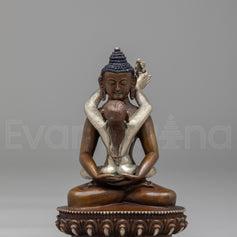
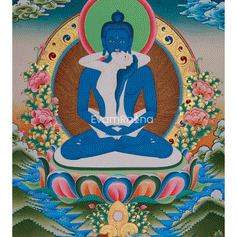
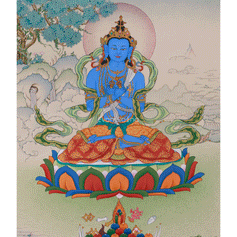
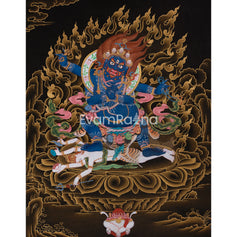
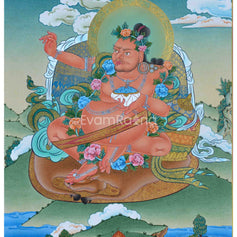
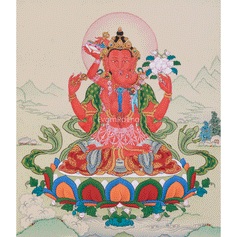
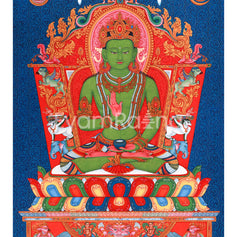
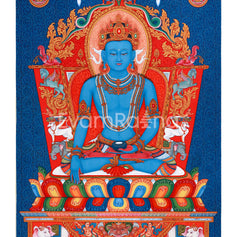
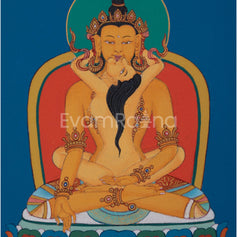
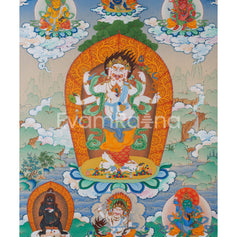
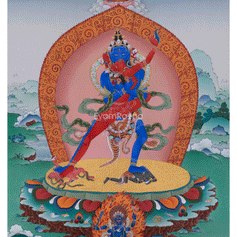
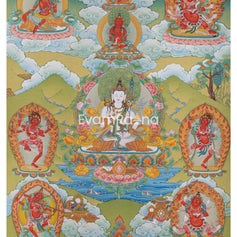
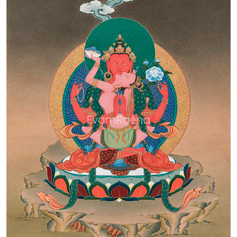
Samantabhadra is typically depicted as a deep blue, naked male figure seated in meditation, often in union with his consort Samantabhadri (Kuntuzangmo), who is white. Together, they form the Yab-Yum, the divine union symbolizing the inseparable nature of compassion (male) and wisdom (female), emptiness and clarity, bliss and awareness.
Samantabhadra as Adi Buddha: The Primordial Source
The term Adi Buddha translates to “Primordial Buddha” or “the first Buddha,” not first in a chronological sense, but in the sense of being the most fundamental, the source from which all phenomena and all enlightened beings arise. Adi means beginning, primordial, or source; Buddha means "awakened one."
In Tibetan Buddhism, the concept of Adi Buddha points to the ultimate nature of mind, the dharmakaya, or truth body, which is said to be intrinsically pure, luminous, and free of all conceptual elaboration. Samantabhadra is this nature personified.
Iconography and Symbolism of Samantabhadra

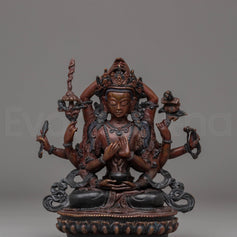
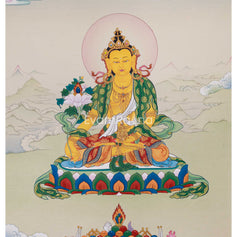
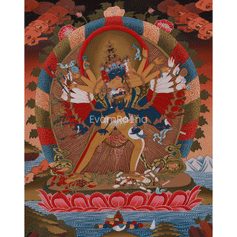
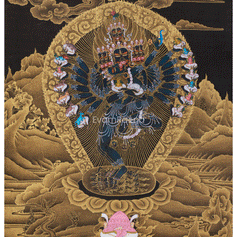
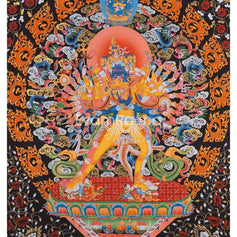
In Thangka paintings and sacred sculpture, Samantabhadra is depicted with the following iconographic precision:
- Deep Blue Color Body: Samantabhadra is shown in a deep blue color, like a clear, endless sky. This color represents vastness, openness, and the infinite nature of the mind. It shows that true awareness has no limits and is completely pure and clear.
- Naked body: Perhaps the most striking and theologically important aspect of Samantabhadra's iconography is that he is depicted completely naked, without ornaments, clothing, or any attributes. It symbolizes total freedom from illusions, ego, and all mental coverings. It represents truth in its most natural and pure state.
- Meditative Posture: He is typically shown in the vajra position (full lotus) with his hands in the meditation mudra, signifying a state of permanent, unshakable equilibrium.
- Absence of Attributes: Unlike many other deities who hold ritual objects like vajras or bells, the Primordial Samantabhadra often holds nothing. His empty hands represent non-duality and the lack of any need for external tools to achieve or maintain enlightenment.
Samantabhadra in the Nyingma and Dzogchen tradition
Within the Nyingma school, the oldest of the four main schools of Tibetan Buddhism, Samantabhadra occupies the highest position in the spiritual hierarchy. He is the primordial source of the Dzogchen (Great Perfection) teachings, also called Atiyoga. These teachings are considered the most direct path to liberation, pointing directly to the nature of the mind without the need for elaborate rituals or gradual stages of practice.
In Dzogchen cosmology, Samantabhadra is the dharmakaya, the unmanifest, formless dimension of enlightened mind. From him arises the sambhogakaya (enjoyment body), represented by deities such as Vajrasattva and the five Dhyani Buddhas. And from the sambhogakaya arises the nirmanakaya (manifestation body), which includes all historical Buddhas such as Shakyamuni.
The famous Samantabhadra Prayer, found in the Bardo Thodol (Tibetan Book of the Dead), is believed to have been spoken by Samantabhadra himself at the very beginning of time, and its recitation is said to lead beings to liberation in the bardo state after death.
Samantabhadra and Samantabhadri: The Yab-Yum Union

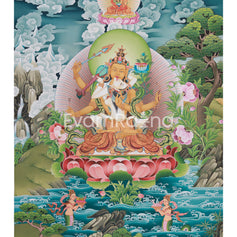
In many Tibetan thangkas and statues, Samantabhadra is depicted in Yab-Yum, the union of male and female principles, with his consort Samantabhadri (Kuntuzangmo), who is depicted in white color. This sacred union carries multiple levels of symbolism:
- Male (Yab): Compassion, skillful means, method, bliss
- Female (Yum): Wisdom, emptiness, prajna, space
- Their union: The inseparability of compassion and wisdom, form and emptiness, appearance and awareness
Samantabhadra (the Father) represents the method, compassion, and skillful means (upaya). He is the active, manifest aspect of reality that engages with the world for the benefit of all beings. Samantabhadri (the Mother), who is typically depicted as white in color, represents wisdom (prajna) and emptiness (shunyata). She is the passive, sensible aspect that understands the ultimate nature of all phenomena as being free from inherent existence.
Read More About Yab-Yum: The Sexual Union of Male & Female in Buddhism
Samantabhadra vs. Samantabhadra Bodhisattva in Mahayana

It is important to distinguish between the two figures who share the name Samantabhadra:
Samantabhadra Adi Buddha (Tibetan: Kuntuzangpo): The primordial Buddha of the Nyingma/Vajrayana tradition. He is the ground of all reality, depicted as a naked blue figure.
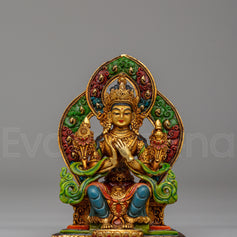
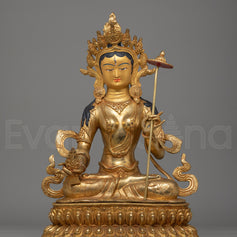
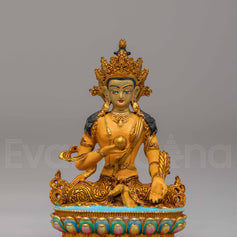
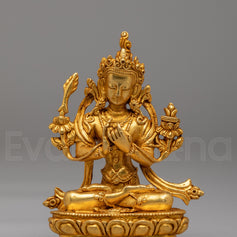
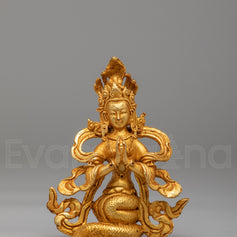
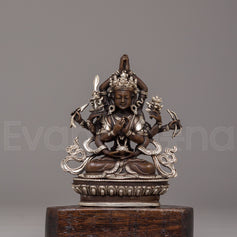
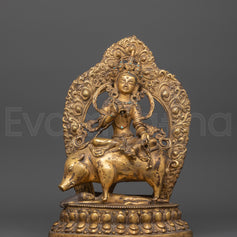
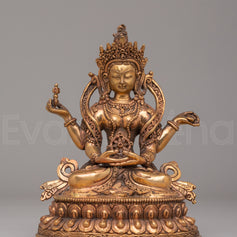
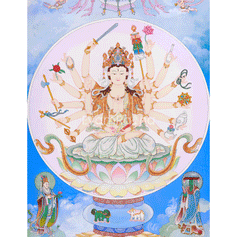
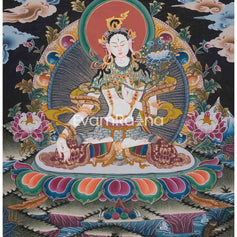
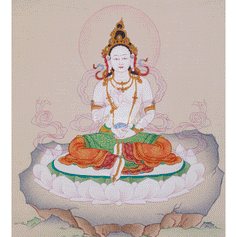
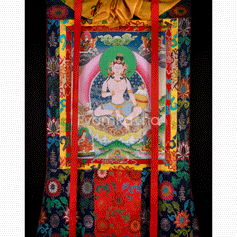
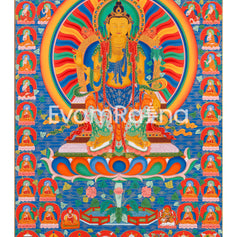
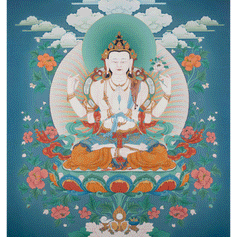
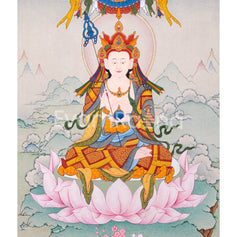
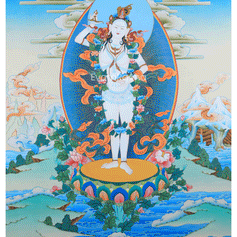
Samantabhadra Bodhisattva: A great bodhisattva found in Mahayana Buddhism, particularly revered in Chinese and Japanese Buddhism. He is associated with the Avatamsaka Sutra (Flower Garland Sutra) and is known for his Ten Great Vows. He is depicted as a white-robed bodhisattva riding a six-tusked white elephant, holding a lotus or jewel.
While both embody boundless goodness and compassion, the Mahayana Samantabhadra Bodhisattva is a figure you can follow and learn from. He represents right intention, good actions, and the path of practice. He is someone practitioners look up to as a guide for living a meaningful and compassionate life. While the Vajrayana Samantabhadra is understood as the Adi Buddha, the Primordial Buddha. Here, he is not a guide or role model, but the very nature of the mind itself, pure awareness that exists beyond effort, practice, or goals.
The Ten Great Vows of Samantabhadra
The Ten Great Vows of Samantabhadra Bodhisattva, drawn from the Avatamsaka Sutra, represent the highest ideal of bodhisattva action, the way a being committed to universal liberation moves through the world. These vows are chanted and recited in Buddhist communities around the world as an aspiration for practice.
Overview of the ten vows
- To pay homage and respect to all Buddhas: bowing to the enlightened nature in all beings and phenomena
- To praise the Thus Come Ones (Tathagatas): to recognize and celebrate the Buddha-nature wherever it is found
- To make abundant offerings: giving not just materially, but offering one's practice, merit, and awareness
- To repent of misdeeds: purifying negativity through honest acknowledgment and renewed intention
- To rejoice in others' merits and virtues: celebrating the good in others, dissolving jealousy
- To request the Buddhas to continue teaching: honoring the continuity of wisdom transmission
- To request the Buddhas to remain in the world: an aspiration for the presence of enlightened teachers
- To follow the teachings of the Buddhas at all times: a commitment to practice through all circumstances
- To accommodate and benefit all living beings: the core of bodhisattva action: serving all without exception
-
To transfer all merits and virtues to all beings: dedicating every positive act to the liberation of all
How do the vows reflect universal compassion and peace?
What is striking about these vows is their total inclusivity. There is no being excluded from the circle of concern. Not one person, not one animal, not one being across any realm of existence. Samantabhadra's compassion is described as being "as vast as the dharmadhatu (reality itself) and as endless as space."
This is not just about trying to be good or compassionate; it describes the natural state of an enlightened mind. When we connect with the state of Samantabhadra, compassion is not something we have to force or create. It comes naturally and effortlessly. It arises on its own, just like the warmth of the sun. It is not limited to certain people or situations; it flows equally to everyone, without judgment or preference.
Benefits of Chanting Mantras and Meditation

The consistent practice of the mantra associated with the Samantabhadra lineage is said to:
- Purify obscurations of body, speech, and mind accumulated over countless lifetimes.
- Strengthen the recognition of (Rigpa) the nature of the mind.
- Generate compassion and open-heartedness toward all beings.
- Protect the practitioner in the bardo state after death.
- Plant seeds of liberation that ripen across many lifetimes.
Beyond spiritual ideas, many practitioners over time have shared that regular mantra practice brings real, noticeable changes in their daily lives. They feel more peaceful inside, more balanced during difficult situations, and more connected to other people and all living beings. From the perspective of Samantabhadra’s teachings, these changes are not something new being created. They are simply the natural expression of what has always been present within us; it is simply the natural unfolding of what was always already there.
Why is Samantabhadra the symbol of universal peace?
Samantabhadra is the symbol of universal peace for reasons that go deeper than what we usually think of. Normally, we think peace means the absence of conflict or problems.
But the peace of Samantabhadra is different; it is always present, whether there is joy or sorrow, calm or difficulty. It is like the open sky, which remains unchanged whether clouds appear or disappear.
This peace is called universal because it does not belong to any one religion, culture, or person. It is the true nature of every mind. No matter who we are or what we go through, this peaceful awareness is always within us. Even in the most difficult states, this inner nature is never completely lost; it is only temporarily hidden.
This is what makes Samantabhadra a symbol not just of Buddhist peace, but of a universal peace that humanity has always intuited in its deepest moments, in great art, in near-death experiences, in meditation, in the sudden stillness that descends in a forest or at the edge of an ocean. The peace that is always already here. The goodness that cannot be damaged. The awareness that was never born and will never die.
Conclusion: Embracing the path of Samantabhadra
Studying Samantabhadra helps us understand something truly powerful: the peace and compassion we are searching for are not far away; they are already part of who we are.The Adi Buddha is not a deity in the sky waiting to be pleased. He is the nature of your own mind, looking out through your own eyes, listening through your own ears, aware of this very moment.
Teachings from traditions like Nyingma and Dzogchen do not ask you to become something new or different. Instead, they guide you to recognize what has always been within you. When you begin to see this clearly, a deep and lasting peace becomes available, one that does not depend on situations, people, or external conditions, but comes from your own natural state.
No matter your background, whether you are a Buddhist practitioner, a spiritual seeker, or simply curious, Samantabhadra’s teaching offers something meaningful. It reminds you that even in the middle of life’s struggles, there is a part of you that remains pure, peaceful, and untouched. A goodness that is always present, everywhere, and in every moment.


