Unlock the Power of the Mandala Offering Mudras: A Journey from Ego to Enlightenment
The Mandala Offering Mudras of Buddhism serve as an important component of Buddhist Rituals that lead the individual into a deeper spiritual experience by leaving behind one's ego and totally offering the Universe. The hand gestures of the mudras symbolize not only the offering of all that exists but also provide a means to elevate the practitioner to a more profound state of being. It is like having a map to explore a vast, unknown territory. Each mudra, like an indication on the map, will bring you closer to the experience of meeting and becoming one with the Divine. The Mandala represents the entire universe; therefore, the mudras represent the individual's totality of being.
Mandala Offering in Buddhism

Click here to view our Buddhist Guru Offering Mandala
The Mandala and the Mandala Offering are closely intertwined, much like a map and a journey. Imagine the Mandala as a detailed map of the universe, outlining the interconnectedness of all things—just as a map helps you navigate a vast land, the Mandala guides you through the spiritual realms. Each intricate design and symbol within the Mandala represents different aspects of the cosmos, offering a visual path toward enlightenment. It's as though you're holding the map to a treasure, and each turn brings you closer to the inner peace and wisdom you seek.
The Mandala Offering, on the other hand, is like preparing a feast for a king, but instead of food, you present the universe itself—earth, air, water, fire, and all beings—and the king represents the supreme entity or the personifications of the desired Buddha qualities. This offering is not just a gesture; it’s an expression of selflessness, a way to let go of attachment and share your deepest intentions with the divine. It’s as if you're gifting the entire cosmos to the Buddha, symbolizing the act of giving up everything to embrace spiritual growth and compassion.
Now, the Mandala offering Mudra is the hand gesture that makes this offering. Picture it like holding out a beautifully wrapped gift with your hands open and palms facing upward. In this mudra, you are symbolically holding the universe, ready to offer it. Just as a bow or handshake conveys respect or intent, this mudra speaks to your heart’s sincerity, showing that you’re offering not just an object but your whole being. It’s a physical representation of the mindset of surrender and devotion required by the Mandala Offering. Together, the Mandala, Offering, and Mudra form a complete spiritual practice, like a well-charted journey with every step designed to connect you more deeply with the divine.
How to Perform Mandala Offering Mudra?
In Vajrayana Buddhism, the Mandala Offering Mudra serves as a powerful technique in meditation and Spiritual Practice, as it reflects ultimate detachment by offering the universe to the divine, which we dearly consider ours. Incorporating this mudra while offering a mandala will act as a catalyst for acquiring wisdom and enlightenment.
To perform the Mandala Offering Mudra, follow these steps, ideally using a mala or without:
All step-by-step images are courtesy of the Langri Tangpa Buddhist Centre

1. Relax your hands: Begin by keeping your hands relaxed and open, with your fingers gently positioned back to back.
2. Cross your little fingers: Gently cross your little fingers over each other, and use your thumbs to hold them down.
3. Cross your middle fingers: Next, cross your middle fingers over one another, and press them down with your index fingers.
4. Position the ring fingers: Your two ring fingers should remain straight and positioned vertically, facing each other, with the backs of the fingers touching.
This mudra symbolizes the interconnectedness of all elements in the universe and is a powerful gesture used during the Mandala Offering, representing the vajra and the commitment to offer the universe with devotion and selflessness.
Symbolism of Mandala Offering Mudra:
The Mandala Offering Mudra is not merely a physical gesture; it holds profound spiritual significance, symbolizing the renunciation of the ego and attachment. By making this offering, the practitioner surrenders their sense of self and material attachments, offering the entire universe to the Buddha and all spiritual teachers. This selfless act represents the practitioner’s dedication to the path of enlightenment, motivated by bodhicitta—the compassionate intention to attain Buddhahood for the benefit of all beings.
In this mudra, the practitioner offers the world the hope that all sentient beings, including all human beings, will experience the beauty of the land free from suffering and delusion. It is an expression of the deep desire that all beings may awaken to the truth, transcend ignorance, and live in harmony with the world, free from the grasp of attachment and confusion. Through this offering, the practitioner aligns their own transformation with the greater wish for universal liberation, symbolizing a commitment to help others overcome suffering and realize enlightenment.
Little Fingers (Crossed, Held by Thumbs):
Symbolizes the Four Human Continents: These continents surround the central axis of the universe, Mount Meru, which represents the center of existence.
The crossed little fingers represent the vast diversity and interconnectedness of all beings in the world.
Middle Fingers (Crossed, Held by Index Fingers):
Symbolizes the Four Additional Continents: These continents expand upon the world, reflecting the expansiveness of the cosmos and the far-reaching nature of Buddhist teachings.
It acknowledges the inclusivity of all sentient beings, emphasizing the universality of compassion.
Ring Fingers (Straight, Facing Each Other, Back to Back):
Symbolizes the Eight Subcontinents: These subcontinents surround the central Mount Meru, providing the foundation for the human continents.
The vertical position of the ring fingers represents the stability and support these subcontinents offer, highlighting balance and interconnectedness.
Bodhicitta Motivation:
The entire mudra is performed with bodhicitta—the compassionate intention to attain enlightenment for the benefit of all beings.
This signifies a deep offering not just of material wealth, but the entire universe, reflecting the practitioner's selfless devotion to others' enlightenment.
Offering to Guru Buddha and All Spiritual Teachers:
The mudra is an offering made to Guru Buddha and all other spiritual teachers, expressing respect, gratitude, and devotion.
It symbolizes the practitioner’s commitment to following the path of wisdom, compassion, and selfless service.
The Eight Offering Mudras in Buddhism:
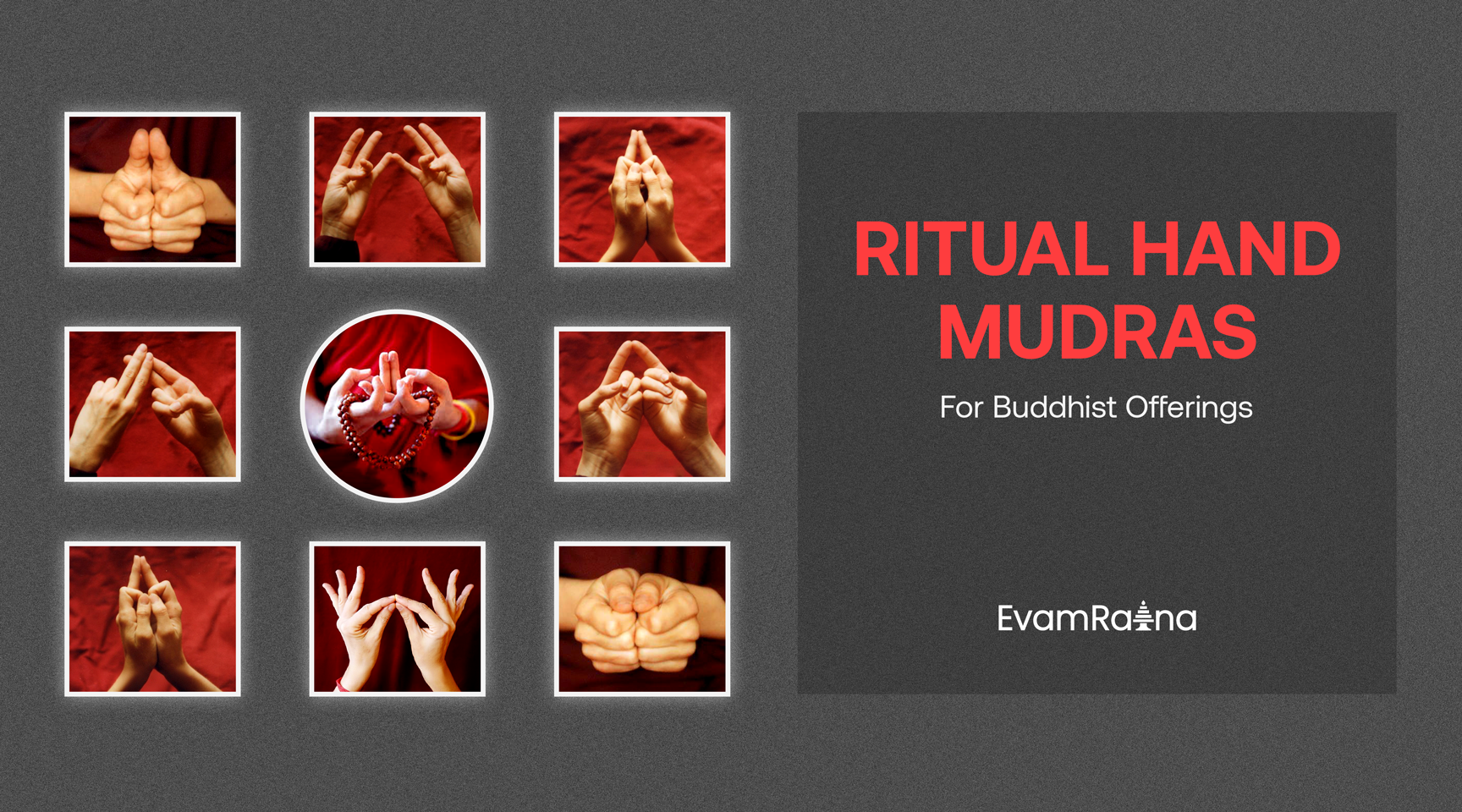
Offering and giving in Buddhism play an essential role in fostering mindfulness and compassion and in developing the practitioner along the Buddhist path. One of the greatest ways to create offerings is with the assistance of the Eight Offering Mudras, which are considered sacred hand gestures that represent different aspects of the Buddhist path. Each mudra is associated with an offering to the Buddha, Bodhisattvas, and all sentient beings and reflects the practitioner's intention to cleanse their mind and gather merit. More than just being a physical movement, the Eight Offering Mudras are also deep, heartfelt, and loving expressions of devotion to the Buddha, selflessness, and giving up, or renouncing, one's ego. Practitioners can enhance their relationship with the divine by practicing the Eight Offering Mudras in meditation and establish a strong altruistic desire to benefit others, known as bodhicitta (the wish to bring all sentient beings to enlightenment).
Here are the eight offering Mudras:
Argham (Water Offering):

The water offering symbolizes purification and cleansing of the body, speech, mind, and spiritual path, as well as wishing for clarity and freshness. At the same time, it is offering the purification of negative karma.
Padhyam (Bathing Water Offering):
 Offering footwater to the Buddha is symbolic of humility, devotion, and respect for the Buddha's sacredness.
Pushpe (Flower Offering):
 Flowers symbolize the fleeting nature of life and the beauty of impermanence. By offering flowers, we express our wish for all beings to attain enlightenment while recognizing the impermanence of existence, as well as offering sincerity and the blossoming of wisdom and virtue.
Dhoope (Incense Offering):

Dhoope represents the offering of endlessly purifying the environment and mind. The fragrance represents the best qualities of virtuous action and removing the negativity of the environment. This symbolizes the offering of virtue, as well as purifying one's surroundings.
Aloke Mudra (Light Offering):

The lamp symbolizes the light of wisdom and is representative of the dispelling of ignorance. Therefore, when we offer a lamp, we illuminate our minds by removing darkness (ignorance). Similarly, we offer a lamp as an offering to the Buddha as well, signifying the illumination of the mind through enlightenment and clarity.
Gandhe (Perfume Offering):

You offer up beautiful aromas that signify the sweetness of virtue and goodness. By offering fragrances, you cultivate good qualities, pay attention to what is good, and create harmony and joy. When you make an offering of fragrance, you acknowledge that it is important to cultivate a pure mind and a virtuous life.
Nevidhya (Food Offering):

Food represents both the physical and spiritual sustenance of life. By offering sustenance, you are practicing generosity and compassion, as well as nourishing yourself and others through the Dharma. With this offering, you will share your sustenance with your body, share your sustenance with your spirit, and share the wisdom of the Dharma with others.

Why are Mudras so powerful in Buddhist offerings and Practices?
Embodying Spiritual Qualities:
Each mudra symbolizes a form of enlightenment representing Compassion, Wisdom, Courage, and Meditation. The use of mudras for the expression of these qualities also refers to practitioners being able to emulate them.
Aiding Meditation and Concentration:
Mudras allow practitioners to focus their thoughts and internal energy through their chakras and nadis for intense concentration and awareness while in meditation and ritual.
Accumulating Merit and Purifying Karma:
Through the use of Mudras, specifically the Mandala Offering Mudra in Vajrayana Buddhist rituals, practitioners symbolically make offerings of the universe to others in Buddhist rituals, thus eradicating negative karmic accumulation and attachments with ego and gaining key Buddhist spiritual merit.
Invoking Deities and Their Blessings:
A mudra, as a form of symbolic gesture, allows for a special connection (or relationship) between the practitioner and a specific Buddha/Bodhisattva; by performing a mudra associated with a deity (i.e., the Earth-Touching gesture of Akshobhya Buddha), the practitioner invokes that deity to be present and bless them.
Narrative and Teaching Tools:
Mudras serve as visual languages on artistic representations of the Buddha and capture important moments in the life of the Buddha (such as the first sermon or enlightenment) while allowing the rest of the population, who may not read easily, to understand complex philosophies.
Guiding Energy Flow:
The positioning of each finger in a mudra corresponds to the five elements based on ancient yogic and Ayurvedic texts. When placed correctly, the fingers are said to form an energy loop, redirecting the flow of prana through physical and emotional benefit, and spiritual benefit.
Conclusion: Embrace the Path of Devotion with the Mandala Offering Mudras
The Eight Offering Mudras, when incorporated into your daily practices, will help enhance your spiritual connection and bring about many positive changes across all aspects of your daily life. These sacred hand gestures help you release attachments and purify your mind, while opening your heart to experience the presence of God. This process opens a pathway for the vitality of Divine Wisdom, Peace, and Compassion to flow through you. The Bodhichitta intention behind these mudras transcends the physical movement of your hands; through the Bodhichitta intention, you are giving everything of your being for the benefit of all sentient beings. Be it during meditation, rituals or everyday living, when you perform these mudras or when they come naturally into your life—these mudras remind you of your journey toward enlightenment, bringing clarity, calm, and balance to every step of your journey.
Explore our Mandala offering Set from Evamratna