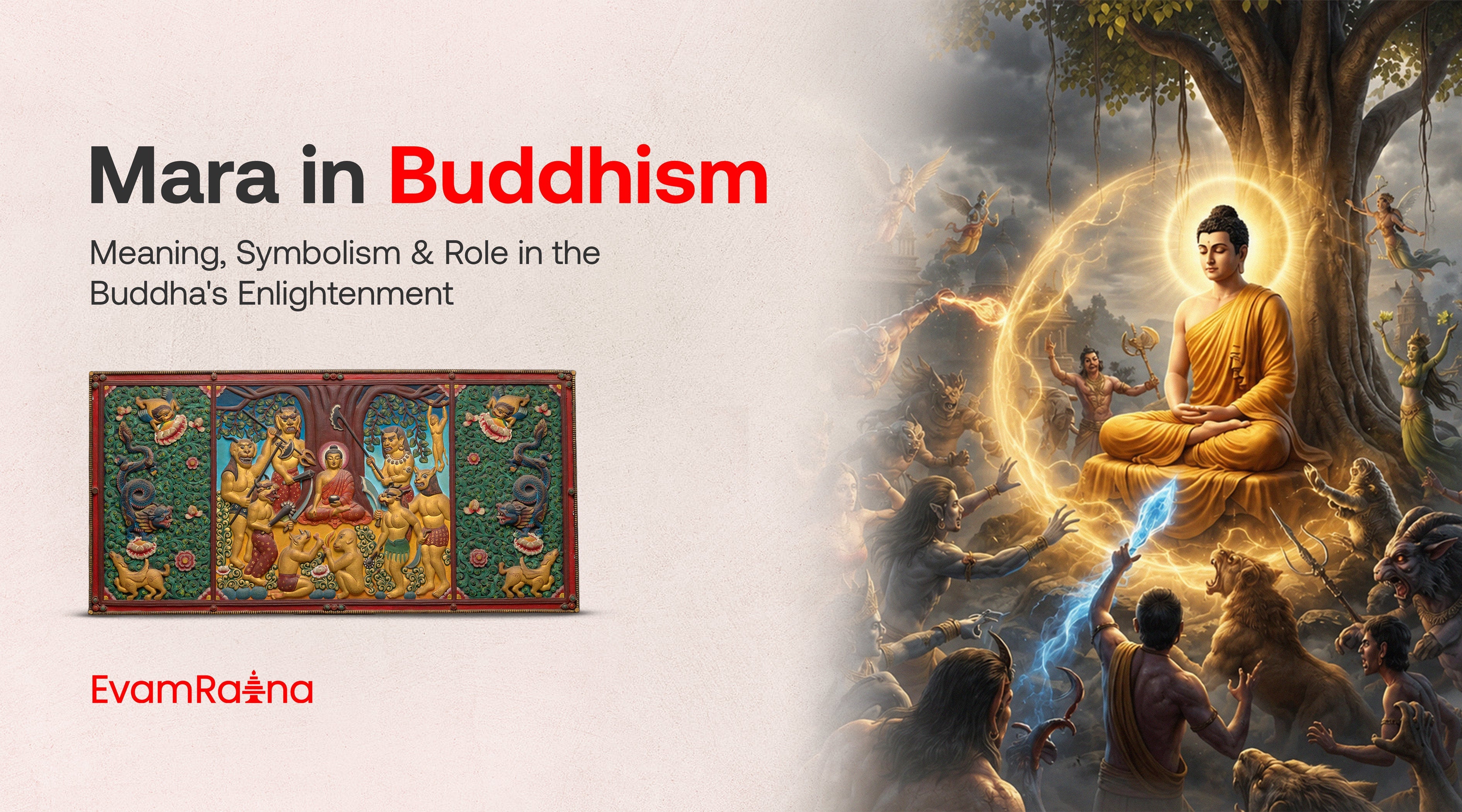
Mara the Tempter: The Demon-God of Death, Desire, and Delusion
The Demon-God Mara in Buddhism is one of the most important figures, as he appears many times in Buddhist literature, best known for his role in the story of the Buddha’s enlightenment. Mara personifies the negative qualities in the human ego, which cause the arising of delusion and the ripening of karmic retribution. He is also the tempter who attempted on numerous occasions to persuade Shakyamuni Buddha to abandon his noble aspiration to liberate all sentient beings. In a visual illustration, he looks like a demon, complete with weapons, a fierce expression, and an army of frightening followers. But in truth, Mara is not an external force; he symbolizes the internal enemies of the mind.
Mara as the Deva King:

Mara is a paranirmitavasavartin deva from the highest celestial heaven of desire, the Heaven of Controlling Others' Emanations. Still, owing to his attachment to objects of desire, he dwells in the celestial heaven of Tushita, the Joyous Realm.
Mara is known as the lord of illusion because he creates attractive distractions that make people mistake harmful things for good things. He pulls the mind toward the eight worldly concerns: wanting gain and fearing loss, wanting happiness and fearing suffering, wanting fame and fearing bad reputation, and wanting praise while fearing blame. In simple terms, Mara represents the part of the mind that gets trapped in desire, fear, approval, and attachment instead of seeing things clearly.
The Four Maras: A Complete Classification

According to the philosophy of the Buddha, and in the context of the Sutra tradition of his followers known as the Sutrayana, there are four different types of Maras, all four are different manifestations of bondage and obstruction in the path of awakening.
Skandha Mara: Mara of the Contaminated Aggregates
Skandha mara represents the illusion of a solid self or ego within Buddhist teachings. This mara personifies our obscuration in holding on to conditioned existence, like our body, our sensory experience, and mental phenomena, and taking them as real.
Klesha Mara: Mara of Disruptive Emotion
Klesha Mara is the "Demon of Defilements", which refers to the inner emotional or mental impurities: greed, hatred, delusion, and ignorance that hinder spiritual enlightenment. This mara is a representative of our attitude of “habitual inclination” to act impulsively at the spur of the moment, triggered by the things we feel.
Mrtyu Mara: Mara of the Lord of Death
Mrtyu Mara is known as "Death as Mara", the demonic force of death and the endless cycle of birth and death. This mara represents impermanence, change, and death, which are uncontrollable and a danger to our precious human rebirth.
Devaputra Mara: Mara of the Deva's Son
Devaputra Mara, a deity or "son of the gods" of the sensual world. This mara serves as an example of our spontaneous desire to enjoy sensuality and favourable circumstances in everyday activities.
Mara and the Night of Enlightenment

The most pivotal story in all of Buddhist mythology is the night of Siddhartha Gautama's enlightenment, and Mara stands at its very centre. On the eve of his enlightenment, Siddhartha sat beneath the Bodhi tree, determined not to rise until he had discovered the truth.
Sensing this, Mara appeared, determined to stop Siddhartha. He sent his daughters to seduce Siddhartha and awaken desire; he unleashed a terrifying army of demons to spark fear; and finally, he challenged Siddhartha's right to find enlightenment, appealing to the ego and trying to break his determination.
Desire: The Three Daughters
Mara sent his beautiful daughters, Tanha (desire), Arati (discontent), and Raga (attachment), to seduce Siddhartha. They represented the three seductive faces of attachment. The Buddha remained utterly unmoved, seeing through the illusion of form with perfect clarity.
Fear: The Demonic Army
Mara conjured a terrifying demon army, shooting flaming arrows and violent storms. Yet before the clarity of the meditator's awareness, every weapon transformed into flowers and every threatening force dissolved. The external world held no power over one who had made peace with the inner world.
Ego and Doubt: The Challenge of Worthiness
Mara asked, "Who do you think you are to claim enlightenment? Who will testify on your behalf?" In response, Siddhartha touched the earth with his right hand, a gesture known as the Bhumisparsha Mudra. This powerful act asked the Earth Devi to witness his lifetime of compassion and merit. The Earth shook, Mara's illusions vanished, and Siddhartha awakened as the Buddha.
What Does Mara Symbolize?

Beyond the mythology, Mara's deepest significance is psychological and philosophical. He is the personification of all that keeps the mind from waking up.
Mara as the Ego:
Mara is merely the reflection of our own delusion. The only way Mara can overwhelm us is when we choose to surrender ourselves to the delusion of our own making, which has its origin in our mind and is susceptible to changes in accordance with what thoughts we may choose to entertain.
Mara as Craving:
His daughters embody the three roots of suffering, craving for pleasure, aversion to pain, and passionate confusion between them.
Mara as Death-Terror:
As Mrtyu-Mara, his inner aspect is the disturbing mental activities that activate the karmic forces to propel us into subsequent rebirth, the grasping of a false sense of existence that is devoid of the true state of the absolute.
Mara as the Inner Critic:
His final challenge, "Who witnesses for you?", is the voice of self-doubt and unworthiness that arises precisely when we are closest to genuine insight.
In Buddhism, Mara is not to be feared as a villain but to be studied and recognized. He represents the internal barriers that block awakening.
Why is Mara Called the "Mirror of Our Mind"?
Mara is the mirror of our own mind. He does not come from outside. He arises from within. A mirror shows only what stands before it. If the mind is clouded by craving, Mara appears as desire. If the mind is gripped by fear, Mara appears as a terrifying army. If the mind is riddled with self-doubt, Mara appears and says, "Who are you to claim enlightenment?" In every case, Mara reflects the inner contents of the practitioner's mind back at them, amplified, dramatised, and disguised as something external.
This is why Mara has no fixed face. He wears every face the mind already carries. Mara has power only to the extent that our minds give it to him." Strip away that mental fuel, and Mara has nothing to work with. The mirror metaphor also explains why recognising Mara is itself the antidote. You cannot dispel a reflection by fighting the mirror. You dispel it by cleaning the glass, by practising mindfulness, insight, and compassion until the mind no longer projects what Mara needs to exist.
"Mara is merely the reflection of our own delusion. The only way Mara can overwhelm us is when we choose to surrender ourselves to the delusion of our own making, which has its origin in our mind."
What does Mara look like in everyday modern life?
Mara does not arrive, announcing himself. He arrives wearing familiar clothes. Recognising when Mara shows up in the mind is the first step to transformation. He might appear as:
Klesha-Mara Today
Anxiety spirals, jealousy scrolling, reactive anger, chronic comparison, the inner voice that says "you are not enough."
Skandha-Mara Today
Clinging to a fixed identity, protecting the ego on social media, the terror of being "nobody."
Mrtyu-Mara Today
Avoiding conversations about death, obsessive anti-aging, clinging to the past, fear of change, or loss.
Devaputra-Mara Today
"Just five more minutes of scrolling." Numbing pain with food, entertainment, or distraction. Comfort that costs clarity.
How to Defeat Mara: Buddhist Teachings and Practice

In Buddhism, Mara is not defeated by fighting, running away, or suppressing desire. Mara is defeated through awareness. He is the one who embodies the confusion of desire, fear, doubt, pride, distraction, and attachment that holds beings in bondage. In Buddhist texts, Mara appears as a tempter with armies and daughters, but he is also understood as a symbol of attachment, aversion, and delusion within the mind.
Mindfulness Meditation:
The first way to overcome Mara is to recognize him clearly. When desire, anger, fear, laziness, or doubt arises, we do not need to panic or obey it. We simply observe: “This is craving,” “This is fear,” “This is doubt.” The Buddha’s response to Mara was not hatred but recognition, “I see you, Mara.” In this way, mindfulness removes Mara’s hidden power. When the mind is aware, Mara has no place to enter. Buddhist teachings compare strong mindfulness of the body to a solid door where Mara cannot gain a foothold.
Bodhicitta Meditation:
Bodhicitta, the awakened heart that wishes to attain enlightenment for the benefit of all beings, weakens Mara at the root. Mara thrives on self-centered grasping: “my fear,” “my desire,” “my success,” “my pain.” But bodhicitta expands the heart beyond the small self. When we examine emotions with compassion and wisdom, we begin to see that anger, jealousy, pride, and craving are not solid enemies. They arise from causes and conditions, and they can dissolve. Mahayana teachings explain that enlightenment is achieved through the power of bodhicitta, because it turns practice away from self-obsession and toward the liberation of all beings.
Mantras and Chanting:
Mantra practice gives the mind a sacred anchor. Repeating mantras such as Om Mani Padme Hum helps redirect attention away from Mara’s distractions and toward compassion, clarity, and devotion. The sound of the mantra steadies the mind when thoughts are scattered. In Vajrayana practice, mantra is not only sound; it is a method of protecting and transforming the mind. When repeated with sincerity, chanting becomes a shield against confusion and a bridge back to awareness.
Single-Pointed Samadhi:
Mara loses strength when the mind becomes stable. Through single-pointed concentration, the practitioner no longer follows every attraction, fear, or fantasy that appears. The Buddha’s own awakening is connected with deep meditative absorption, and Buddhist teachings explain that mindfulness supports concentration, concentration supports wisdom, and wisdom supports liberation. When the mind rests steadily, even beautiful or frightening visions cannot pull it away from the path.
Conclusion:
The Buddha's Mara is not just a terrifying figure in ancient legends; he is the living embodiment of all the things that bind the mind to suffering. In this blog, we looked at Mara as a deva king, a lord of illusion, the tempter of Buddha, and the inner force behind craving, fear, ego, death, doubt, and distraction. The Four Maras are a glimpse of how attachment to the body, emotional defilements, fear of death, and lust are all obstacles in the path of awakening.
The Buddha's triumph over Mara is one of the most important lessons in Buddhism: to overcome the darkness within ourselves, we must not fight it, but rather look it in the eye. When desire is understood, loss of strength is avoided; when fear is met with calmness, loss of strength is avoided; when doubt is answered by the strength of accumulated merit and wisdom, loss of strength is avoided. By practicing mindfulness, bodhicitta, mantra, and samadhi, practitioners discover how to see Mara in everyday life and return to the state of the pure, awake mind. So, the story of Mara is not just about Buddha's attainment of nirvana under the Bodhi Tree, but about anyone's effort to transcend illusion and discover freedom in.