Symbolism of the Four Guardian Animals in Buddhist Cosmology
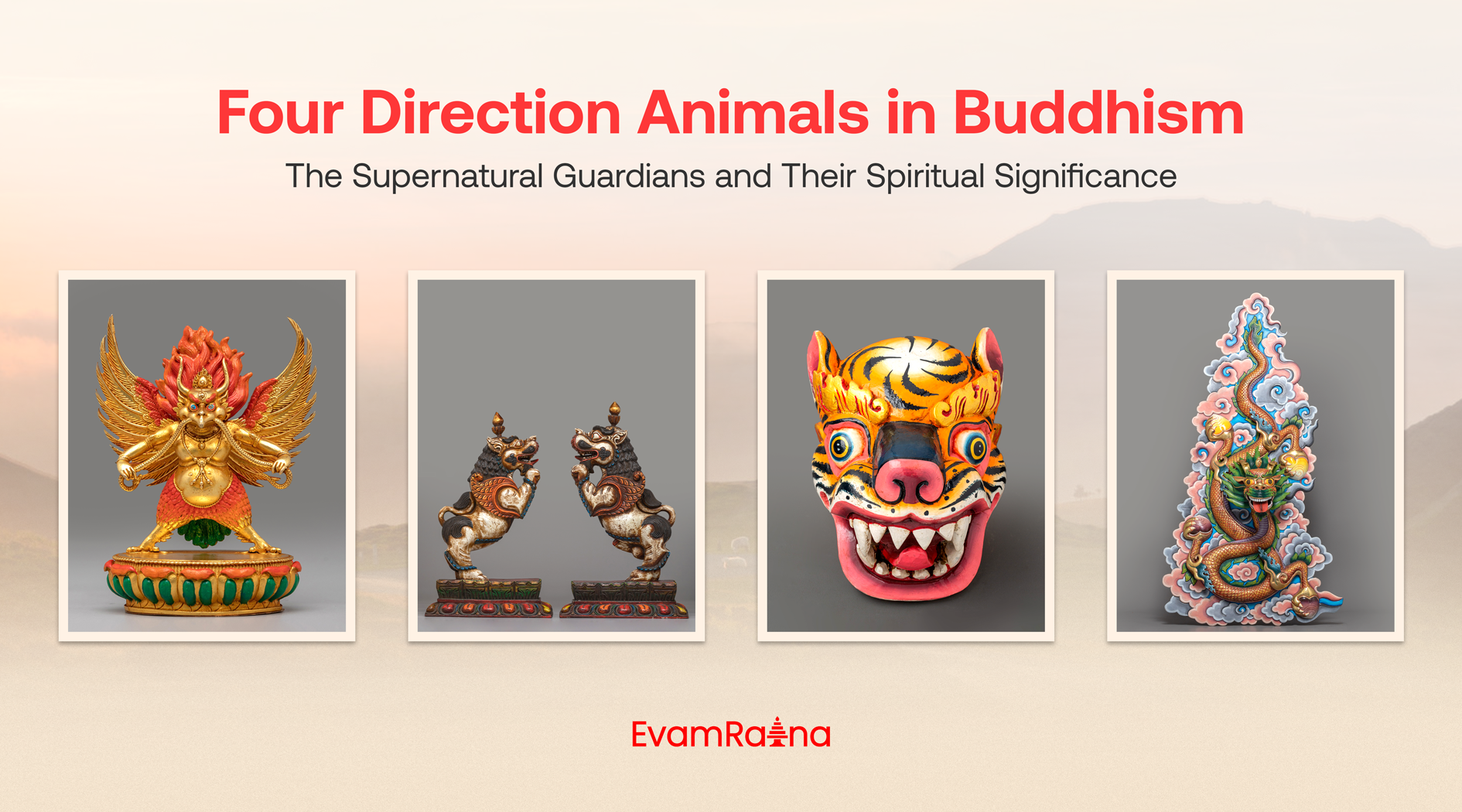
The Four Direction Animals in Buddhism serve as the supernatural guardians of the four cardinal directions at the heart of this spiritual landscape. These creatures, the Dragon, the Tiger, the Snow Lion, and the Garuda, are ancient symbols representing the inner air or wind of the body and the core qualities of the Windhorse (Lungta). From the thunderous roar of the Dragon to the playful fearlessness of the Snow Lion, these "Four Dignities" represent a timeless roadmap for overcoming the "four great fears" that we all share: birth, disease, old age, and death. By understanding these powerful mind guardians, you can learn to synchronize your own body and mind, transforming life's inevitable challenges into a source of unfathomable power and unconditional cheerfulness.
The Origins: From Ancient Chinese Feng Shui to Tibetan Buddhism
The folklore behind the four guardian animals is an interesting story made out of ancient strings. The origin of these animals can be traced back to the ancient Chinese astrological and Feng Shui traditions. In the Chinese system, the four directions were related to the four seasons and the daily path of the sun:
- East (Spring): The rising sun, which is represented by the Blue Dragon.
- South (Summer): The midday sun, which is represented by the Red Bird or Phoenix.
- West (Autumn): The setting sun, which is represented by the White Tiger.
- North (Winter): The sunless regions, which are represented by the Tortoise (the "Dark Warrior").
Evolution into Tibetan Buddhism: The Four Dignities
 (Image from Robert Beer, The Encyclopedia of Tibetan Symbols)
As these concepts lie in ancient Chinese astronomy and Feng Shui, they were later adapted by Tibetan Buddhism and Bhutanese culture to represent spiritual awakening, elements, and the overcoming of existential fears. As long as the Dragon, Tiger, and Red Bird stood, the Tortoise, which was a national emblem of China, was substituted by the White Snow Lion, which is the national emblem of Tibet. According to this new setup, the animals were matched to the Buddhist mandala with various colors and Buddhas at the center of the spiritual map.
Tibetan Buddhism (Vajrayana) and Bhutanese tradition adopted these concepts, altering them to suit Indian/Tibetan imagery. These are collectively known as Tak, Seng, Chung, Druk (Tiger, Snow Lion, Garuda, Dragon).
- Garuda (Chung)-North: Represents freedom from hopes and fears and the wind/air. It is the king of birds and the enemy of snakes/nagas (disease).
- Snow Lion (Seng)-East: Symbolizes vitality, purity, unconditional cheerfulness, and the earth element. As the emblem of Tibet, it represents a "playful yet fierce" mind and is a protector of the Buddha.
- Tiger (Tak)-South: Symbolizes confidence, discipline, and the air element. It is thought to be the aggressive defender of the south, and is commonly linked with Guru Padmasambhava.
- Dragon (Druk)-West: Symbolizes power, wisdom, and the water element. Tibetan dragons differ from Chinese ones whch have four legs and horns, representing primordial wisdom.
Read More in Detail About Mythical Creatures of Tibetan Buddhist Art
The Four Direction Animals in Buddhism: Roles, Fears, and Daily Practice
|
Animal |
Direction |
Spiritual Role |
Great Fear Addressed |
Transformation |
How to Apply in Daily Life? |
|
Tiger |
South |
Confidence, discipline, grounded awareness |
Fear of insecurity and instability |
Calm confidence and precision |
Practice mindfulness, stay focused, and make decisions with clarity and discipline. |
|
Snow Lion |
East |
Joy, purity, fearless energy |
Fear of suffering and emotional heaviness |
Unconditional cheerfulness and openness |
Cultivate positivity, embrace challenges playfully, and maintain inner joy. |
|
Garuda |
North |
Freedom, expansive awareness, overcoming limitations |
Fear of disease, negativity, and unseen threats |
Fearlessness and liberation from doubt |
Let go of limiting beliefs, think big, and rise above negativity. |
|
Dragon |
West |
Wisdom, power, truth, communication |
Fear of ignorance and confusion (especially fear of death) |
Clarity, insight, and fearless expression of truth |
Speak truth, trust intuition, and develop wisdom through learning and reflection. |
The Role of the Four Direction Animals in Sacred Art and Rituals

The Four Direction Animals are deeply embedded in Buddhist visual culture. You can find them in:
- Prayer flags (Lungta flags): One of the most common depictions shows the four animals occupying the corners of a prayer flag, surrounding a central Windhorse (Lungta). In this configuration, the airborne creatures (Garuda and Dragon) are typically at the top, while the terrestrial ones (Tiger and Snow Lion) are at the bottom.
- Iconography and Thrones: In Buddhist art, the Snow Lion is frequently depicted on the thrones of Buddhas; for instance, eight Snow Lions may support a throne to represent the eight main Bodhisattva-disciples of Shakyamuni Buddha. Wrathful deities are often depicted wearing or sitting on a tiger skin, symbolizing their dominance over the ego and their role as fierce protectors.
- National and Royal Symbols: The Dragon (Druk) is the national personification of Bhutan, featured prominently on the national flag and snarling while clutching jewels that represent wealth and prosperity. Similarly, the Snow Lion is the national emblem of Tibet, symbolizing a spirit that is both powerful and calm.
- Banners: Displaying a dragon banner is a specific artistic practice believed to protect an individual from slander and enhance their reputation.
The Connection to Windhorse (Lungta): Energy, Luck, and Vitality

At the heart of these four animals lies the concept of Windhorse (Lungta), a central idea in Tibetan Buddhism representing life-force energy, vitality, and spiritual momentum.
Lungta is believed to carry:
- Fortune and success
- Mental clarity
- Spiritual strength
Significance of Windhorse:
- You feel confident and uplifted
- Your actions flow naturally
- Obstacles become easier to overcome
Each of the Four Dignities uniquely strengthens this energy:
- Tiger: Stability and grounding
- Snow Lion: Joy and enthusiasm
- Garuda: Expansion and fearlessness
- Dragon: Wisdom and clarity
The Role in Rituals and Ceremonies

Masked Dances: In the traditional masked dances, the "Four Guardians" are the stars, and they are dressed in colorful masks with the images of Chung (Garuda), Seng (Snow lion), Tak (tiger), and Druk (dragon). These dances are involved with the larger ritual endeavors to overwhelm the passions of the mind and ego.
Geomancy and Construction: The animals serve as "earth pillars" or native spirits (gnyan) used in geomantic rituals to identify the "perfect landscape". If a site has the correct environmental features, such as a mountain to the north (Snow Lion) and water to the south (Dragon), it is deemed an auspicious location to construct a monastery, stupa, or temple.
Averting Calamity: Specific rituals invoke the power of these guardians to control the elements and disease. The Dragon is perceived as a friendly god who can be placated by rituals to bring rain and good fortune. The Garuda is called in to assist a lot in fighting off diseases and black magic that is thought to be inflicted by Nagas (serpent spirits).
Daily Devotion: This practice, even of hanging prayer flags, is a ritual that is supposed to transfer blessings to the wind. As the wind blows, the four animals are believed to help carry the wishes and prayers of practitioners to all sentient beings.
Whether viewed as symbolic emblems or spiritually real deities, these four animals are essential to the rituals intended to avoid destructive storms, disease, and death, while fostering a mind that is clear, precise, and free of doubt.
Modern Relevance: Why These Ancient Symbols Still Matter

Click Here To View Our Sacred Dragon Wall Hanging
The Four Dignities, the Dragon, the Tiger, the Snow Lion, and the Garuda have been highly applicable in the contemporary world due to their effectiveness in assisting people to access profound spiritual energies. These ancient symbols are symbols of the past, and they represent a spiritual technology designed to synchronize the body and mind, fostering a life of vitality, dignity, and purity.
This is why these symbols of the ancient period are still relevant in the contemporary world:
Mental Resilience and Mindfulness Tools
Such animals in Tibetan tradition symbolize the inner air or wind of the body and signify particular features of the attitude of the Bodhisattva, including strength, protection, and cheerfulness.
Daily Motivation
Seeing these signs, like the ones on a prayer flag called Lungta (Windhorse), reminds a modern person of the constant need to remain mindful of what he or she is motivated to be kind, compassionate, and happy, and actively does this throughout the day.
Overcoming Anxiety
The Garuda is used as a symbol of liberty of hopes and fears and wide mind, which has no reference point, which is a symbolic remedy to the anxious worries of modern life.
Going through the Universal Human Life Cycle

The symbols remain relevant because they are related to the four great fears that every human eventually faces: birth, disease, old age, and death.
By personifying these stages from the Dragon of spring (birth) to the Snow Lion/Tortoise of winter (death), the tradition provides a framework for understanding the transient nature of existence.
The Garuda and Snow Lion specifically act as symbolic "antidotes" to disease and doubt, offering a sense of protection against physical and mental illness.
Cultivating Confidence and Communication
Modern professional and social lives often demand the very qualities these animals represent:
The Tiger: Represents unconditional confidence and disciplined awareness. It models a state of being that is "relaxed yet energized," finding a natural sense of satisfaction even amidst challenges.
The Dragon: Symbolizes complete communication and all-seeing wisdom. Displaying dragon imagery is traditionally believed to protect an individual from slander and enhance their reputation, concerns that are as pressing today as they were centuries ago.
Fostering Unconditional Cheerfulness
Living in a time when most people are more likely to have their minds obscured by distraction rather than a clear mental state, the Snow Lion provides an example of a mind free of doubt that is accurate and precise. This vibrant power of good offers a blue plan of how to be in a positive and stable mental state despite the external conditions.
Environmental and Spiritual Harmony
The animals are also a manifestation of the harmonious disposition of the landscape, the perfect landscape. This can be seen in the modern world as a quest towards geomantic peace, that of assuming our bodily surroundings accommodate our spiritual and mental health.
Finally, all four of these supernatural or spiritually gifted animals serve as symbols of deep ideas that appeal to the human mind. They are either symbolic metaphors or spiritually concrete deities, and they give a continuum of wisdom and inner peace in a complicated world.
Conclusion:
The Four Direction Animals in Buddhism, the Dragon, Tiger, Snow Lion, and Garuda, serve as supernatural guardians that offer profound guidance for overcoming life’s greatest fears: birth, disease, old age, and death. These timeless symbols teach us to transform our fears into strength, our challenges into opportunities, and our doubts into wisdom. By understanding their spiritual significance, you can synchronize your body and mind, cultivating unwavering courage, joy, and wisdom in your daily life.
As you reflect on the Four Direction Animals, remember that they represent inner qualities we can all embody such as the Tiger, which teaches discipline and confidence. The Snow Lion invites joy and purity. The Garuda calls for liberation and expansive awareness. The Dragon embodies wisdom and clarity.
No matter where you are in your spiritual journey, these symbols are available to you as tools for growth and transformation.