Stupas: The Symbol of Buddhist Teachings
Stupas are not structures but a prominent symbol of the Buddhist teachings. According to the Buddhist philosophy, all things are mutually dependent, and the concept is extended to the construction of stupas. Every stupa element symbolizes something different about the Buddha and his doctrine. There is a lot of deep symbolism in stupas and their role in Buddhism, which we will examine in this blog.
Introduction: The Stupa and Its Symbolism

A stupa serves as a sacred architectural form that preserves the essence of the Buddha’s teachings and presence. More than a monument, it functions as a support for meditation and devotion, guiding practitioners toward mindfulness, wisdom, and inner transformation. Through circumambulation and contemplation, the stupa becomes a living symbol of the path to enlightenment, reminding devotees of impermanence, compassion, and the awakened state of the Buddha.
So, what qualifies a Structure to be a stupa?
Relic Containment: Houses sacred relics, such as ashes or bodily remains (śarīra) of revered Buddhist figures. (Just like the remains of Kashyapa Buddha are being preserved inside the Boudhanath)
Mound/Dome Shape (Anda): A hemispherical or mound-like structure, symbolizing the Buddha's burial mound.
Symbolic Elements:
- Harmika: A square railing on top of the dome, representing a sacred enclosure.
- Chattra: A central pillar with tiered umbrellas, symbolizing royalty and protection.
Architectural Features: Includes a circular base, a circumambulation(Kora) path (pradakshina), and ornate gateways (toranas).
Spiritual Significance: Acts as a focal point for meditation and pilgrimage, symbolizing the Buddha’s awakened mind and the universe.
The Structure of the Stupa

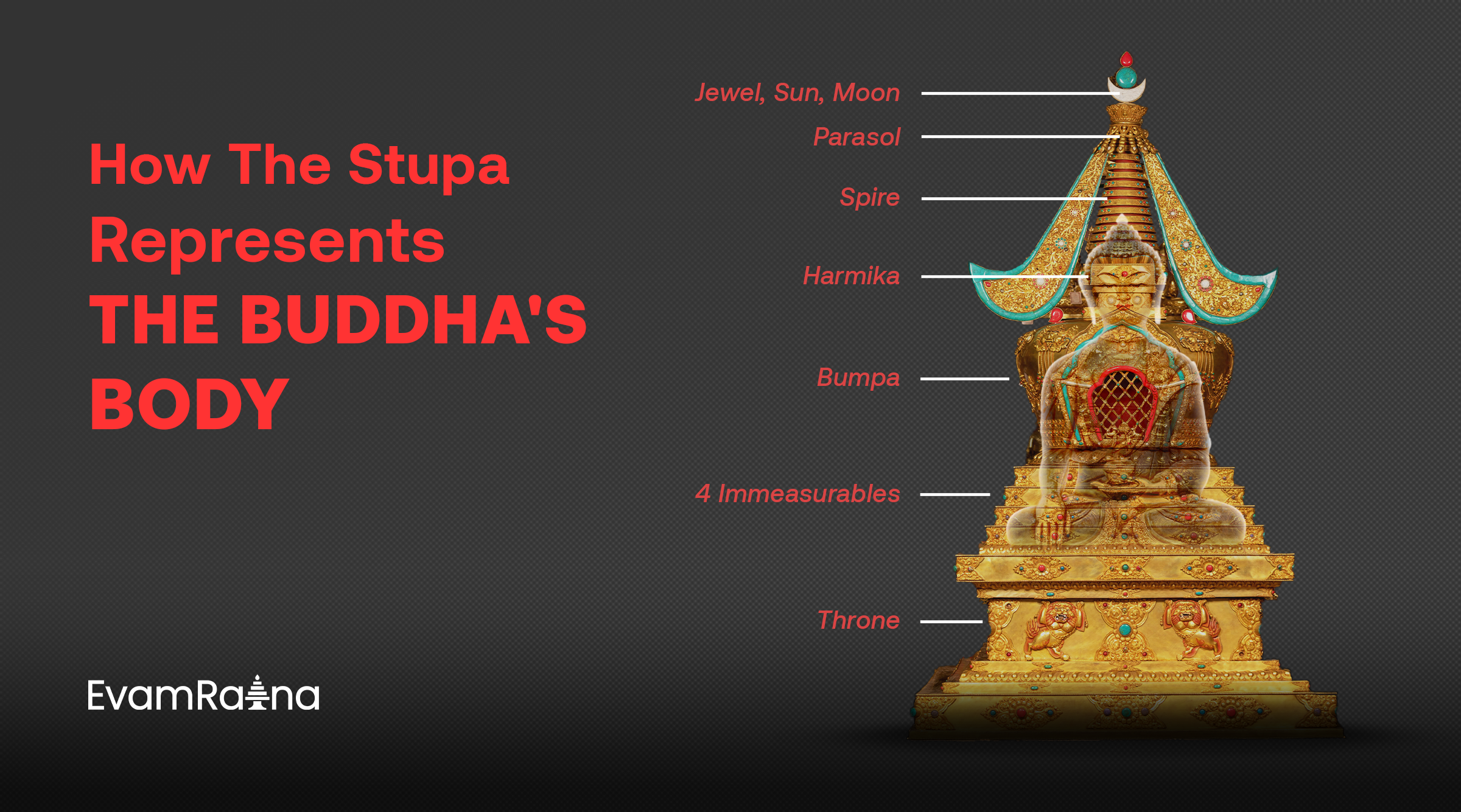
I have always been captivated by the architecture of the Stupas. It is so complex to build and rich with symbolism, which guides us towards enlightenment. More than an intricate structure, it is also a representation of Buddha's Body, Mind, and Teaching. Let's explore the structures of the Stupa from bottom to top:
The First Three Steps:
The first three steps at the base of the stupa represent Buddha, Dharma, and Sangha, honoring Buddha, his teachings, and his community.
The Throne (Torana):
The Torana is an ornate gateway that marks the entrance to the stupa, symbolizing the passage into the sacred space. There are usually four toranas, positioned at the cardinal points (north, south, east, and west), creating a symmetrical layout. These gateways are intricately decorated with sculptures and carvings that often depict significant events in the life of the Buddha or various symbols representing Buddhist teachings.
The Four Steps below Bhumpa:
The four steps right below Bhumpa represent Buddha's profound teachings - The Four Noble Truths, which are suffering (Dukkha), its cause (craving/attachment, Samudāya), the possibility of ending it (Nirodha), and the path to achieve this (the Noble Eightfold Path, Magga)
The Bhumpa (Dome):
The Bhumpa is one of the main attributes of the Stupa, representing mindfulness (Sati), Investigation of Dhamma (Dhammavicaya), Energy (Viriya), Rapture (Pīti), Tranquility (Passaddhi), Concentration (Samādhi), and Equanimity (Upekkhā).
The Harmika
Positioned above the Bhumpa, resembling a balcony, symbolizing the Noble Eightfold Paths. Buddha's gaze is situated in this area.
The Spire (Yasti)
It is just located above the Harmika, and the first three represent the highest stages of the Vajrayana path. The lower ten rings or bhumis symbolize the ten levels of the Mahayana path.
The Parasol:
Situated at the pinnacle of the stupa, it represents royalty, protection, and divinity. Above it lie the elements of the highest level of enlightenment:
Jewel: Enlightenment
Sun: Wisdom
Moon: Bodhicitta (Heart of Awakening)

By: World Heritage Journey
Sometimes there are only three layers of rings on top, such as the Sanchi Stupa of India, which symbolizes the Triratna - Buddha, Dharma, and Sangha.
The elaborate design of the stupa, overlaid with symbolic meaning, acts both as a physical and a metaphysical guide to the enlightenment of the practitioners. All of the constituents, starting with the foundation and going all the way up to the summit, reflect key areas of the doctrine and knowledge of the Buddha. By making people come closer to the architecture of the stupa, we are informed that each part of this building is a teaching framework, pointing the person towards spiritual awakening, inner peace, and final enlightenment.
The connection between Buddha's Body and the Stupa's Structure:

We have revealed the structure of the Stupa, now explore its connection to Buddha's body:
| Stupa Structure | Buddha's Body | Symbolism |
| The square base | Buddha's Legs | The Four Noble Truths |
| The hemispherical dome (Anda) | Buddha's Chest | The Seven Elements of Enlightenment |
| The Harmika | Buddha's Eyes | The Noble Eightfold Paths |
| The spire (yasti) | The crown of Buddha | The ultimate achievement of enlightenment |
Through their intricate carvings and symbolic form, stupas communicate profound Buddhist teachings, offering a physical manifestation of the Buddhist faith and an opportunity for practitioners to connect with the divine.
The Five Elements in the Stupa: A Sacred Pathway to Enlightenment
Stupas are more than just impressive structures; they carry deep spiritual meaning, embodying the Five Elements—Earth, Water, Fire, Air, and Space. Each element represents a fundamental aspect of the universe and our journey toward enlightenment. The layered design of the stupa isn’t just for show—it’s a powerful spiritual tool, helping us move from the everyday world to a state of pure consciousness. Let’s take a closer look at how each element is represented in the stupa.

By: Ayu Ayurveda
1. Earth: The Square Base - Stability and Foundation
The square base represents Earth, symbolizing stability, foundation, and the physical world. The yellow color reflects Earth’s grounding nature, reminding us to stay rooted in our own existence. Earth signifies balance and the solid foundation needed to begin the journey of enlightenment.
2. Water: The Dome or Bhumpa- Flow and Universality
The dome represents Water, symbolizing fluidity, purification, and the interconnectedness of all things. The white or blue color of the dome signifies purity, while the dome’s round shape mirrors the cyclical nature of life, inviting adaptability and flexibility on the path to wisdom.
3. Fire: The Conical Spire - Transformation and Purification
The spire embodies Fire, symbolizing transformation, purification, and spiritual energy. The red color reflects fire’s transformative power, burning away ignorance and guiding us toward enlightenment. Fire represents the spiritual heat needed for growth and purification.
4. Air: The Parasol or Crescent - Movement and Action
The parasol or crescent represents Air, symbolizing movement, breath, and action. Associated with green, Air is linked to vitality and growth, reminding us of the constant change and evolution necessary in our spiritual practice.
5. Space: The Jewel or Sun - Pure Awareness and the Void
The jewel or sun at the top represents Space, symbolizing pure awareness and the infinite consciousness beyond form. This element is often associated with light or radiance, representing the clarity and wisdom that come with spiritual realization.
The Stupa as a Mandala: A Sacred Journey
The stupa is a three-dimensional mandala, a sacred symbol of the cosmos and the spiritual path. Circumambulating the stupa represents the purification of the mind, as the practitioner moves through the five elements and ascends spiritually.
The Stupa as the Buddha’s Body
The entire stupa can be seen as the Body of the Buddha, with each element symbolizing aspects of his enlightened mind. From the foundation (Earth) to the ultimate wisdom (Space), the stupa represents the journey of purification and spiritual growth.
Conclusion: The Stupa as a Sacred Guide to Enlightenment
To sum up, the stupa is not just a simple construction, but it is a deep symbol that summarizes the teachings of the Buddha and is also a tool that can be used in the path of the spiritual enlightenment of the followers. All the elements of the stupa, including the square base and the top, explain the main ideas of Buddhism and include the aspects of the embodiment of the corporeal presence, mental abilities, and wisdom of the Buddha. Its complex design and symbolic features challenge its followers to start a journey of cleansing and enlightenment, hence offering a consecrated site favorable to meditation and reflective thought. We question the stratified structure of the stupa, and we understand it to be more than just a monument of the presence of the Buddha; it is also a powerful tool for approaching the deeper truths of the universe, helping practitioners navigate to inner peace and spiritual awakening.