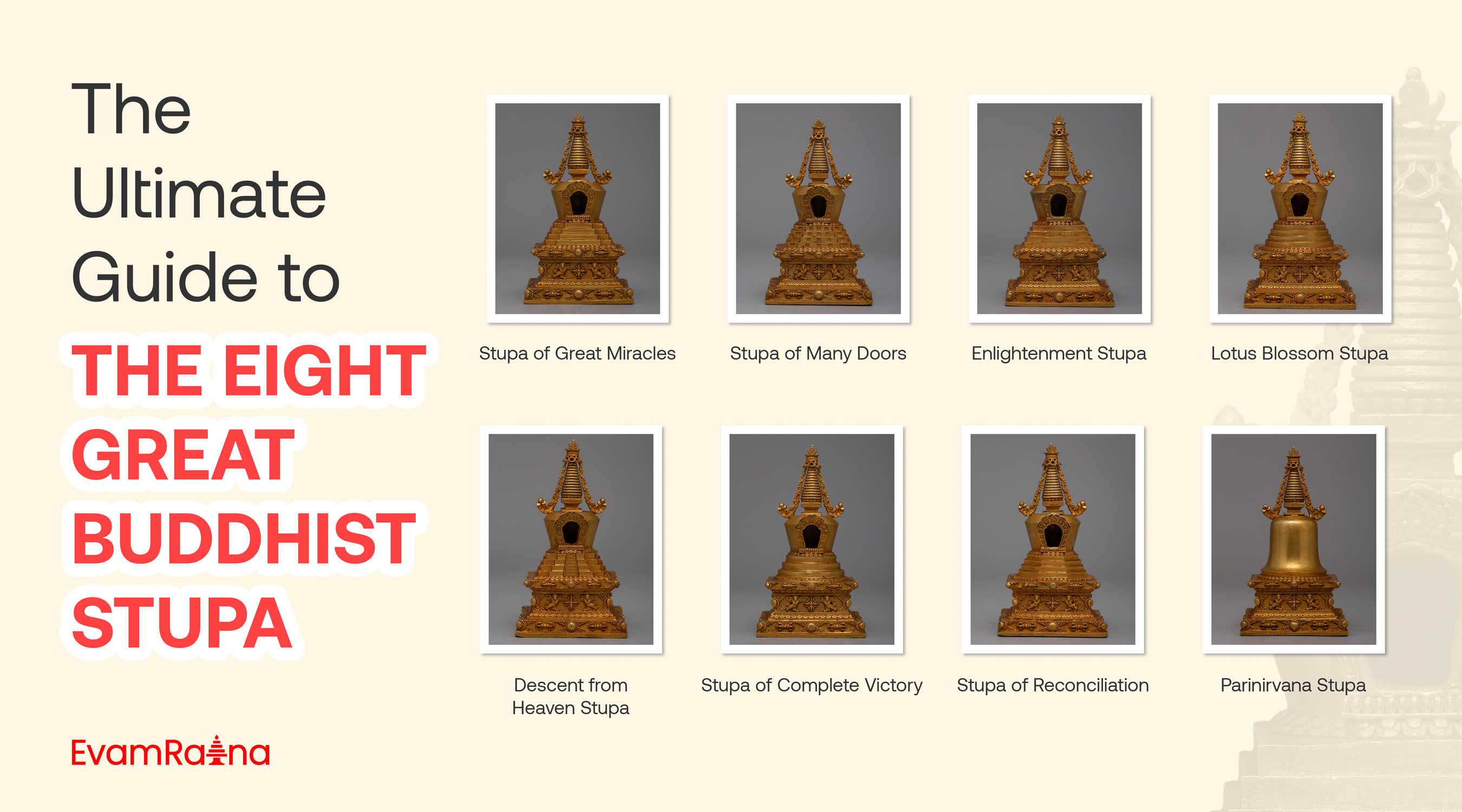
Beyond the Stone: Unlocking the 8 Secret Tales of the Buddhist Stupa
Imagine standing in the land of ancient India, 2500 years ago, witnessing the eight great stupas rise from the earth, not as tombs of stone but as a living map of a journey that changed the course of human consciousness forever. In their presence, you feel a profound sigh of relief that the world has finally found a path out of the eternal suffering - the enlightenment.
Although the physical journey has ended, the story continues. These eight stupas tell eight unique tales to anyone willing to listen to their silence.
What You Will Discover in the Silence
To truly hear the tales these monuments tell, we must understand the language they speak. In this guide, we will journey through:
-
The Soul of the Stone: Uncovering the true meaning of the Stupa beyond its physical form.
-
Echoes of the Past: A look into the history that birthed these sacred landmarks.
-
Eight Paths to Awakening: How to identify each stupa and the unique story of the Buddha it holds.
-
The Sacred Anatomy: Deconstructing the structure, where every curve and tier represents a step toward liberation.
-
Artistry of the Devout: Exploring the aesthetics and materials that breathe life into handmade stupas.
- The Infinite Circle: The ritual of Circumambulation (Kora)—why we walk, and what we find in the turning.
Defining "Stupa" (Sanskrit) vs. "Chorten" (Tibetan)

While the heart of the monument remains the same, the name changes as it reaches the Himalayas. In ancient India, the Sanskrit term stupa translates to “Dome” or “Knot”. As the teachings travelled to Tibet, they became “Chorten,” meaning “offering holder”.
In our interactions with artists from both traditions, we’ve seen how these names reflect their cultures. Stupa, meaning a historical monument of earth, and chorten as a vessel of the divine. But whether seeking the Chorten of Tibetan tradition or the Stupa of Newari and Indian tradition, you will encounter the same thing: a physical monument to represent Buddha’s enlightened mind and body.
| Aspect | Stupa (Sanskrit) | Chorten (Tibetan) |
|
Linguistic Root |
Means "Knot" or "Dome" | Means "Basis for Offering" |
| Visual Focus | Emphasizes the Anda ( The Rounded, "Dome-like "Egg) | Emphasizes the Bhumpa (The "vase" or Vessel-Shaped Dome). |
| Architectural Design | Grounded and Earthly, a historical monument of the Earth | Soaring and Vertical: a vessel for the divine |
The Expert’s Eye: How to Identify the 8 Great Stupas

The 8 Buddha Stupas share a common sacred silhouette; the actual story is hidden in their detail. Through years of experience observing thousands of stupa pieces in our collection, we have identified an essential “Expert Key” for distinguishing them.
While the base (Thrones) and the upper spire (Pinnacle) often remain identical across the eight stupas, the middle tiers whisper the unique stories and events that commemorate the Buddha’s life.
To accurately identify an Ashtamahachaitya (Eight Great Stupa), it's essential to look beyond its gems and gold. Focus on the stupa’s shape and design of the central structure, known as the "Central Tiers." By doing this, you will be able to distinguish the stupa's name and understand the significance it holds in the Buddha’s life story.
1. The Lotus Blossom Stupa

The four steps of the basis of this stupa are circular, and it is decorated with lotus-petal designs.
It commemorates Buddha’s Birth. At birth in Kapilvastu, Lumbini, Buddha took seven steps in each of the four directions (East, South, West, and North). Most noteworthy, each direction lotuses sprang, symbolizing the Four Immeasurable: love, compassion, joy, and equanimity.
Key Identifier: The Stupa has 4 Steps and is decorated with lotuses in all Steps
2. The Stupa of Enlightenment (The Conquest over Mara)

It commemorates Buddha’s victory over Mara. His enlightenment under the Bodhi tree in Bodh Gaya marked the end of the cycle of life and death.
Key Identifier: The four steps are plain, square, and straight
3. Stupa of Many Doors

It commemorates the first “Turning of the wheel of Dharma” in the deer park of Sarnath near Varanasi (Banaras, India).
Key Identifier: This can be distinguished by the many doors located in the four plain steps.
4. Stupa of Great Miracles

It commemorates an important part of the Buddha’s life, when he revealed his miraculous powers to defeat the Tirthika (heretical teachers) at the Jetavana Grove in Sravasti. This is primarily associated with the Twin Miracle (Yamaka Patihariya), which the Buddha performed to overcome the arrogance of rival religious sects.
Key Identifier: Square Steps with Central Projections.
5. The Stupa of Descent from Heaven

It commemorates the Buddha’s descent from Trāyastriṃśa Heaven to Sankashya after teaching the Abhidharma to His mother, Queen Maya Devi, who died 7 days after the Buddha’s birth.
Key Identifier: This stupa is easier to recognize than others because it has a ladder between the steps.
6. The Stupa of Reconciliation

It commemorates the Buddha’s reconciliation of the disputing factions within the sangha at the Veluvana bamboo grove at Rajagriha.
Key Identifier: This Stupa has eight-sided Octagonal Steps
7. The Stupa of Great Victory

This Stupa commemorates Buddha’s successful prolongation of his life by three months at the city of Vaishali, when he was eighty years of age
Key Identifier: It has only three steps, which are circular and unadorned
8. The Stupa of Parinirvana

It commemorates the Buddha's passing away, free of sorrow, between two sal trees in the city of Kusinagara.
Key Identifier: It is bell-shaped and usually not ornamented
We hope this guide helps you distinguish among the stupas you encounter. Here is a small summary table:
| Stupa Name | Key Identifier | Event Representation |
| Lotus Blossom Stupa | 4 circular steps with lotus decorations | Birth in Lumbini |
| Enlightenment Stupa | 4 plain, square, and straight steps | Victory over Mara |
| Stupa of Many Doors | Many doors are located in the 4 steps | First Dharma teaching |
| Stupa of Great Miracles | 4 plain steps in the middle | Defeating heretical teachers |
| Stupa of Descent | Visible stairs between the steps | Return from Heaven |
| Stupa of Reconciliation | Octagonal middle tiers (traditional key) | Healing the Sangha |
| Stupa of Great Victory | 3 circular and unadorned steps | Prolonging Buddha's life |
| Stupa of Parinirvana | Often features no steps; bell-shaped dome | Buddha’s passing away |
From Relics to Realization: Echoes of the Past

The Ashtamahachaitya, or Eight Stupas, began after the Buddha’s Parinirvana in the 4th or 5th century BCE. A Brahmin named Drona divided the Buddha’s sacred relics among eight kingdoms.
These monuments today serve as a living map of the Buddha's life, with eight points marking significant moments, from his birth at Lumbini to his final resting place at Kushinagar.
It is also believed that King Ashoka created 7 original stupas and redistributed these relics in eighty-four thousand smaller stupas; Ramagrama Stupa in Nepal is the only one of the 8 original stupa sites that still contains the complete portion of the Buddha’s bodily relics.
Although all of the sites are dedicated to a particular miracle or event, the structures were refined over centuries during their journey to Tibet and Nepal, becoming the distinctive structures they are today, with their middle-level designs. Such stupas are not merely historical monuments; they are physical reminders of the path to enlightenment and an eternal guide to harmony and spiritual realization.
The Sacred Anatomy: Decoding the Language of the Chorten

Though the eight great stupas represent different events of Buddha’s life, they all speak the same universal language of sacred geometry. Every part, symbol, and curve integrated in the stupa is intentional and deliberate, which guides practitioners from the ground of earth to each of the infinite spaces.
The Throne:

The throne is the primary foundation of the stupa. In traditional architecture, a stupa typically has four entrances, forming a Mandala Shape. The throne is often decorated with Buddhist iconography such as lions, Makaras, kirtimukha, and a Dragon that reflect powerful symbols in buddhism.
The Middle Tiers (The Story Tellers):

The Middle tiers are the structural elements that are critical for differentiating the type of stupa and the event it represents. The image above depicts the Descent from Heaven Stupa, with a ladder between plain steps, commemorating the Buddha's return to earth after teaching the dharma to his mother in Trayastrimsa heaven.
The Bhumpa:

The Bhumpa is located just above the middle tiers, which is also called the Anda “Egg”, due to its shape and potential for rebirth and spiritual growth. Traditionally, it is believed that the bhumpa, the heart of the monument, contains the relics of Buddha’s body after his passing.
Note: According to the Department of Archaeology and UNESCO, Ramagrama Stupa is the only untouched, original Stupa that contains the Buddha's relics.
The Harmika:

Positioned above the Bhumpa like a balcony, the Harmika is the seat of the "Buddha’s Gaze." This Structure symbolizes the Buddha's Noble Eightfold Path.
The Spire (Yasti):

A spire is located just above Harmika. It is part of the Shikara. There are 13 umbrella wheels in this part: the first three represent the highest level of Vajrayana, and the ten lower wheels symbolize the ten levels of the Mahayana Path. Together, they form the crown of the Buddha.
The Lotus Umbrella Pinnacle (The Final Liberation):

This is situated at the top of the Stupa, and a crowning finial of a lotus - umbrella, crescent moon, sun disc, and dissolving flame or a jewel.
The Lotus Parasol & Crescent Moon:
Represent the Air element and the cooling shade of compassion.
The Sun & Dissolving Point:
Represent wisdom and Space, where the individual self finally dissolves into the infinite life of nirvana.
Spiritual Protocol: Interacting with a Chorten

Tibetans commonly use the term "nékor" (Tibetan: གནས་སྐོར) to describe a type of pilgrimage that involves circling around a sacred site or object. This practice, known as circumambulation, allows practitioners to connect with the space's spiritual significance. The sacred site or object is referred to as a "né" or "néchen" (Tibetan: གནས་ཆེན), and it is believed to have the power to transform those who walk around it.
The kora is done clockwise; however, the bon tradition pilgrims circumambulate counterclockwise
How to make a kora meaningful?
Circumambulation is an act of great merit, but we have observed near Boudhanath Stupa that people do not realize the value of accumulating great merits from circumambulation. People are often distracted by taking selfies, interrupting others, and walking against the flow. This type of behaviour disrespects the Buddha and the sangha, even if it is unintentional.
So, to make a kora meaningful, we should walk clockwise rotation, chant mantras, rotate the prayer wheel, and contemplate the meaningful teachings of Buddha. If it's not possible in any circumstance, then just being mindful and delving into thoughtful processes would suffice, like praying for living beings to be liberated from suffering (Bodhichitta motivation).
How to Find the Best Stupas in Nepal?

To find the best stupas in Nepal, it's important to seek out authentic designs that reflect Buddhist iconography and tradition. Here are a few suggestions to consider before purchasing a stupa:
Verify Authentic Craftsmanship: Examine the product's craftsmanship; look for hand-tooling marks and carvings on the stupa.
Check Materials Clearly: Ensure the gold gilding is genuine and the natural stones are not synthetic imitations.
Understanding Size & Weight for Altar Placement: Understand the size and weight of the stupa to ensure it fits perfectly in your altar.
Asking about Symbolic Accuracy: Inquire if every attribute of the stupa aligns with the traditional description of the stupa, which includes a four-stepped Base, Bhumpa, harmika, and the 13 Umbrella Rings.
Inspect Finishing Quality: Check whether the gold gilding is smooth, and the “Thapa”(Pinnacle) aligns with the central axis of the Stupa.
Purchasing from Trusted Sellers: Choose curators who can articulate the history and origin of their stupas; certifications are even more beneficial.
We have observed that mass-produced stupas lack spiritual significance and appear superficial due to their flawless designs.
At Evamratna, we believe that Newari and Tibetan artists are ideally suited to create perfectly handcrafted, authentic stupas. While these pieces may have minor imperfections, we see them as evidence of the artists' touch and devotion. Our commitment is to directly support local artisans, ensuring that the legacy of Himalayan craftsmanship endures alongside the teachings of Dharma.
If you want to explore our stupa collection, then please visit Evamratna Stupas.
“Sacred Objects Deserve Sacred Craftsmanship.”
Frequently Asked Questions (FAQs):
Why are there 13 rings in the Stupa?
The Thirteen Rings on Yasti represent the 10 stages of the Mahayana path and the three highest levels of Vajrayana practice.
What is inside a stupa?
Inside the Buddhist Stupa is a dome-shaped monument designed to contain the sacred relics of the Buddha, including his bones/ash, millions of tightly rolled Zung (Printed Mantra scrolls), and dharma relics such as fragments of robes, hair, or personal items of the Buddha.
Which stupa should I have at home?
Starting with the Enlightenment Stupa is the best approach because it represents the Buddha’s enlightenment under the bodhi tree in Bodh Gaya and encapsulates Buddhism's core goal.
Conclusion: The Reminder of Buddhist Teachings
In conclusion, the eight great stupas are seen as potent elements of the life and teachings of the Buddha, each of which is a major milestone of his path to enlightenment. These stupas are eternal reminders of the path to spiritual liberation through their design and sacred geometry. They foster an intense attachment to the Dharma and the Buddha's transformative wisdom, whether through meditation or adoration, and in both, they guide us toward enlightenment.
Sources & Further Reading:
Special thanks to Robert Beer for his book The Handbook of Tibetan Buddhist Symbols, which served as a valuable reference for this article.