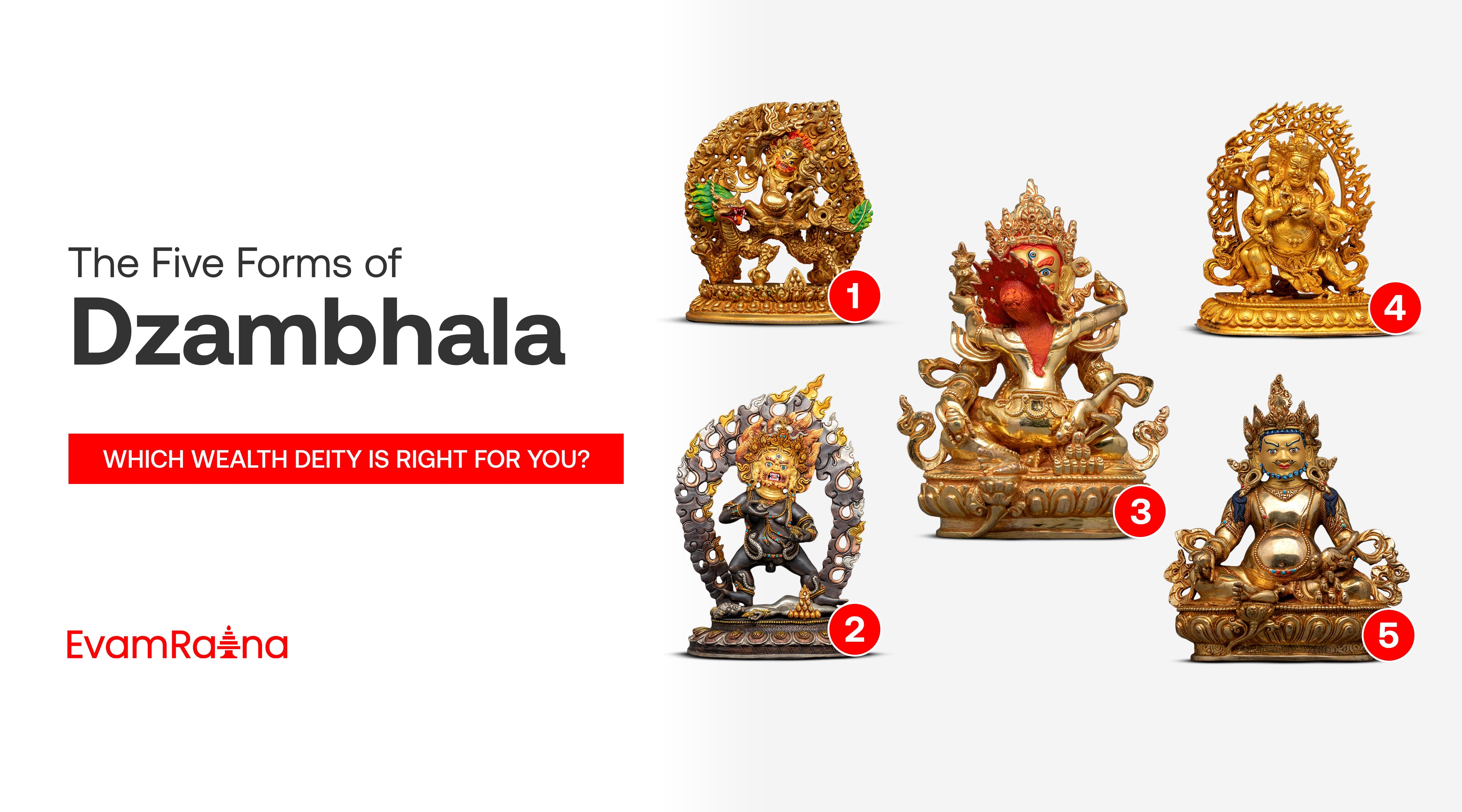
Yellow, White, Black, Green & Red Dzambhala: Which Form Should You Practice?
In Vajrayana Buddhism, Dzambhala is known as the deity of wealth and prosperity, and, in this tradition, true wealth includes good health, peace of mind, strong relationships, and the right conditions to live a meaningful life. Dzambhala appears in five different forms, each offering a unique kind of support, whether it’s removing obstacles, healing struggles, attracting opportunities, or building stability. Understanding these five forms helps you connect with the one that best supports foy your current needs and spiritual journey. They are all compassionate guardians, each standing with a different hand: one to heal you, one to shield you, one to guide you, one to energize you, and one to magnetize fortune toward you. All you need to do is choose the right hand.
Introduction to Dzambhala:

Click Here To View Our Collection of Five Dzambhalas
The name Dzambhala (also written as Jambala or Zambhala) comes from Sanskrit. "Dzam" meaning deity, "Bhah" meaning gold or wealth, and "La" meaning to honor. He is often called the "precious golden deity" who gathers spiritual and material stability at our doorsteps. The name itself is a prayer. He is widely regarded as a manifestation of Avalokiteshvara (Chenrezig), the Bodhisattva of Compassion, and is sometimes identified with the Hindu deity Kubera.
His power doesn't come from greed; it comes from a wound healed by compassion. Legend tells us that the five forms of Dzambhala protected Buddha from attacks. Out of immense mercy, the Buddha appeared and cured them and blessed them as guardians of wealth by pouring nectar from an alms bowl onto his head. This is why, in many rituals, we pour water over his crown, not just as an offering, but as a reminder that true wealth flows from the heart of compassion.
In Tibetan Buddhist teachings, true wealth encompasses material security, good health, harmonious relationships, spiritual merit, and the conditions needed for Dharma practice. The five Dzambhalas address each dimension of that abundance.
The Five Forms of Dzambhala:
Here is a quick overview of each form before we dive deep:
- Yellow Dzambhala (Dzambhala Serpo): Material wealth, spiritual abundance, generosity, Emanation of Buddha Ratnasambhava
- White Dzambhala (Dzambhala Gapee): Healing, karmic purification, removing poverty & sickness, Emanation of Chenrezig
- Black Dzambhala (Dzambhala Nagpo): Obstacle removal, fierce protection, karmic power, Emanation of Akshobhya
- Green Dzambhala (Dzambhala Janggu): Victory, success, enlightened activity, Manifestation of Buddha Amoghasiddhi
- Red Dzambhala (Dzambhala Marpo): Power, influence, business fortune, relationships, Manifestation of Vajrasattva
Yellow Dzambhala (Dzambhala Serpo): The Abundant Earth King

Among the Dzambhala family, Yellow Dzambhala is the beloved patriarch, steady, generous, universally respected, and always with something to offer. He is the most widely practiced of the five forms. He is linked to Buddha Ratnasambhava, the Buddha of the Jewel Family, whose defining spiritual quality is generosity, the complete fulfillment of both material and spiritual needs.
He is also holding a jewel-spewing mongoose in his left hand, which continually spews out precious gems, a symbol of the inexhaustible, overflowing nature of generosity. He holds a citron fruit (bijapuraka), a symbol of fertility, prosperity, and ever-growing abundance, in his right hand. He sits in the posture of royal ease, radiating quiet authority and boundless warmth.
He is the most widely chanted of all the Dzambhala mantras, and is revered across all four major schools of Tibetan Buddhism: Gelug, Nyingma, Kagyu, and Sakya. In most cases, when Tibetan Buddhist communities assemble to pray for prosperity, Yellow Dzambhala is virtually always at the centre of the mandala.
Who Should Practice Yellow Dzambhala?
Yellow Dzambhala is the natural starting point for nearly anyone drawn to Dzambhala practice. He is particularly suited for:
- Those seeking financial stability and the removal of material poverty as a foundation for spiritual practice.
- Practitioners who wish to develop generosity as true abundance flows outward as much as it flows in.
- Anyone beginning a Dzambhala practice for the first time, as his energy is broadly accessible and highly kind.
- Those looking to support their Dharma practice with sufficient resources.
In short: If you are asking, "How do I begin to invite prosperity into my life?", then start following Yellow Dzambhala.
White Dzambhala (Dzambhala Gapee): The Compassionate Healer of Poverty

If Yellow Dzambhala is the sun warming the earth, White Dzambhala is the gentle rain that restores it after a long drought.
White Dzambhala, known in Tibetan as Dzambhala Gapee, is the compassionate manifestation of Chenrezig, the Bodhisattva of boundless compassion. His very origin story is one of the most tender in all of Buddhist iconography. The great Indian master Lama Atisha once encountered a starving man dying on the road. Unable to find food, Atisha cut flesh from his own body to offer him, but the man refused. As Atisha sat in despair beside him, a blinding white light appeared, and Chenrezig manifested before him. He vowed to take the form of the Wealth Deity, Dzambhala, so that no one would ever suffer from poverty again.
White Dzambhala rides a turquoise dragon and is shown with flame-like hair and a glowing white body. He is singularly strong in his power to eliminate not only material poverty but also the poverty of the spirit, sickness, fear, negative karma, and karmic barriers that obstruct well-being at all levels.
His practice is said to purify negative karma related to wealth, avert disaster and illness, and cultivate the Bodhicitta mind, the awakened heart of compassion.
Who Should Practice White Dzambhala?
- Those experiencing poverty alongside illness or chronic health challenges.
- Practitioners focused on karmic purification for those who feel stuck due to past negative actions.
- Anyone dealing with fear, scarcity mindset, or deep-seated feelings of unworthiness around abundance.
- Those who would like to acquire Bodhicitta and have the wish to help all beings with compassion.
In short: if you are asking, "How do I heal the wounds that keep me from thriving?" White Dzambhala holds the medicine.
Black Dzambhala (Dzambala Nagpo): The Fierce Remover of Obstacles

Black Dzambhala in Tibetan Buddhism is the most wrathful and the most powerful in destroying the obstacles of the five wealth deities. He is an emanation of Akshobhya Buddha, the Buddha of unshakable clarity, and he channels that power into fierce, compassionate action. Where other Dzambhalas invite prosperity, Black Dzambhala breaks down the walls blocking it.
He is depicted with dark, blue-black skin and an intense, wrathful expression, often standing tall or standing upon a figure representing the ego, ignorance, and self-destructive attachment. He wears a crown of skulls and serpent ornaments, imagery that connects him to the great protector deities like Mahakala. In his hand, he holds a mongoose and a jewel, and from his body radiates a fierce, electric energy of transformation.
His wrathfulness is not anger in the ordinary sense but to fiercely destroy obstacles, negativity, ego, and poverty, acting as a protector who removes mental and material blocks to spiritual prosperity.
Who Should Practice Black Dzambhala?
- Those facing significant, persistent obstacles, financial blocks, broken deals, and stalled careers that seem immovable by other means.
- Practitioners dealing with negative spiritual influences, harmful spirits, or very heavy negative karma.
- Those who feel their prosperity is being actively blocked by external forces or deep internal resistance.
- Experienced practitioners who are ready to work with a more wrathful energy, Black Dzambhala, are not typically the first form recommended for beginners.
In short: if you are asking, "How do I break free from what keeps holding me back?", Black Dzambhala wields the sword of liberation.
Green Dzambhala: The Chief of Enlightened Activity

Among the five Dzambhalas, Green Dzambhala holds a uniquely elevated position. He is the chief of the five wealth deities, and yet he is perhaps the least discussed, which is precisely what makes him worth knowing deeply.
Green Dzambhala is the manifestation of Buddha Amoghasiddhi, the Buddha of All-Accomplishing Wisdom, associated with the wind element and the direction of the North. He is depicted with a blue-green body, he is depicted with a green complexion, seated in a relaxed, alert posture (often on a lotus throne), holding a jewel-spitting mongoose in his left hand and a bijaparaka fruit in his left hand. He is typically shown alongside his consort Vasudhara, also known as the Yellow Tara, goddess of fertility and abundance. Together, they embody both the active and receptive aspects of enlightened prosperity.
Where Yellow Dzambhala represents steady material wealth, Green Dzambhala governs the activity of wealth in all its dimensions, the momentum, the skill, the dynamic energy required to create favorable conditions for both worldly success and spiritual realization. He activates prosperity; he gets things moving.
Who Should Practice Green Dzambhala?
- Those engaged in projects, businesses, or endeavors that require momentum and the successful completion of activities.
- Practitioners seek protection from bad omens, misfortune, and obstacles to achievement.
- Those who wish to work with the most comprehensive, all-encompassing form of the wealth deities.
- Advanced practitioners who resonate with Amoghasiddhi's energy of fearless, accomplished activity.
In short, if you are asking, "How do I turn my spiritual and material goals into reality?", Green Dzambhala is the activating force.
Red Dzambhala (Dzambhala Mapo): The Magnetizer of Fortune & Influence

Imagine a gathering where every door opens for you, where people are drawn to you naturally, where wealth and opportunity seem to flow in your direction as if by some invisible law of attraction. That is the energy of Red Dzambhala.
Red Dzambhala, known as Dzambhala Mapo in Tibetan, is the manifestation of Vajrasattva and holds a unique position among the five forms. Historically, his practice was reserved for kings, royalty, and those in positions of power, because his energy is inherently magnetizing. He draws people, wealth, respect, and favorable circumstances toward the practitioner like a golden magnet.
He is depicted with a vivid red body, three faces, and four arms. The three right hands hold a hook, jewel, and a jewel-spitting mongoose. He sits in the vajra position with his consort Dakini in front of him, reflecting the union of power and wisdom, action and receptivity. His practice includes a special magnetizing method said to bring not only financial abundance but also marital bliss, family harmony, and deep relational well-being.
Who Should Practice Red Dzambhala?
- Those in leadership, business, politics, or public life who seek to expand their influence and attract the right people.
- Practitioners looking to attract favorable partnerships, contracts, business opportunities, or public recognition.
- Those who wish to call in both wealth and relational abundance, prosperity that extends into family and community.
- Anyone who feels energetically "invisible" or overlooked and wishes to step into a more magnetic presence.
In short: if you are asking "How do I attract the people, opportunities, and influence I need to thrive?", then invoke Red Dzambhala.
Conclusion:
The Tibetan Buddhist understanding of wealth is, at its heart, deeply optimistic. It says: " You are not condemned to poverty by fate. Poverty, whether material, spiritual, or relational, has causes, and those causes can be addressed. The five Dzambhalas are, in the most profound sense, teachers of that truth. They remind us that abundance is not about accumulation. It is about flow. It is about receiving with gratitude, giving with an open heart, and using material and spiritual resources alike to benefit all beings.
So the next time you feel that invisible current pushing you away from the shore, remember: there are five compassionate guardians waiting to lend you their hand. You simply need to reach out.
May you always have enough to give. May you always have more than you need. May your prosperity be a blessing to everyone you touch.