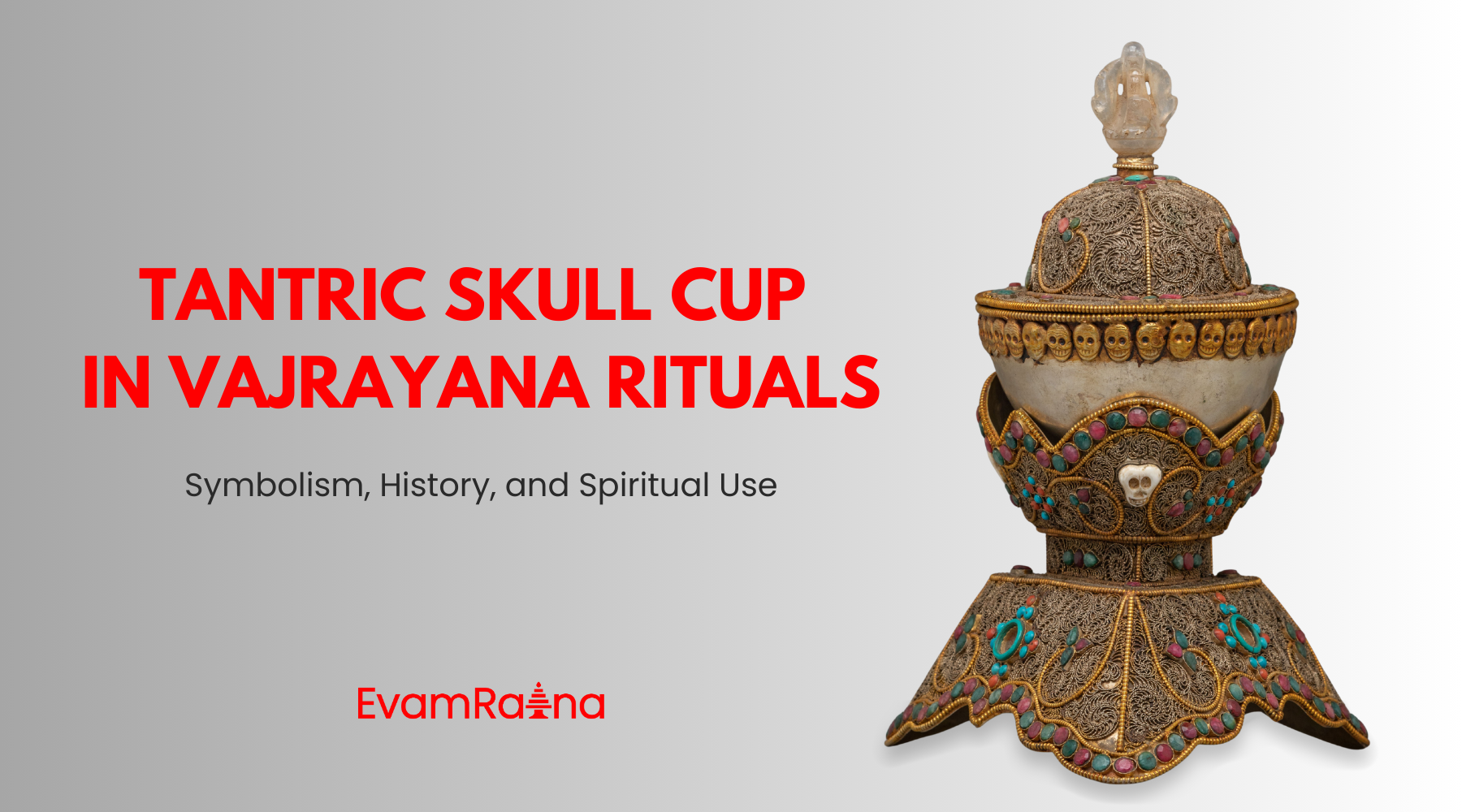
The Spiritual Significance of Kapala in Tibetan Tantric Rituals: Symbol of Impermanence
The most remarkable object that is not properly understood in the field of religious iconography is the Kapala. This ritual implement is a truly potent instrument of spiritual transformation, known as the Kapala (or thopa in Tibetan), and functioning as a potent symbol of spiritual transformation in the Vedic context of Vajrayana Buddhism and the ancient Shaivite traditions. It serves as a profound vessel for spiritual transformation. Kapala is a sophisticated tool used in a way of controlling sacred energies and meditate on the ultimate nature of existence. It is a profound contemplation of impermanence, an instrument of alchemical change, and a sign of the ultimate in the realization that wisdom is compassion.
Historical Foundations: From Indian Cremation Grounds to Tibetan Peaks

The history of the Kapala dates back to the asceticism of ancient India, and Buddhism was not even a written tradition. It was first found in the Shaivite and Hindu tantric tradition, specifically among the Kapalikas, "skull-bearers" who resided in cremation grounds. These practitioners attempted to face death in direct contact and by means of human bones, to overcome the fear of death, and to learn the unreality of the material world.
These early examples link the skull with the main feature of the fierce deities like Kali (the goddess of time and destruction) and Bhairava (a wrathful form of Shiva). These esoteric practices were incorporated into Vajrayana Buddhism that arose in the 6th-7th centuries, but put into a new perspective in terms of Buddhist thought. These tantric techniques had been introduced to Tibet by the great master Padmasambhava as early as the 8th century, and the Kapala had become a fundamental part of monastic and yogic practice.
The Profound Symbolism of the Kapala

The Kapala is a versatile mirror, a reflection of the main beliefs about the Buddhist way.
The Mirror of Impermanence and Emptiness
The simplest form of the Kapala is a visual representation of the mortality of the human body. Being an artifact of a previous existence, it is a constant reminder of impermanence and emptiness (sunyata), the truth of everything as having no intrinsic, permanent existence. By focusing on the skull, the person who practices meditation can separate oneself from the ego and materialistic connections and turn the fear of death into a source of spiritual freedom.
The Union of Male and Female Principles
In the complex iconography of the "Highest Yoga Tantras," the Kapala is a symbol of the perfect union of two seemingly opposite poles:
- The White Skull: Represents the male principle, Bodhichitta, or skillful means (upaya). This is esoterically related to the white seed of the father that lives in the head.
- The Red Contents (Blood/Rakta): Represents the female principle, Yeshe (transcendent wisdom), or emptiness. This is symbolized by the red seed of the mother line, which resides in the navel or pelvis.
Their union within the Kapala symbolizes full realization, the state where relative and absolute truths are regarded as equal. This polarity is further most commonly given as the sun (female/blood) and the half-moon (male/skull).
Breaking Cultural and Societal Hierarchies
The traditional belief in the orthodox Indian society was that the mishandling of human remains was extremely impure. Tantric practitioners consciously aimed at breaking the codes of culture and status-based ideologies through the means of Kapala. Giving an object that was considered taboo meant leaving the artificiality of the manmade culture to an unelaborated state of nature that was beyond conceptualization.
Spiritual and Ritual Applications

The Kapala is a versatile tool used across various dimensions of tantric practice:
- Empowerment and Initiation: In the Secret Empowerment (Secret Wong), the practitioner is allowed drink from a Kapala filled with consecrated alcohol or tea. This act symbolizes the integration of transcendent wisdom and the blissful union of phenomena with the universal ground of consciousness.
- Shrine Objects: Traditionally, a shrine features a male and female skull. The male skull contains medicine (alcohol), and the female contains blood (black tea), maintaining the symbolic balance of polarities.
- The Unfabricated Bowl: Some practitioners vow to only eat or drink from a Kapala. Because it is a "natural bowl" not made by human ingenuity, it serves as a constant reminder to stay in the unembellished natural state.
- Wrathful Rites and Exorcism: Kapala is employed in serious rituals of removing the demon or exorcism. It may also be combined with the curved knife (chopper) to cut the spiritual barriers of life in the form of life veins.
- Divination: Some methods involve adding alcohol and butter to a Kapala and reading the signs that appear in the cracks of the solidified butter, similar to ancient tortoise shell prognostication.
- Transference of Consciousness (Phowa): A rare and supposedly extinct practice involves using a Kapala to learn to transfer one's consciousness into another body.
Craftsmanship and Consecration
Artisans may carve sacred designs like the vajra or lotus into the surface and line the interior with beaten gold or silver. The edges are often reinforced with metal strips for durability. The vessel must be consecrated through prayers, mantras, and the invocation of deities so that it can be empowered spiritually.
To avoid offending all these sensitivities and meet legal limitations, numerous practitioners are currently employing contemporary developments made out of:
- Metal (gold, silver, brass)
- Wood, Resin, or Ceramic.
These artificial versions do not have a direct physical connection with mortality but are also consecrated and can be used as efficient symbols of meditating on the same deep truths. For those who continue to use traditional human Kapalas, the community emphasizes deep respect for the remains and strictly forbids the commercialization or sale of these sacred objects.
Deities Holding Skull Cup

Wrathful and protective deities (Dharmapalas) and Dakinis have the signature attribute of a Kapala in Tibetan art.
-
Vajrayogini: She is often depicted holding an upraised Kapala at her heart, pouring blood into her mouth. This symbolizes her role in consuming common aspirations and transforming them into ultimate spiritual accomplishment.
-
Chakrasamvara: He holds a blood-filled Kapala in one of his left hands (the hand of wisdom), symbolizing a mind filled with great bliss.
- Mahakala: This fierce protector is depicted with a Kapala often containing the "heart-blood of enemies," symbolizing the destruction of the ego and the consumption of ignorance.
- Dakinis: Known as "sky-goers" (Khandroma), these feminine manifestations of wisdom carry the Kapala to remind the practitioner of the boundlessness of nothingness (sunyata).
Read More About Vajrayogini's Kapala Skull Cup: Hidden Meanings and Significance
Spiritual Significance of Kapala in Vajrayana Practice
In addition to the historical and symbolic aspects, the Kapala is also a significant tool during the high level of tantric visualization, as is explained in Vajrayana commentaries and traditional Himalayan Buddhist teachings. In deity yoga (yidam practice), the followers envision giving the whole universe, which has been changed into nectar, in a skull cup to enlightened beings. This action represents a total conversion of the usual perception into the divine perception. The substances put in the Kapala, which are sometimes called the five meats and the five nectars in the esoteric literature, do not actually refer to literal indulgence but instead signify the conversion of the negative emotions of anger, attachment, and ignorance into the light of enlightenment.
According to the ritual manuals, a well consecrated Kapala turns into a holy support (samaya object), a manifestation of the enlightened body, speech, and mind of the invoked deity. It is never handled as a decorative curiosity, and it is dealt with with great reverence because of its deep-seated symbolism. Actually, it is regarded that wrong or improper treatment or handling of a Kapala is a failure of tantric discipline.
The Kapala is also used in the Chöd practice, a meditation practice associated with Machig Labdrön, where practitioners visualize offering their own body as a feast within a skull cup to cut attachment to the ego. The skull cup in this case is a strong psychological device used to deal with fear, self-clinging, and dualistic sight. Instead of idolizing death, it frees the adept of death phobia by being in direct contact with impermanence. Moreover, authoritative Vajrayana teachings emphasize that the Kapala ultimately represents the transformation of the “poisons” into wisdom.
Conclusion:
The Kapala has been considered to be one of the most effective symbols of the Vajrayana way. It is a ship between the material and spiritual world, a bridge that transforms the poisons of life into the nectar of enlightenment. It calls upon the practitioner to live wholly in keeping with the most spiritual realities, since there is in the bare form of mortality the immortal light of wisdom.
Ultimately, the skull cup teaches fearlessness. It asks the practitioners to gaze into impermanence and understand the enlightened quality of mind beyond birth and death. In its ritual uses, symbolic richness, and existence in tantric iconography, the Kapala incorporates the spirit of Vajrayana: to change poison into nectar, ignorance into wisdom, and mortality into liberation.